Many new beginnings, many endings too. We are all temporary.
Tag Archives: Reflections
California Sociological Association Annual Conference

Network Map of Nugan Hand Ltd private bank and connections by Mark Lombardi.
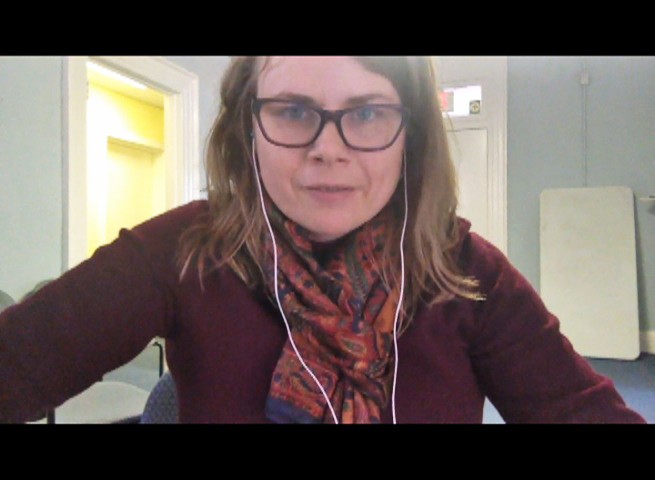
I was recently in Sacramento, California, at the annual meeting of the California Sociological Association. Two years ago I attended the meeting in Oakland, where I live. I again saw none of my sociology teachers or classmates from any of the four Peralta Community Colleges. I did run onto William Ochoa, a former colleague and Senator in the Associated Students of Laney (Community) College, now working on his Master’s degree in Sociology at Mills College in Oakland, California.
I attended all seven sessions of the two day conference including; the Popular Culture & New Technology panel, the Community College Roundtable, Critical Perspectives in Education, The 2016 Presidential Election Revisited panel, Making Sociology Matter, Social Movements and Sociology: the Big Picture. The panels included many interesting presentations and many I attended were student driven. The highlight for me was an unusual and memorable presentation by Frank Roberts from Mt. San Antonio Community College on his project to unify the major theories of sociology. The last session of the conference, there were only five attendees which allowed a lively and prolonged discussion.

PP slide by Frank Roberts
First Roberts mapped Donald Brown’s Anthropological catalog of 369 “Human Universals” traits to Robert Nisbet’s “Unit Ideas of Sociology” using an Excel spreadsheet. Balancing Nisbet’s conservative, community oriented approach, Roberts added sociological Agency to Community, Sacred, Authority, Status, Alienation units. This accounted for many personal and creative traits. Then Roberts mapped these six unit ideas to the three major sociological theories: Structural-Functionalism, Comfit Theory and Symbolic Internationalism. I imagine the resulting integration of sociological theories can be used to describe and possibly clarify many intersectional positions. This is an idea I will continue to reflect on and try to use in my future sociological studies.
The official theme of the California Sociological Association annual meeting was “A Legacy of Sociology”: the keynote presentation was “Who rules America?” by William Domhoff, Distinguished Professor Emeritus and Research Professor in the Sociology Department at the University of California, Santa Cruz. His latest work is as co-author of Studying the Power Elite: Fifty Years of Who Rules America? (Routledge 2018). Dr. Domhoff summarized his long career in researching America’s elite and focused on the rise of think tanks (and policy discussion groups) in influencing policy and politics. This corresponded with the waning of Marxist theorists’ influence in academia and resulted in a lessening of criticism of corporate influence. Dr. Domhoff didn’t mention Louis Powell’s 1971 memorandum for the American Chamber of Commerce, “Attack on the American Free Enterprise System” but I couldn’t help wondering how Dr. Domhoff would characterize its influence. He’s inspired me to read the book that started this line of inquiry, C. Wright Mill’s 1956 book The Power Elite. Researching the interlocking nature of corporate directors, first with excel spreadsheets and now with powerful computers running social network analysis software, Dr. Domhoff has tracked how corporate power has fragmented from being centered in banks to a more distributed system of endowed academic chairs, corporate funded policy groups and think tanks, foundations and emerging industries. Dr. Domhoff concluded optimistically; there’s a new wave of power structure researchers using larger databases and the final chapter of the story of “America’s Power Elite” has not been written.

Network Map of World Finance by Mark Lombardi
Why Open Matters

A global network of social media and open resources, including Liberal, Radical and Conservative educational “canons.” Remix by MCW
A retired American scientific glassblower, I started on my career journey at a California community college after I graduated from high school. On a whim I signed up for a glass class, the teacher was a ceramicist and designer who wanted to experiment with glass so we built the equipment, made the glass and learned together how to play with this fascinating material. I soon left college to learn more about glass. It never occurred to me to go to Alfred University like my teacher had, I sought out working glassblowers and made myself useful. Eventually I ended up in Silicon Valley making high intensity lamps and LASERs. I have worked with researchers, engineers and artists and no one ever asked if I had a college degree.
In the History of the Open University Lord Perry of Walton, OU’s first Vice Chancellor is quoted on his motivation to take the job of creating the open University in 1969:
“It wasn’t that I had any deep-seated urge to mitigate the miseries of the depressed adult; it was that I was persuaded that the standard of teaching in conventional universities was pretty deplorable. It suddenly struck me that if you could use the media and devise course materials that would work for students all by themselves, then inevitably you were bound to affect – for good – the standard of teaching in conventional universities. I believed that to be so important that it overrode almost everything else.”
Returning to a California community college during the Great Recession, I found that little had changed regarding the standard of teaching and mitigating the miseries of workers was not even on the agenda. Protecting the institution during a time of budget cuts along with the jobs of the faculty and staff were the highest priorities. Despite the fact adult learners make up nearly two thirds of California’s two million community college students, there are no programs to support the taxpayers that need to retrain during capitalism’s down cycles. Night and distance students fare even worse with financial aid offices, libraries, advisors and technical support staff that all work bankers hours.
I managed to graduate even after falling into the “Community College Trap” and am now designing my Individualized Studies Bachelor’s degree. As a distance student, I’m finding the same structural problems a the University as the community colleges. Open matters to me because I’ve learned to use other institutions, social media and the world wide web to gather the resources I need to learn what I choose. I intend to create an Open Heutagogy anyone with an data connection can use to gather free and open resources to create their own learning program. I think as the world economy continues to limp along and higher education divides into training for the masses and private education for the children of the elites, self directed learning will help the working class and those left behind learn what they need to build a diverse, sustainable and cooperative local economies. While the elites will still run the Universities and reproduce the managerial class to run the global economic and military empires, perhaps openness will help the rest of us survive.

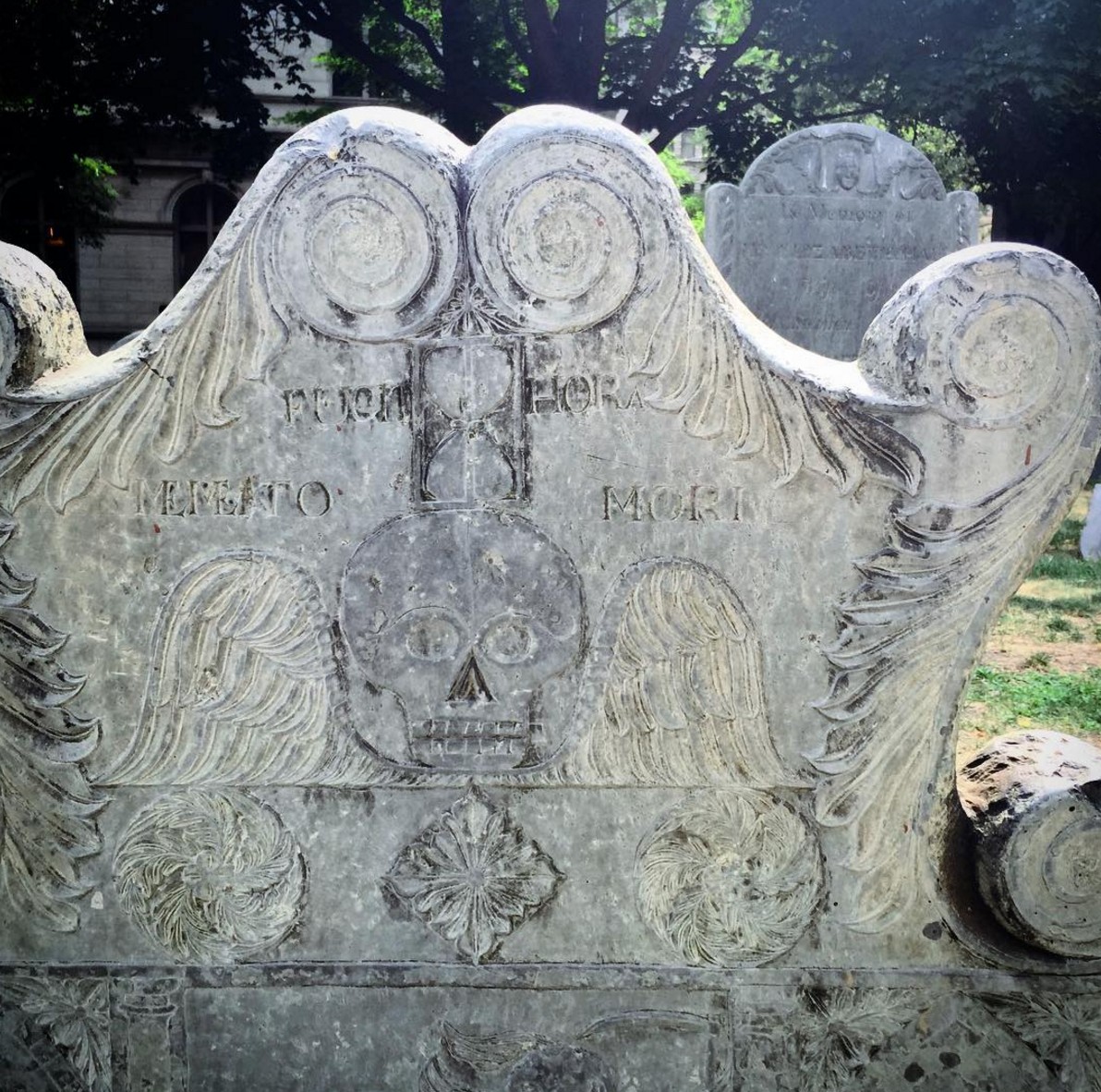
My College Degree as a Digital Humanities Project

Digital Humanities by Craig Bellamy CC BY-NC-SA 2.0
I’m developing a new model for adult learners so they can avoid the experience I had while trying to improve my skills at a Community College. Combining Self-Directed Learning, Computational Thinking, Digital Pedagogy, Open Education and Open Social Scholarship theories with Open Education Resources (OER), Free and Open Source Software (FOSS) and ePortfolios, I intend to create a free platform for any adult learner to document and reflect on their diverse learning experiences. I think simplifying all these dense and often conflicting learning theories into an approach (Praxis) any adult student can use to design their own self-directed education pathway will be useful. (Heutagogy)
I’ve been working on these ideas for three years, starting with attending a presentation by faculty from Evergreen College in Washington on integrating individual courses’ homework assignments across institutional silos. That led me to eportfolios as a way to collect all types of evidence (digital objects) of learning. Learning about tagging and metadata for discoverability on the internets, I observed the need for a controlled metadata vocabulary to allow searches for emerging patterns. These new ways of looking at one’s learning has the potential to suggest new constructions of learning experiences and new areas of research.
I belong to the Association for Authentic, Experiential and Evidence-Based Learning (AAEEBL) and have attended their conferences, including a session at this year’s 8th Annual Forum on Digital Learning and ePortfolios at the 2017 AAC&U conference in San Francisco. The ePortfolio Forum is jointly sponsored by AAC&U’s project, VALUE: Valid Assessment of Learning in Undergraduate Education; the Association for Authentic, Experiential and Evidence-Based Learning (AAEEBL), the association of ePortfolio professionals; and the International Journal of ePortfolio (IjeP). At this year’s AAEEBL Conference I joined the Technology Special Interest Group and convinced them to take on my idea for an ePortfolio Ontology as their first project. I’ve also joined the Association for Learning Technology, the UK group to “advance education through increasing, exploring and disseminating knowledge in the field of Learning Technology for the benefit of the general public.”

The Hurley Information and Technology Convergence Center at the University of Mary Washington in Fredericksburg, Virginia. Photo by MCW
I recently realized that my idea of ‘finishing a Bachelor’s degree while using Free and Open Source Software to create a learning eportfolio on my own domain and blogging about it in public’ is a Digital Humanities project. In 2016 I attended the Digital Pedagogy Lab Institute at the University of Mary Washington, VA, home of ds106 and the Domian of One’s Own initiative. I learned about UMW while attending the Digital Humanities Summer Institute at the University of Victoria, BC, where I took Critical Pedagogy and Digital Praxis in the Humanities from Jesse Stommel and Chris Friend. This year I took two courses during DHSI to support my project; ‘Open Access and Open Social Scholarship’ and ‘TEI and Metadata.’ That led me to explore metadata ‘triples’ which led to the concepts of graph databases and ‘faceted’ searches.
Lincoln as a boy reading at night. Library of Congress CollectionNow I want to learn how to integrate a FOSS graph database (Neo4j?) with FOSS curation tools (WP, Omeka, GitHub?) to utilize the power of humanities computing and the semantic web to document and reflect on my learning experiences. And then document my reflections and be able to do faceted searches of everything I’ve created together with everything I’ve curated into my database. I need to learn to appropriately tag all these digital objects with metadata so that they integrate seamlessly with the semantic web. Hopefully this can be automated to a large degree.
My plan is to structure my Metro State University’s College of Individualized Studies Bachelor’s degree as a Digital Humanities project using an eportfolio to document, reflect on and publish my learning. Which tagline do you like: Learning in Public or Learning Out Loud? Or suggest another.
Learning Strategies and Goals
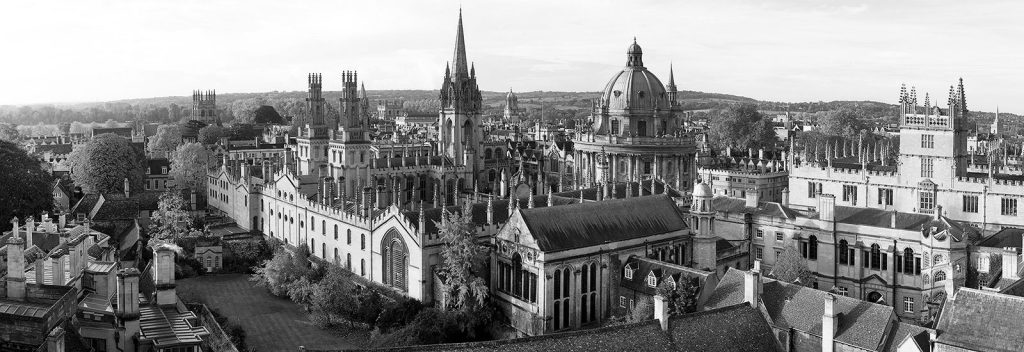
Oxford University
“A university training…aims at raising the intellectual tone of society, at cultivating the public mine, at purifying the national taste, at supplying true principles to popular enthusiasm and fixed aims to popular aspiration…at facilitating the exercise of political power, and refining the intercourse of private life.”
I don’t think this quote from Cardinal John Henry Newman’s 1852 book “The Idea of a University” aligns very well with our contemporary concept of a ‘Liberal Education.’ I’m not sure what a quote from a Catholic priest, from a time before Charles Darwin, Karl Marx or Albert Einstein influenced the academy, has to do with modern education at all. I think we are past the notion of “Universal” ideas and values.
In the mid-Victorian era, very few people were educated and many graduates never had to hold a job. The British Empire, like the American Empire, didn’t require educated men, just well trained, obedient men. With corporations controlling every aspect of our lives, American Universities are now turning out highly trained technocrats (of all gender identities) to run this Neoliberal Empire.
To me, a more appropriate quote would be from a 1959 graduation speech by Leo Strauss, the University of Chicago political philosopher and primary theorist of Neoliberalism;
“Education to perfect gentlemanship, to human excellence, liberal education consists in reminding oneself of human excellence, of human greatness. …we know that there cannot be the simply true substantive view but only a simply true formal view; that formal view consists in the insight that every comprehensive view is relative to a specific perspective, or that all comprehensive views are mutually exclusive and none can be simply true. The facile delusions which conceal from us our true situation all amount to this, that we are, or can be, wiser than the wisest men of the past. We are thus induced to play the part not of attentive and docile listeners but of impresarios or lion-tamers. Yet we must face our awesome situation, created by the necessity that we try to be more than attentive and docile listeners, namely, judges, and yet we are not competent to be judges. As it seems to me, the cause of this situation is that we have lost all simply authoritative traditions in which we could trust, the nomos which gave us authoritative guidance, because our immediate teachers and teachers’ teachers believed in the possibility of a simply rational society. Each of us here is compelled to find his bearings by his own powers however defective they may be.” http://www.ditext.com/strauss/liberal.html
Not to worry, Neoliberal Universities and corporate employers will surely supply you with any traditions they think you need.
I’m retired, don’t need job training and have been watching the creeping fascism of Neoliberalism since Reagan was elected President. I’m also working class and an American-Scot so I look to other educational traditions. After inventing compulsory education with “The Education Act 1496”, whereby the Parliament of Scotland required that landowners send their eldest sons to school, “[t]he Mechanics’ Institute movement began in 1800 when Dr George Birkbeck of the Andersonian Institute in Scotland gave a series of lectures to local mechanics. The nineteenth century term “mechanic” meant artisan or working man. The lectures were free and proved popular. They led to the formation of the Edinburgh School of Arts (1821) and the London Mechanics’ Institute (1823). The movement spread quickly throughout the British Empire.” http://mivic.org.au/history-of-mechanics-institutes.html
I belong to the San Francisco Mechanics Library, which was established in 1854, just four years after California became a state. I attend lectures, classes, book groups and writing groups, in addition to the library and computer lab. One of the reasons I chose Metro State is that I’m not interested in a traditional (or Neoliberal) education. In addition to getting credit for prior learning, my learning strategy is to use an eportfolio, as a Digital Humanities and Open Education project on the internets, to document my lifetime of learning together with all my coursework. This will allow me to reflect on how these learning experiences are connected to the wider world of ideas and for other learners to participate and comment. This is a radical idea for most Universities.
Here’s an example of one workers’ plan, learned at a Mechanic’s Institute, for documenting his learning (while Cardinal Newman was busy setting up a Catholic University in Dublin for the Pope):
“In an essay, remarkable at once for the originality of its views and the practical good sense it contains, John Foster recommends the propriety of every man writing memoirs of himself, not as an exercise of ingenuity — not as a means of drawing the world’s regard — but to fix in a man’s own mind, a sense of the progress he has made in moral and intellectual ideas to mark the change in his sensations which a prolonged experience of life produces and to excite a feeling of gratitude for those many providential interpositions which the most careful observer can scarcely fail to recognize as exercised in his behalf.” Diary for 1858 by Andrew Mcllwraith (Craftsman and former Mechanic’s Institute student) from More of a Man: Diaries of a Scottish Craftsman in Mid-Nineteenth-Century.
In order to get “a sense of progress” I’ll document the educational conferences, online courses and webinars I’ve attended, as well as the research I’ve been doing on Open Education, Networked Knowledge Organization Systems, graph databases, semantic metadata and the philosophy of semiotics.
I also intend to take more writing courses like “Memoirs and Creative Nonfiction” and communication and social research courses to deepen my work with community groups in social justice and the educators I’m working with to develop my local community colleges’ student leadership. I don’t see any Metro courses that teach one how to build a personal information technology infrastructure but perhaps I’ll find some.
I highly recommend the media, computing and learning textbook The Future of Thinking, Learning Institutions in a Digital Age written by students, educators and others interested in Higher Education in collaboration with the Humanities, Arts, Science, and Technology Advanced Collaboratory (HASTC). http://futureofthebook.org/HASTAC/learningreport/about/ or get a polished version for free on Google Play https://play.google.com/store/books/details/Cathy_N_Davidson_The_Future_of_Thinking?id=7B5znR_ki4MC
They (collectively) wrote;
“Over the past two decades, the way we learn has changed dramatically. We have new sources of information and new ways to exchange and to interact with information. But our schools and the way we teach have remained largely the same for years, even centuries. What happens to traditional educational institutions when learning also takes place on a vast range of Internet sites, from Pokemon Web pages to Wikipedia? This report investigates how traditional learning institutions can become as innovative, flexible, robust, and collaborative as the best social networking sites. The authors propose an alternative definition of “institution” as a “mobilizing network”–emphasizing its flexibility, the permeability of its boundaries, its interactive productivity, and its potential as a catalyst for change–and explore the implications for higher education. …In order to create a new field of digital learning, we must bring together research, knowledge, methodologies, and expertise from radically distributed existing fields— from the media and design arts to history, sociology, communications, psychology, philosophy, education, policy studies, political science, the computational sciences, engineering, and all points in between. A field cannot exist without institutional grounding.”
As far as inspiration for my learning, I look to a more contemporary, and pertinent source. Though an academic, twenty years ago Richard Rorty predicted:
“At [some] point, something will crack. The nonsuburban electorate will decide that the system has failed and start looking around for a strongman to vote for — someone willing to assure them that, once he is elected, the smug bureaucrats, tricky lawyers, overpaid bond salesmen, and postmodernist professors will no longer be calling the shots.
And this:
One thing that is very likely to happen is that the gains made in the past forty years by black and brown Americans, and by homosexuals, will be wiped out. Jocular contempt for women will come back into fashion. The words “ni**er” and “ki*e” will once again be heard in the workplace. All the sadism which the academic Left has tried to make unacceptable to its students will come flooding back. All the resentment which badly educated Americans feel about having their manners dictated to them by college graduates will find an outlet.
And, finally, this, the eerie anticipation of our current presidential predicament:
He will be a disaster for the country and the world. People will wonder why there was so little resistance to his inevitable rise. Where, they will ask, was the American Left? Why was it only rightists like Buchanan who spoke to the workers about the consequences of globalization? Why could not the Left channel the mounting rage of the newly dispossessed?” (from Achieving Our Country: Leftist Thought in Twentieth-Century America by Richard Rorty)
In “Philosophy as Poetry, a slim volume that contains the 2004 Page-Barbour Lectures, …he suggests that “the imagination is the principle vehicle of human progress.” It makes for a memorable slogan, especially for those of us who would like to see federal support of the arts and the humanities — along with such basic goods as health care and environmental protection — continue. But I think a sound pedagogy can be made out of it as well, one that highlights the importance of, among other things, social hope. After all, it is up to us to imagine a different future for our democracy.” from Rorty and Social Hope – Los Angeles Review of Books https://lareviewofbooks.org/article/rorty-social-hope/
Richard Rorty had a pragmatic approach to education as well. He recognized the conservative values of tradition and ‘truth’ and suggested these would be best leaned in primary education; what he termed education as socialization. He suggested that higher education was the appropriate place to learn the liberal values of freedom and progress through rational criticism, or education as individualization. Unfortunately, Rorty had no sympathy for radical ideas like Mechanic’s Institutes or Universities Without Walls, so we don’t know what he would think about Metro State.
I hope to learn more about alternative educational models and research their efficacy. As Rick Hendra and Ed Harris note in their paper The University Without Walls Experiment;
“The only UWW unit actively engaged over the years in research and publication efforts appears to be the UWW at the University of Minnesota, (now called First College). [Metro State]…may have developed instruments worthy of examination or replication by other researchers so that good comparative data might be made available.
…We don’t know how the educational outcomes of the UWW approach, centered on mentoring relationships, compare either to traditional undergraduate education or to adult-oriented continuing education programs. We don’t know — and must find out — the principles of good practice established by these programs. What we do know is that the existence of fifty roughly equivalent programs, operating in a wide variety of academic institutions, provides opportunities for comparative studies that are exceedingly rich.
It is an historic irony that such an ambitious experiment was able to generate so little published research. It would be regrettable were that irony allowed to persist: the founding generation of educators may not be available much longer and they are likely the best references we have as to how all these experiments, separate and together, played out. As much as we need to document their individual recollections, we need even more urgently to recapture their vision and their wisdom as higher education enters a new period of turbulence fed by technology and competitive pressures.” http://people.umass.edu/~hendra/Unpublished%20Results.html
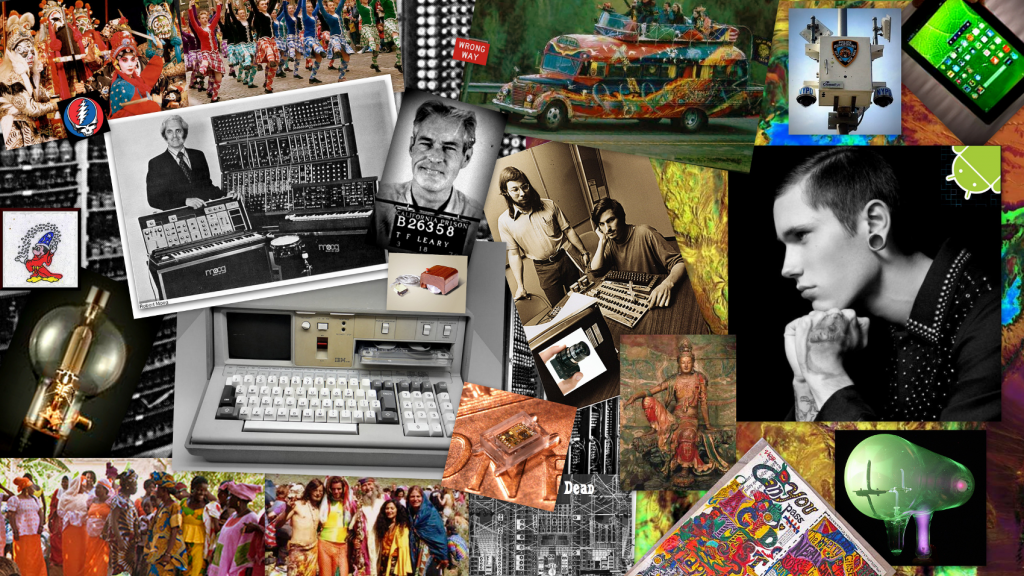
My first digital media project 2013
My goal is to develop a (free and open source) digital approach to a liberal arts education, both heutagogy (theory of self-directed learning) and praxis, that will support anyone with access to a computer as they learn how to learn. From savants in the global south to illiterate inmates of America’s prisons, having a way to document, reflect on and share one’s learning should help people collaborate to improve their lives.
As for ‘social hope’, I prefer Antonio Gramsci’s famous quote from his Prison Notebooks, written while a prisoner of Benito Mussolini’s Fascist regime; “I’m a pessimist because of intelligence, but an optimist because of will.”
In the Valley of Hearts’ Delight

Bronze bust of DeWissant by Auguste Rodin
I caught a ride to Stanford yesterday to discuss eportfolios with Dr. Helen Chen. We didn’t get a chance to talk at the recent Association for Authentic, Experiential and Evidence-Based Learning (AAEEBL) conference in Portland. My friend had an appointment at Stanford Hospital and being early for my meeting, I walked over to the Cantor Center for Visual Arts at Stanford University. I wandered around the Rodin sculpture garden and then sat on the cafe patio to wait for the museum to open.

Cantor Center for Visual Arts at Stanford University
I signed into the free wifi and checked my phone to see if the orientation hold had been lifted on my account at Metropolitan State University in St. Paul, Minnesota. One morning at the AAEEBL conference Paul Wasko had introduced me to Marcia Anderson, the director of Academic Advising in the College of Individualized Studies at Metro State. She encouraged me to apply that day in order to be enrolled for the fall semester. Metro State was founded in 1971 as a ‘University without Walls’ “serving adult students by recognizing demonstrated learning gained outside the classroom” while working toward their higher educational goals. I applied and during the one day I was home from Portland before leaving for a weekend training in LA, I went online and had my transcripts sent. From all of the eleven colleges I have attended!

Ocean Park No. 94 by Richard Diebenkorn
The email had arrived, inviting me to register for “Educational Philosophy & Planning” the foundation class all Individualized Studies students take to create their personal learning plan. I had been working with Jane Kreuger, my admissions advisor, and Marcia had contacted Dr. Tedder, the Chair of Individualized, Interdisciplinary and Life Long Learning in the College of Individualized Studies, and convinced him to enroll me in his already full class. I went to the website, selected the class (the override worked!), finished enrolling, went to the payment site and paid my fees. I still had five minutes before the museum opened so I called Jane and told her I was sitting on the Cantor Arts Center patio at Stanford and had successfully enrolled using my phone! It was Friday afternoon in Minnesota and classes begin the following Monday.

Glassblowers hand torch
I toured the main exhibit, Creativity on the Line: Design for the Corporate World, 1950–1975, and had lunch on the patio; a Cobb salad and iced tea. (only $20!) I was reminded by the planes overhead, that on Friday afternoons the private jets leave San Jose International Airport every ten or fifteen minutes. I then saw the Modern & Contemporary exhibit and some of the main collection, Object Lessons: Art & Its Histories, before meeting with Helen in her office in Wallenburg Hall.

Hoover Tower and Wallenberg Hall at Stanford University
We discussed my ‘controlled vocabulary (ontology) for eportfolios and the semantic web’ project (the reason I joined AAEEBL and went to the conference in Boston two years ago) and I shared that the AAEEBL Technology Special Interest Group had decided to take on this project. I also shared my newest project: creating a Free and Open Source Software (FOSS) stack for any learner to have the tools to create a lifewide eportfolio, on their own domain, to collect their lifetimes of learning. It all come together after I learned about semantic triples in Beyond TEI: Metadata for Digital Humanities at the University of Victoria, BC, during this years’ Digital Humanities Summer Institute. But that’s another story. Helen asked if this had anything to do with “Linked Data”, so I took out my phone and showed her the picture I had taken earlier that morning.

Recent additions to book pile on my desk
As far as I can tell (I’ll never have a degree in Library and Information Science nor Computer and Information Systems), having an ontology and using semantic triples are the basis for the latest graph databases, being able to discover fellow researchers on the internet and structuring one’s eportfolio to take advantage of ‘faceted’ (semantic) searches. It’s my theory that creating a properly structured database for an eportfolio of one’s lifetime of learning projects and products can lead to perspectives only made possible by computing. These unique clusters of data should help generate the deep reflections that are central to eportfolios function of supporting lifewide learning.

High-intensity short arc mercury vapor lamps used in the production of computer chips
Aint digital technology amazing? I’m glad I spent most of my glassblowing career supporting California’s computer industry. I regret that the term ‘Silicon Valley’ is now being used in place of ‘predatory venture capital.’ What we workers created in Silicon Valley has linked together the entire world (with some areas and peoples yet to be connected). Workers are not responsible for how their products are used, nor who buys the companies we work for. Capitalist predation is a centuries old problem. I look forward to using these new technologies and sharing FOSS platforms with everyone, especially under served adult learners. It was a good day in the (former) Valley of Hearts’ Delight.

Seaweed by Georgia O’Keefe
Digital Pedagogy redux
After hundreds of hours of research (online and otherwise), travelling to the University of Victoria, British Columbia, for the Digital Humanities Summer Institute (twice!), taking the “Digital Pedagogy and Praxis” class, and talking with several of the presenters mentioned in this story at #DHSI last month: today I discovered the Digital Pedagogy Network. I must not be asking the right questions!
Where I Am From
I was invited to post something on their site by the Young Writers Project through their collaboration with the Networked Narratives open access learning project based at Kean University. I then realized I hadn’t posted this on my site. Now I have!

Where I Am From by Mark Corbett Wilson
I am from fire,
from Pyro Engineering Inc. and Advanced Radiation Corporation
I am from glittering quartz, a desert washed by Pacific tides.
(Hot and dry, cool and moist,
it smelled of passion and petroleum.)
I am from cactus,
the thorns, flowers and fruit whose
visions and pain I remember
as if they were my own.
I am from Pictland and perseverance,
from Corbett and Duncan and Fraser.
I am from Hollywoodland lesbians
and disgraced Republican Nixonian Quakers,
from ‘early to rise’ and don’t call it Fascism.
I am from the middle way of Mr. Gotama’s Eight Tasks
before dialectic atheism emerged.
Soy un Californiano. Mis comidas
son chiles, frijoles y maíz.
The indentured Highland lad o’ pairts
and America’s First Peoples,
the prettiest girl at Schwabs’ soda counter;
the Slaughter cowboy’s homestead graveyard.
I am from kitchen jam sessions and garage workshops,
table saws and lapidary equipment,
art cars and personal computers
conceived during new moons.
I am from lifetimes disappeared –
the Jurupa Oak contemplating ancient valleys
obscured by smoke.
Networked Narratives: Fair Use
The internet is down, again. Another annoying phone call, another appointment made. This time the technician found a connection problem outside my apartment and thus, no charge for the service call. After four months of international phone calls, emails, surveys and chats. Have I been talking to bots all this time? But that’s a different digital story…
This is my first attempt to reflect on the Digital Alchemy of Networked Narratives. On America’s Presidential Inauguration Day. Is this an omen? No, that would be digital augury and I’m interested in transformation, digital and otherwise.
That’s how I found the Center for Digital Storytelling, now StoryCenter, in Berkeley California. Learning to use story circles to explore my life and to increase my ability to listen with compassion has transformed me. Last week I had the honor to assist StoryCenter founder Joe Lambert teach a group of facilitators to continue story work in education, non-profits and social services.
In the same week I received the invitation to participate in netnarr, finished my Copyright for Educators & Librarians Certificate through Coursera (in anticipation of taking the new Creative Commons Certification class), and got an A in my Physical Geography class. It was a four week intersession online course that covered sixteen weeks of material. I’m pretty sure it’s some kind of academic fraud, but I’ll take the four units I need to finish my Associates degree in Sociology. Spring semester starts next week and I’m looking forward to my last SOC class, taught by my department chair; The Sociology of Death and Dying.
My main project this year is to finally create the structure for an eportfolio. I’ve been trying to understand how I can use one to document all my learning and experience. A retired scientific glassblower, I have so much experience to document that isn’t text based (implicit or tacit knowledge) that I don’t know where to begin. I’ve attended one AAEEBL conference, read several books and interviewed some portfolio users. Anyone else going to the AAEEBL Conference in Portland this year? My takeaway is that by building a digital portfolio (data base), one can reflect on their learning and experiences to make new connections and reach new understandings they didn’t realize at the time they were creating their digital artifacts. I look forward to including everything I make and learn while participating in Networked Narratives.
Long ago I set up my own domain. I tried blogging. No one cared, especially me, but I was just a cranky old returning Community College student pissed off at the Financial Aid Department. Lately, I’ve made many ds106 Daily Creates and cross posted them to my website, Twitter, Google+ and facebook. CogDog has inspired (shamed?) me to try and give proper attributions, but I’m still not sure if I’m tagging things in the best way. I know I’m not including the necessary metadata for the semantic web. (anyone else taking the Metadata Workshop at DHSI in Victoria this summer?) I’ve tried and abandoned all the other social media sites (who else has thousands of del.icio.us bookmarks and no followers?) with the same result, except facebook: Now I stay in touch with a half-sister I’ve never met because she found me on facebook.
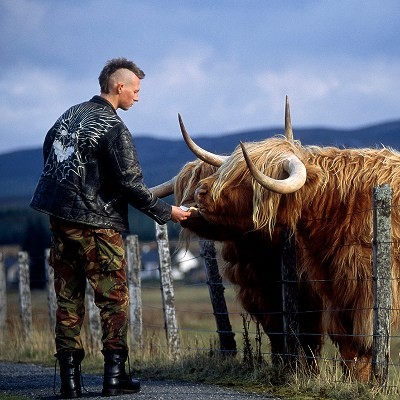
The first thing I saw on facebook today was a reminder of my first ds106 post: Cow Punk. I love serendipity!
Dalwhinnie, Scotland Photograph by Jim Richardson
https://t.co/AmLSFcWa1M
I wasn’t sure it was my first post, so I googled how to search my twitter posts. In settings you ‘create archive’ which is emailed as a .zip file. Unzipping the archive you can view it many different ways, the easiest for me being through a browser. (Any JSON enthusiasts want to explain how that search works?) First I searched for #ds106: it wasn’t there. Harrumph (rhymes with Drumpf). How do I search my images to find which one was first? Google says just type modified: into the file explorer search box and files are automagically ordered by date. Then you can type a range after the colon if need be. There it is. I called it Cow Punk after the musical style popularized by The Beat Farmers, Lone Justice, Rank and File and X. I was born in Hollywood and lived in Whittier (home town of Richard M. Nixon) until I moved to the Bay Area. I included a link to Rank and File’s song/video “Ever see a sheep in a pork pie hat?” in my tweet. I was (hopefully) alluding to Scottish sheep (and cow) herders and their American cousins (cowboys) [should have left the typo ala CogDog *cowbots*], 60’s British Mods and today’s hipsters (pork pie hats), punks and edupunks. (google it)
It was my first post, why wasn’t it in my twitter archive? Doh! I started by playing with #western106, Alan Levine’s 2016 fork of #ds106. Back to search my twitter archive with #western106 and there it is! @ds106dc #tdc1472 #western106
A quick search of my gmail reminds me of the #tdc1472 prompt: “An old Western saying tells us not to approach a bull from the front, nor a horse from the rear. It also tells us not to approach a fool from either side. Make one image/drawing or several (like in a comic).” I just googled for an image I liked and downloaded it. Now, an image search of my tweet reminds me that I misappropriated a National Geographic picture from “30 Years in Pictures: Celebrate National Geographic Traveler’s first three decades with flashes from the past” It was from “”History in a Bottle,” a look at the Scottish Highlands—and its single malt whisky—that appeared in the July/August 2001 issue of Traveler.” Ooops. And I didn’t attribute the photograph as “Dalwhinnie, Scotland” by Jim Richardson. Since all I did was crop and reverse the image, I can’t even honestly claim it’s repurposed. In my Copyright for Educators & Librarians class I recently learned to go through the Four Factors used by the US courts:
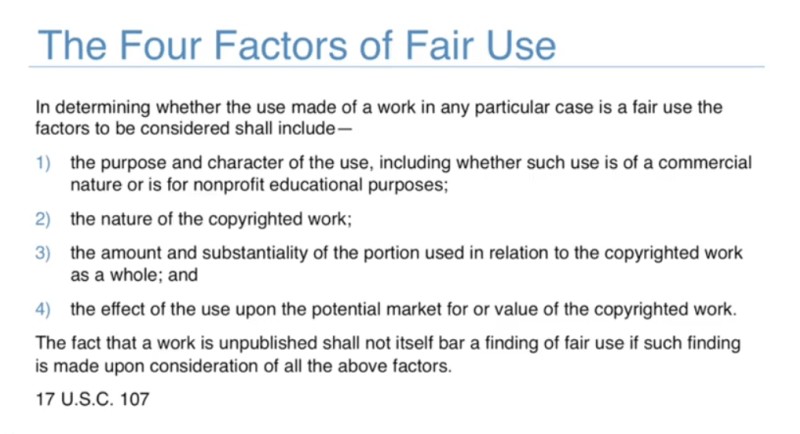
Nope, nope, nope, nope; this doesn’t augur well. My only defense is that I’m a student, a really old student. All I can do now is wait for a letter from the National Geographic and perhaps the Scotch Whisky Association. Good thing the Dalwhinnie Distillery isn’t a member. Ain’t google grand?
I’ve learned that I don’t have to do anything to secure my copyrights, so here are images I do have the right to use. I took them on Route 66 in Albuquerque, New Mexico, in 2016 while at the Southwest Popular/American Culture Association annual conference. I didn’t get a signed release, but the young person was sitting on a public sidewalk so I’m not worried. He was a block away from Maisel’s Indian Trading Post, built in 1939. Visiting Maisel’s reminded me that I was 11 when I started working during summers in my aunt and uncle Pobar’s Chevron Service Station And Sawahu Trading Post in Organ, New Mexico, southwest of White Sands Missile Range and National Monument. That’s Maisel’s politically incorrect antique sign.

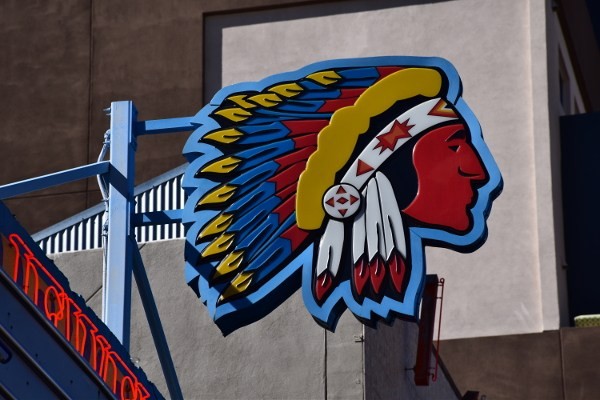
I didn’t see the obvious connection between the photos that afternoon on Central Avenue. Today while looking looking for Cow Punk it jumped out at me. And all I did was resize the originals, so now I’m reflecting on the reflections!
The night before President Trump’s Inauguration, there was thunder and lightening in Oakland, California. This is rare for the Bay Area (after taking GEOG1 I could explain why) and I took it as an inauspicious sign for living under the new regime. Last week I made a commemorative thing and I’ll use it to close my inaugural post. Look closely for the shadow. I’ve learned that what I see on my 4K monitor isn’t what everybody else sees, especially on their phones.

- President Trump Inauguration January 20, 2017
Notes
“30 Years In Pictures: Celebrate National Geographic Traveler’s First Three Decades With Flashes From The Past.”. Traveler 2014. Web. 21 Jan. 2017.
“Augury”. En.wikipedia.org. N.p., 2017. Web. 21 Jan. 2017.
“Cowpunk”. En.wikipedia.org. N.p., 2017. Web. 21 Jan. 2017.
“Inauguration”. En.wikipedia.org. N.p., 2017. Web. 21 Jan. 2017.