Image from page 30 of “British sanatoria for the open-air treatment of tuberculosis : with numerous illustrations ; [reprinted with additions and alterations from the “West London Medical Journal.”]” (1899)
It’s been a while since I joined a MOOC. Mostly that’s because I recognize that I don’t have the time. #OpenLearning17 is hard to pass up though, because of the format, the great people involved, and the topic, which means a lot to me. Hopefully I will find some openings in my schedule so I can put something in and get something out of it.
I’m thinking about my journey to open education. I’ve always been a heavy library user, and the library represents a form of open education although I never thought of it that way. Fifteen years ago or so I enrolled in a distance ed masters program in digital printing and publishing. It taught me to get out of the printing industry, but I learned some other lessons as well. I noticed that almost all of the tools, readings and materials we used were freely available online. What we were paying for in the program was mainly the selection and organization of the materials, and some occasional feedback and interaction. Thinking there might be more of a payoff in learning about the selection and organization of information, I dropped that program and entered one in library science.
Then, as I was transitioning from a K-12 librarian to academia, I found out about MOOCs. I thought this was a brilliant innovation. Siemens and Downes opened their course to learner input, and at the same time opened it up to the public, sharing the learning experience with the world and seeing what the world could add to it. This became addictive, and eventually I got sucked into ds106 and never escaped. (ds106 is 4life, you know.) So I’ve been thinking about the value of open resources and the potential of open pedagogy and practices, trying to talk the talk and hoping to walk the walk, to get better at it and do it more. OpenLearning17 can be another step on the journey.
At the invitation of Steve Greenlaw (hi, Steve!) I’ve enrolled in the #OpenLearning17 cMOOC. On the one hand: I’ve done plenty of work with OER in the past. I’ve posted about it. I’ve even presented about it. That doesn’t mean I’m doing as much as I could, and it doesn’t mean I’ve learned all that can …
Not too sure what it’s all about exactly (yet), but I’m going to belly flop my way into Open Learning 17. Why? Because I see Laura Gogia, Gardner Campbell, Autumm Caines, Chuck Pearson, among others, are involved. That’s enough for me to give it a go. See you out there!
Where is our community? This Google map shows the locations of everyone who has registered a blog site at http://openlearninghub.net. The map will update over time, so be sure to check back. [Post by Steve Greenlaw, and lightly edited for the Hub by Gardner Campbell.]
Even as I’m still getting my arms around this demanding new job in this demanding new place, I am going to take a few hours of my time this spring to (attempt to) keep up with this and make a few public comments along the lines of this here syllabus. I have plenty of good reasons – nah, let’s be real, excuses – for doing so:
1. I’m still an Open Education neophyte. I threw in a couple of last-minute assists towards one open educational resource in particular that I love a lot, but OER are one thing; that’s not fully shifting your attitudes towards the classroom or your methods of teaching to give the learner more control and to give you less. I want to see more of what my peers at other institutions are doing.
2. I speak for two groups of faculty that don’t tend to get a whole lot of attention in these dialogues.
I’m science faculty, and historically physical science faculty (although I seem to be focusing a lot more on biology these days, darn that cross-disciplinary doctorate) and I’ve had roles in pre-professional education and pre-professional advising in particular. Premeds get a very precise list of courses they have to take to prepare for a very precise standardized exam that plays a very outsized role in their admissions process. Other pre-professionals (pre-dentistry, pre-optometry, pre-pharmacy) have different precise demands. The things asked of those teaching and advising those students don’t tend to get associated with “student agency.” How do we take well-defined – even overly-defined – curricula and bring open attitudes towards our work there?
I’m employed at a private (or, to use the industry euphemism, an “independent”) institution with less selective admissions in the Central Appalachians. When you think of private colleges, you think of places that have large endowments and a wealth of resources – environments that I have never worked in. And when you hear of institutions tending towards open access, you think community colleges or regional state universities, not privates. The vast majority of my students are either local or are student-athletes drawn from a wider region (but still generally East Tennessee or border counties of nearby states). There are a lot of faculty like me, but I don’t hear too many of the voices like mine among the open education community. How do we take our rurally-educated, tradition-conditioned students and reveal the possibilities available to them?
3. I’ve had an occasion or two to start conversations locally about what Open Education is and how to go about implementing it – despite the fact that, at present, I’m not really anything that resembles a role-model. (This semester will be, I fully hope, my last pass at teaching organic chemistry for some time. Am I having my students purchase access to a vendor’s proprietary software so I don’t reinvent the wheel for a class that I may never teach again? You betcha. There’s open practices, and then there’s essential laziness, and I am fully embracing the latter right now.) I need more deliberate ideas for how I go about becoming somebody who has practices that can be pointed to, especially if (as above) I’m constructing those practices specifically within that premed-education context.
4. I still have a ton of thoughts throwing around my head about my fall, and everybody’s fall in particular, and a really stupid election, and a really amazing conference, and these people who have come into my life both locally and internationally and have been inspiration and dedication and love. I’m not going to get them out without a framework. This is a nifty and relevant framework. Let’s go, then.
So, #OpenLearning17, then. I’m going to speak up, and probably be kind of dumb doing so, and probably leave myself open to be shouted down a bit. That’s fine. I have a lot to learn.
I’m super excited that some of my favorite Virginia educators have gotten together to do a cMOOC! #OpenLearning17 started today and I’m so thrilled to follow along and learn with a great community. The syllabus says this week is for introductions, blogs, and working with a connected learning coach. There is also a great reading all about the meaning of “open” which was enlightening to the history of the word. To this end the article starts with the word “free” as defined by Richard Stallman for the Free Software Definition, distinguishing the difference between “free” as in “free speech” not as in “free beer”. “Free”, in the sense that will eventually grow into “Open”, is focused more on liberation than lack of price. So, besides lacking a price, “free” as defined by Stallman also includes the ability to see and change the program itself – also the ability to redistribute changed versions of the program. It seems to me that in this way the program is used by the person instead of the person being used by the program. It also seems that this encourages community as conversations need to arise around this kind of usage.
I am actually struggling with some “free beer” kind of software (at least I think it is free beer) in my life right now so I thought I’d talk about it as my introduction to the group.
I’ll be the first to admit I’m not the best at email management. Our institution has a size limit on faculty and staff inboxes that is like 20mb or something. I’m always archiving stuff off because I’m getting yelled at for not having enough space in my mailbox. To make more room one of the first things that I do is sort by size and archive off the messages that are the largest. Usually these are messages that have large attachments.
A few months ago it seemed to really start filling up quick. The thing was I would do my little trick of sorting by size and I started finding these messages from one particular professor that I was working with that had no attachment – often they were just a sentence or two of text. I checked to see if perhaps there was an image in the signature line that was taking up a bunch of room but I didn’t see anything like that. I thought it was a fluke, archived the messages, and moved on.
The thing was it kept happening and it was getting worse. The first few times I found these messages they were maybe 500kb but then after a week I was finding that they were 1mb – then 2mb – and always from the same professor. What was going on?
I’d had enough and I knew there was something that I couldn’t see in the background of those emails. I asked our Instructional Designer Jim Kerr what he thought and we started a back and forth of trying to deduct what was going on. Was it only in replies? Was it every email that professor sent me? It did not seem to be happening when the professor sent from his phone… Well eventually we pulled up the source code for the emails and the cause became abundantly clear – there was about 11,000 lines of junk code in each of those emails. I don’t read or write code but one word was sticking out all over the place; Grammarly.
Grammarly is a piece of “free” software that is supposed to help you write better. In real time it corrects spelling and grammar errors in all of your text. You can install it as browser plug-in so that you don’t even have to go to a website – wherever you write text on the web it is there.
Grammarly says it is the “free grammar checker” but I believe this is free as in beer not free as in speech. I’m new to the open/free movement and new to Grammarly so let me know if I got this wrong. I don’t see anywhere that I can get to their code to tweak it or to see what exactly it is doing or why it is ending up in the background of very simple emails and bloating them up. Any talk of community on their site applies to those looking to talk about grammar issues not to talk about the software, how it functions, or how users can change it directly. Grammarly is free but there is a paid tier and the volume licensing also has a cost associated to it. So, I suppose it is like free cheap beer – if you want the stuff that tastes good you have to pay.
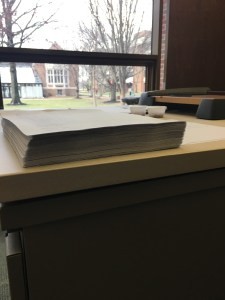
I printed the code that was behind the email just so that I could demonstrate how much was actually going on behind the scenes. Mind you this is double sided.
Printed code behind an email message that was one sentence long. This is double sided.
After going through all of this the professor immediately removed Grammarly from his computer – he said his email box was filling every day and no one could figure out why. But it also got Jim and I thinking about how Grammarly works. It is not entirely on your computer – much of the computing process is in the cloud – it needs the internet to function. So, it seems that it is basically a keylogger. Though it is not covert (I mean you install the thing) it is recording every keystroke and sending it to their servers to check for grammar and spelling issues. It does seem that they are encrypting and such but now we are wondering if there are implications for FERPA in an educational setting. And besides having some program record and send my every keystroke is a little creepy to me. Especially, If I don’t know what is going on in the background.
To be honest, I’m not a coder and even if Grammarly did make their source code available I couldn’t make much of it. I think that there might even be security issues if it were that open. Honestly, a big reason why I’m writing this as a part of my introduction for #OpenLearning17 is because I’m trying to better understand the implications from others that might know better than me. I’m wondering if our concerns about FERPA are warranted and if anyone has any clue how the junk code got into the emails. Any feedback would be great but if not, if this is too far outside the interest of #OpenLearning17, that is okay too. Hoping that this post can still act as a way of saying hi and giving folks some idea of the type of things that I’m thinking about.
Looking forward to working with everyone in #OpenLearning17 and can’t wait to see where this takes us.
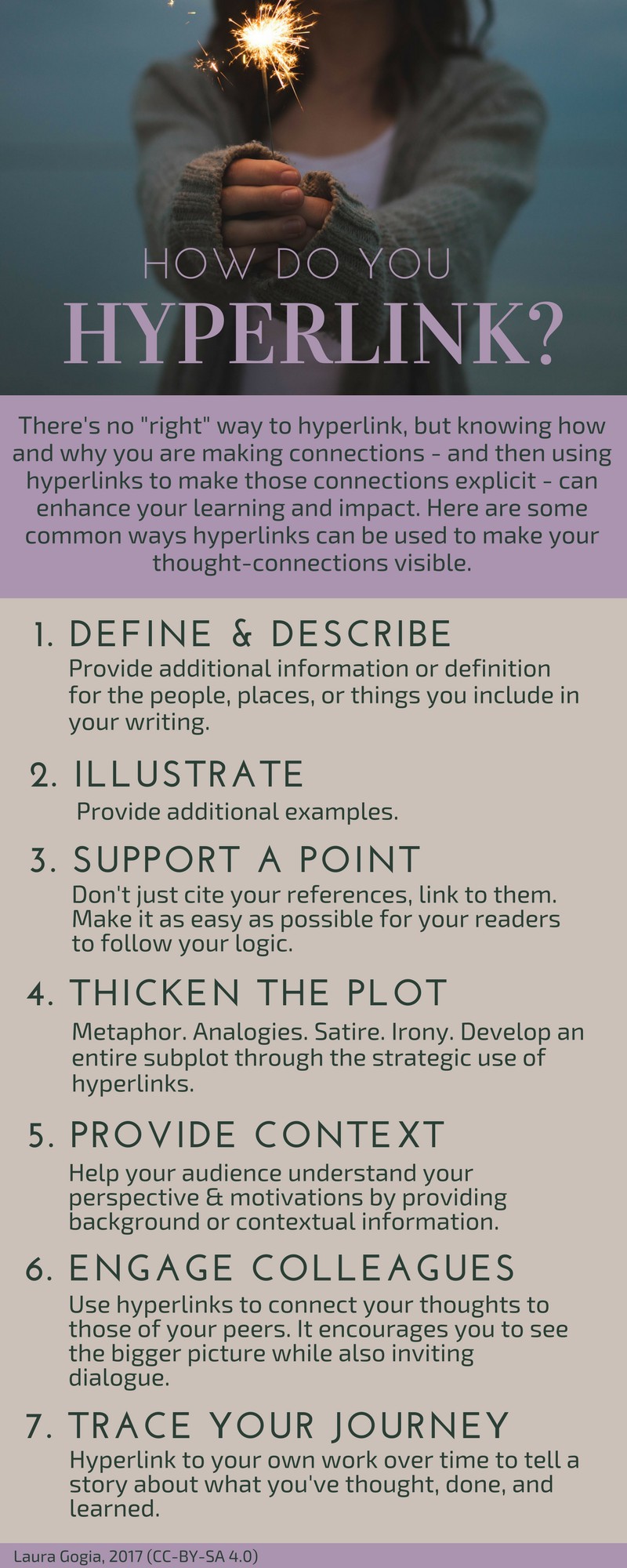
Another remake, this time of a graphic that emerged from my dissertation research. You can find the original here. The photograph was taken by Morgan Sessions and can be found on unsplash.com for universal (public domain) use.
In part two of our conversation, Dr. Laura Gogia talks about strategies for getting to meaningfully connected learning–and for dealing with the feeling of information overload. (You might call it FOIO, not to be confused with FOMO.) Laura also discusses how effective strategies for openly networked learning can also lead to moments of surprising and rewarding serendipity. There are paradoxes at work here, and Laura explores them with her characteristic insight and zest.
I am playing around with more phone photography. I doing some stuff on Instagram but have mixed feelings there. Lots of ‘likes’ and what not but I’m not sure what else.
Given a chunk of the missed time was over break you’ll see a lot more nature shots in here.