So excited about the cMOOC Open Learning ’17!


So excited about the cMOOC Open Learning ’17!
EdTech Nomad is a space to chat about educational technology in higher education.


Seems there will be a “cMOOC” about this. cMOOC being an open course that’s focused on ‘connectivity,’ somehow. We’ll see. The syllabus is pretty dry and academic, going through the history of ‘open.’ Guess my main beef with the ‘open’ community is that it’s so imbued with academic culture, as in “let me pontificate about equity and open” in theory. http://openlearninghub.net/ is the door and it’s out of Virginia and … am I destined to return there? It’s so *in the grid.*
I’m also wading through the convoluted directions for how I should tag my blog posts for it. I did hte best I could… thought about using ds4oer so I could be “the whole blog is about this thing” but … that’s my blog to my self. So
TAG openlearning  (It feels like one more dead end distraction but … let’s see right now about finding that wretched flash drive and getting my ‘five things on the course’ started…)


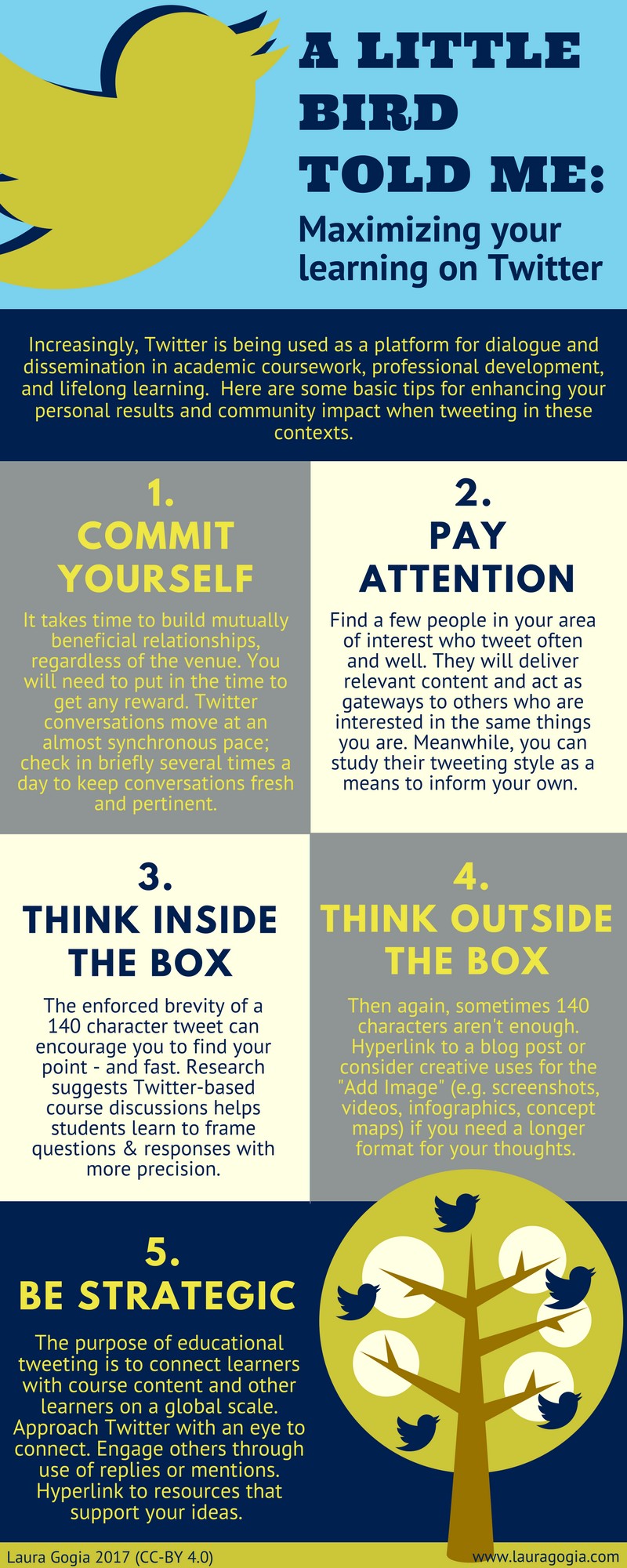
I originally created and published A Little Bird Told Me: Maximizing Your Learning on Twitter in 2015. The one page list of strategies was my first ever pinned tweet. It has been one of my more successful online endeavors, capturing thousands of views and hundreds (maybe close to a thousand if you count across platforms) of downloads. Instructors have incorporated it in their syllabi and I get notifications all the time – one as recently as two days ago – that new seminars and professional groups have passed it around for participant consideration.
A Little Bird has personal significance. It was the first document I created specifically for my own professional need; no one else asked me to make it, nor did I show it to anyone before I published it. I made it for myself, because I was tired of seeing faculty struggle with convincing their students to think about Twitter as a tool for learning. Conceiving, designing, and publishing A Little Bird was the first concrete evidence that I had developed a pedagogical practice and voice. It was my first step in identifying myself as an educator and not just an ex-physician taking classes in education. Like I said, A Little Bird is a personal milepost.
I’ll be honest – although it is only two years old, looking at A Little Bird makes me wince a tiny bit. Content-wise, it is sound. It was never meant to be comprehensive, but what is there is good and reflects the fact that I was more skilled at pedagogical Twitter a year ago than I am now probably. However, the visual presentation – a one paged, tiny font list of bulleted paragraphs – is not how I would present information on the web today. I have been impacted by my subsequent work with Tod Massa, who strongly encouraged me to integrate color, graphics, and design into everything that I do. I no longer put out handouts that look like bulleted lists only.
So. Given the fact that A Little Bird still gets pulled for new classes, seminars, professional development, etc., I wanted to give faculty and participants an option. The original document remains where it has always been. However, yesterday I reformatted the content (and tightened up the copy, but only just a bit) to be an infographic. Yes, I used one of my published color palettes (and yes it saved time). And you can download the infographic as a pdf if you really want to.


Reading “Fifty Shades of Open” by Jeffrey Pomerantz and Robin Peek in First Monday http://firstmonday.org/article/view/6360/5460 one considers the parallel between the growth of fan fiction and the growth of *open* across the array of meanings the word carries. It is a tempting if baffling parallel. Wondering how to grasp a meaning of *open,* I thought of questions for Open Learning ’17. What do the principles and practices of open learning share with liberal education and undergraduate general education—teaching, learning, and assessment in practice right now? What utility in bringing together liberal education practitioners with open learning practitioners? The Faculty Collaboratives project at AAC&U http://www.aacu.org/faculty has been supporting and nurturing communities of practice among educators for liberal and general education. Why? We want to offer the best possible college education to all students, no matter their program or type of institution they attend. There is a focused and principled goal for the project. We’re building networks and infrastructure for educators across states and state systems so that they can in turn do their best work in meeting and reaching all students. We want to emphasize the learning and success of the large numbers of undergraduate students who have the most to benefit from higher education. Students who have not been served well by public education are first in my mind and in the minds of many colleagues. Equity in student success is a great goal. That is the story I offered Gardner Campbell in the interview at http://www.gardnercampbell.net/blog1/?p=2638. I hope students will benefit if we do a better job of collaborating as educators across communities within and among states and state systems. As I see it, the experiment of Open Learning ‘17 will give us a chance to answer the questions above. I confess I want to find stronger ties than I am seeing right now. It is true that information literacy is one of the outcomes of the Liberal Education and America’s Promise or LEAP initiative http://www.aacu.org/leap. Will we find richer points of convergence?
Posing for a picture while holding your hands up in a peace sign could pose a security threat, with hackers able to recreate prints that are the key to phones, computers and tablets.
Researchers at Japan’s National Institute of Informatics (NII) have found that fingerprints can be easily recreated from photos taken up to three metres away without the need for advanced technology. So long as the picture is clear and well-lit, prints can be mimicked.
However, given the many layers of irony, filtering, and conceptual framing that characterize Prince’s oeuvre, it’s unclear whether his public disowning of the work will negatively affect its worth and status as an authentic Richard Prince, or, on the contrary, it will add to its resale value.
While I have made efforts to improve my understanding of other ideas and beliefs, I don’t necessarily accept them as fact, but a possibility that should be considered. RamPages has made me aware of the way I articulate my ideas and encouraged me to be careful when discussing controversial or sensitive topics. It has also made me elaborate as to be sure my point came across the way it was intended.

Today’s Daily Create: Shakespearean insults. #tdc1833 #ds106
I am excited to work on the AAC&U’s Faculty Collaboratives project. The project is being implemented at the state level. Half a dozen states were in the first cohort, which began last year. Virginia is in the second cohort, which means we have benefited by learning from the experiences of the first cohort.
The nominal goal of the Faculty Collaboratives project is for each state group to develop a collection of faculty development resources to increase awareness of how to enhance the effectiveness of teaching and learning, especially in the liberal arts & sciences. These resources will be based on the findings of learning science over the last few decades–findings of which I suspect most rank & file faculty are unaware. I don’t know about you, but learning science was not part of my graduate program. AAC&U has conducted a number of initiatives in this area, including the two I’m most familiar with: LEAP and VALUE. The challenge is to get these resources into the consciousness of faculty.
Gardner Campbell, who is leading the Virginia initiative, expresses the challenge this way: How can we help students (and faculty) see general education requirements as more than checkboxes on the road to the student’s real education (e.g. in the major)? How can we help students and faculty see general education as more than just a set of hurdles to be gotten past? How can we help students and faculty see general education as a foundational part of their undergraduate studies as well as lifetime learning? In short, how can we do what we’ve always valued, only better.
What approach are we taking in Virginia? We decided early on to use open educational practices as the model for our approach. Virginia has a vibrant open education community, so we have both resources and interest to draw from. David Wiley describes what we’re planning as rethinking general education requirements as if the Internet existed.
Open education can be pursued from a variety of angles, including open pedagogy, open access, open educational resources (OER), and more. There is no universally accepted definition of open education, which allows a diversity of approaches to be tried. It’s probably best to think of open education as a philosophy of teaching and learning, a set of practices, rather than a specific technique or set of skills. One can try some, but not all practices, and that’s fine. If this sounds imprecise, we will be exploring these concepts in more detail soon.
Our project will operate at several levels.
Not too ambitious, huh? Beginning later this month (January 2017), we will conduct an open online course to explore open educational practices. The idea is to give interested faculty the opportunity to learn by doing. The course is designed for anyone who would like to learn more about open education, regardless of your background and experience. Everyone is welcome!
The course will be organized by topic. If you are only interested in one or two topics, you can simply participate those weeks. Of course, you’ll get far more out of it if you participate in the whole course. If you have tried taking a MOOC (e.g. Coursera, Udacity) before, you will find our course very different. It will be based on the Constructivist MOOC model developed by George Siemans and Stephen Downs and exemplified by DS 106. For additional information on the course and how to participate, check out the project hub at http://openlearninghub.net. I hope to see you there.

Got a heads-up email from a faculty member in my graduate program this week, Stephanie Blackmon. It was a forward from Gardner, advertising an upcoming cMOOC on open education with an emphasis, or at least a leaning, towards goings-ons in Virginia. Now, I am scrambling to finish my dissertation and teach a course already this semester, but how can I, with any sense of confidence, avoid this course? That would be crazy. So here goes. More at http://openlearninghub.net/