Tag Archives: openlearning17

How to survive (and thrive?) in a cMOOC

I’m in my first MOOC and I’m learning.  I’m learning how to be a learner in this new-to-me environment.  This is a constructivist MOOC, so while each of us is constructing our own learning path, we are also all shaping the learning experience together.

What I’m learning about how to be a learner in this space is this:

  • We need a strategy for managing our time.  This is exactly what our first-year students need to learn and I find myself struggling all over again to find time for learning.  This morning I replaced my 1/2 hour morning-coffee-social-media time with #OpenLearning17 time (I kept the coffee).   I think that’s going to work.  What little bit of time could you let go for the duration of the MOOC to spend on learning?
  • We need to engage.  Commenting on other people’s blog posts and writing my own is not in my current comfort zone, but here I am doing it and I’ve already been rewarded with some great interactions.  We need to step out of our comfort zones and engage.  And won’t it be fun if we meet in person someday and feel like we are already connected!
  • We need discipline.  Just like a new exercise routine, it takes discipline to create a new habit.  It takes discipline to get results.  If we are going to learn in this space, we need to be disciplined enough to come back to it regularly and actively participate.
  • We need to be discriminating.  Not every post will grab our attention, not every week’s topic will pique our interest.  That’s okay.  We don’t need to follow every hyperlink or comment on every post.  We just need to stay engaged in the overall learning and follow what interests each of us.
  • We need each other.  This form only works if we connect, discuss, and debate.  We need to ask questions.  We need to be provocative.  We need to be caring.

What am I missing?  What are your strategies for thriving in this learning environment? What have you learned so far?

Updated 2/10/17:  I just found Laura Gogia’s great Conversation with Gardner Campbell where she articulates the need to develop a strategy for our connected learning.  Great stuff!

Are We Spectators or Actors?

Reading Time: 2 minutes

​(this blogpost is influenced by recent discussions with friends from my digped community – i say “my” because I feel like I belong among them, that kind of “my”)

Photo by me. Please don’t reuse

So much going on in the world right now, keeping everyone’s emotions on a roller-coaster and we are so busy reacting to that, and so little energy left for anything else…

What can/should we be doing to address how people are feeling right now? What’s the place for open learning and open education in the context of what’s happening in the world today? Are the challenges of open learning greater now?  E.g. Because of risks of surveillance and cyberbullying? Is the need for open learning more urgent? E.g. To counter hegemonic discourses that are anti-social justice? What can open learning do to help us cope with the world as it is unfolding in front of us?

Egypt is right now playing against Cameroon in the African Cup final. It made me think of emotion in spectator sports. How we have such emotional reactions to something we have absolutely no control over. Maybe audiences in the stadium can make a little difference because players can feel their energy and support…but viewers at home, on TV? The players aren’t influenced by them at all. Those people watching together are only influencing each other and not the players. What is the point? Some psychologist must have discussed this stuff at some point, I bet.

Are we all mere spectators of the politics unfolding around us, only able to cheer and shout out disagreement, give out orders that no one follows, or are we actors on that stage, able to effect change? Are we cheering and resisting in our own echo chambers, or are we able to build something together to truly challenge the status quo?

Education isn’t like sports. You don’t have to have access to the big stage to make a difference. Working on the small stage is also important work of resistance. But we still have to ask ourselves why we do what we do, and whether it’s achieving what we thought we were hoping to achieve.

How important is it for the work of resistance to be able to seek comfort in communities where we feel we belong, knowing together that we need to venture out into the wild to see what we can do beyond the safety of our community?

I have no idea where I am going with this. But maybe you have ideas?

Associative Trails Around DigCiz, Fake News, and Microtargeting

Microtargeting: A Digital Citizen’s Perspective

I started writing this post about fake news and microtargeting a few days ago and then I was reminded that #OpenLearning17 was talking about Vannevar Bush’s As We May Think this week. I began to see connections between how they might relate. It made this post even longer but I think it was worth it.

Some background if you don’t know: Bush’s article was written in 1945 as the war was ending. He was the Director of Scientific Research and Development during this time so he was all about applying science in warfare. In the article he is envisioning where scientists will put their energies as the war is ending.

Now, as peace approaches, one asks where they [scientists] will find objectives worthy of their best.

The article focuses on the connections we make when we build knowledge. How we associate past discoveries with current ones and tie things together. Bush advocates using technology to track the connections that we make in this process to extend memory for better reflection on those connections. Many credit this article with predicting the Internet.

He uses this term “associative trails” to describe indexing knowledge based on connections that we define. He thinks this is more powerful than typical kinds of indexing like sorting by number or alphabetizing. But I note that this is a much more personalized kind of indexing.

He is advocating for metacognition, that is, realizing what you are thinking and where your trails lie so you can better understand what you are researching, yes, but more importantly your own thought processes. What I am wondering about is what happens when you get the technology part but you leave out the metacognitive part? Bush does not seem to consider this option but I think this is often the world that we live in today.

When I start thinking about fake news and microtargeting I have to ask what if a person does not have access to their associative trails? What if they don’t even realize they are leaving a trail? What if they think that their trail is not so important? What if someone’s trail could be bought and sold? What does the record of all our connections say about us and can it be used in ways that might be exploitive?

I’m not a data scientist. I’m not a journalist. I’m not a librarian.

I am a technologist. I am an educator. I am a person. A person who lives some of her life on the web. I want to say a lot of her life on the web…. But “a lot” is a relative term.

Often it is journalists and librarians that tackle the fake news topic. I think that both of these groups add an important perspective to the conversation but I also think that there is the perspective of a digital citizen and those that advocate for such concepts; the perspective of someone using the web as a place of expression, a place to learn, and to be heard and to listen to others.

What is microtargeting?

When I bring the idea of microtargeting up I’ll start with something like “well you know they track a lot of your data from the internet to try to influence you” and most often, before I can continue, I hear “oh yes of course I know that”. Then there is the inevitable story of shopping for an item on one site and then continuing to see ads for it on other sites. But that is rather mild and not really what concerns me.

I’m not just talking about the machine realizing that you were looking at a product on another site or that you clicked on something from your email, that is cookies and web beacons, that is rudimentary stuff.

I’m talking about gathering thousands of data points, combining them, and analyzing them. Everything from shopping history to facebook likes and what church you attend can be gathered and combined with traditional demographics to create a “personalized experience” meant to influence you with emotional and psychological messaging.

The big story around microtargeting right now has to do with a little company called Cambridge Analytica (CA) in London. They are the big story because they’ve had well known wins with customers like the Brexit Leave and Donald Trump campaigns.  

In this eleven minute video during the Concordia Summit their CEO Alexander Nix explains how they work. In the video Nix explains that demographic and geographic information is child’s play. That the idea of all people from one demographic getting the same message: “all women because of their gender, all African Americans because of their race, all old people because of their age” is ridiculous. That those things are of course important but they are only part of the picture; that psychographics are a much more complete picture because then you are targeting for personality.

The big shocker where people feel a little creeped out is when they learn that CA uses those silly little facebook quizzes (you know the ones that you click the “connect to facebook” button on before you are allowed to take them) to profile your personality. What! Those quizzes are not just there for free for you to have fun with… as they say: if the service is free consider that you might be the product.

As we may forget

CA is not the only one doing this; they are just the popular story right now and the quizzing is only part of things. For me the big part is that connection to facebook which can give the owner of the quiz (be it CA or some other company) access to all of your account information, your likes, your posts, and often much of your friend’s information. Of course, much of your personal and consumer data can be purchased so throw that into the mix. Imagine aligning all of this data for a person. It is a lot. Often people don’t even realize what they are giving away.

You authorize the connection so that you can take the quiz or play the game or whatever and then it is over for you – you have had your fun and you move on. But the app still has that connection to your account and will continue to unless you go in and specifically delete it. This means that it can continue to gather data. Apps will vary of course and I can’t speak for any specific one but I know that all of you are reading the terms of service of each app before you connect it – right?

In this case the user is continuing to make associative trails on facebook through friending and liking. However, they are not using those trails for metacognition. They are not using technology to extend their memory so that they may better reflect on the connections that they are making. Instead they plow forward forgetting many of the connections and the fact that they have authorized someone/thing else access and track their connection trails. The trails are being harvested by an outside entity and the user, more than likely, has no idea who that entity is – did I mention that they could change the terms of service, the name of, or the nature of the app at any moment?

But how much can someone really do with all that data?

I have seen the data scientist folks that I follow sort of look at the CA story a little sideways and it seems every day there is a new article downplaying the impact CA had on the Trump and Brexit campaigns. Interestingly though not too many saying that the idea behind this, using big data and psychographics to personalize experiences, is invalid. Just that CA might be more hype than pay off.

This much more comprehensive story about the origins of CA in Motherboard states that Cambridge is not releasing any empirical evidence on how much or how little they are affecting the outcomes of campaigns. And though CA is more than happy to tout their wins as proof of their effectiveness I’ve yet to see anything about their losses which is a classic vendor ploy.

In this recent Bloomberg article, The Math Babe, Cathy O’Neil points out that what Trump was doing during the campaign is not uncommon and that the Hillary campaign was also doing it. Also, that U.S. companies have for decades been tracking personality. O’Neil points out that “To be sure, there’s plenty to be appalled at in this story…. It is just not specific to Trump”.  She states that Hillary had access to more data than Trump because she had access to Obama’s archive of data from the previous elections. 

But then I think about Bush. As We May Think considers information storage and to be sure the amount of data is important. However, I think the real meat is in the connections. It is here that I have a hunch that having the right context or being able to see the right connections could be more powerful than having more data – well at least if we are talking about the difference between a lot of data and a whole heck of a lot data. Did I mention that I am not a data scientist?

Paul Olivier Dehaye has written about how CA was targeting “low information voters” for the Trump campaign. This article hypothesizes that CA used data (citing CA’s claim to have 5000 data points for every adult American) to specifically look for voters who had a low “need for cognition” for microtarged political advertising. These are the type of folks who would be more likely to not dig too deep or question stories that were presented to them. These folks are not doing a lot of metacognition. I don’t blame them for this, but I’ll get to that in a bit.

What is real and how can we tell?

As I remember it, when the term fake news first started being thrown around during the campaign it was largely being used to define sites that were not run by major news organizations or even particular journalists but rather individuals who knew how to buy a domain name, hosting, and throw up a WordPress site but who were only interested in click revenu. They would come up with crazy stories and even crazier headlines just to get people to click. As these started to be called out as “fake news” some began to create lists of these sites and place parody and satire sites alongside of them.

But then it got more challenging with accusations that major news sources were in fact fake news and that we could tap into “alternative facts” to get to the truth.

Journalists receive training to be sensitive to bias and context and to not let it interfere with their reporting, so they should be more prepared to consider context and fight against bias, especially their own. However, you will never be able to completely remove bias and context; much of it can be hidden and not realized till later. It is here that education is asked to step in and create critical citizens who will hold journalists responsible for what they report and it is here that we see the calls for greater digital and information literacy in regards to fake news.

Fake news, microtargeting, and digital citizenship

Bush envisioned people using technology to extend their memory to be more metacognitive about the connections they were making while they were building knowledge. These seem like rather “high cognition” kind of folks to me but what about those “low cognition” kind of people that Dehaye thinks CA could be after? Who are they?

I mean I’ll admit that I’m guilty myself. I don’t read every terms of service for every new app I download. I have forgotten that I’d given access to some app only later to find it hanging out in my facebook or accessing the geolocation of my phone. But I think that it is really some of the most vulnerable among us that are at risk here.  

What if you work 40/50 hours a week and care for children, parents, or grandparents? What if you have a disability or illness to manage? What if you grew up surrounded by technology and this kind of technology usage is your normal? Do you have time to build all of those literacies? 

Building critical literacies around information and digital technologies takes time. It requires more than just a list of which websites are fake, which are satire, and which are backed by trained journalists. It requires more than a diagram of which news sources lean in which direction politically.

You need the ability to critically look for the nuance of things that could be off. For instance a .com.co is different than a .com. Kin Lane talks about “domain literacy” for which goes much deeper than this basic understanding of domains but I hope you see what I mean. We need to read the article and then ask is it really reporting first hand or are they reporting on reporting as Mike Caulfield points out when he calls for the first step in fact checking to not be evaluating the source but rather determining who the source is!

Once you determine the true source you need to evaluate it – who wrote this, what are their political leanings, are they being backed by other influences (like money) somewhere? You should click on the article’s links and/or look at its sources and read those articles to get context before you make a definitive decision about it’s worth. All of this takes access, and knowledge, and constant practice.

Maha Bali writes about how fake news is not our real problem. She points out how fake news is good for critical thinking and states that we need more than just a cognitive approach; what we really need is cross-cultural dialog, learning, and skills. This is where education and community need to step up to the plate.

It seems like a lot and for me it is a call for better general and liberal education. I think the first step may just be in realizing (and getting students to realize) that my internet is different from your internet. Where possible, taking ownership for our own “associative trails” and demanding that ownership when it is kept from us. Finally, simply realizing that there are political forces and companies with lots of your data… which has always been the case but maybe realizing that they are trying to influence you in increasingly intimate ways.

This article (images and words) are CC-BY Autumm Caines

As We May Write

I live in a fairly rural town at the start of the Northern Neck of Virginia. Some argue that we’re the “Gateway to the Northern Neck,” as our welcome sign proudly states. Regardless of the term we use, geographically we’re situated at a bend in the Potomac River before it feeds into the Chesapeake Bay. I bring this up because the reason I, and around 70% of people I know, live in King George is that it’s home to Dahlgren, a Naval Surface Warfare Base (from what I’m told the bend in the river makes this spot ideal). I’m not qualified to say this but something tells me that if Dahlgren were to cease to exist, King George would just about be finished, too.

While my dad has since changed career paths, my family was moved to KG in the early 90s when my dad got stationed here. After retiring from the Navy, he worked with government contractors outside the base doing basically the same thing he would have been doing inside base. My dad used to joke that he could never wish for world peace because he’d be out of a job. While reading the beginning of the assigned reading for this week, I had this in mind. While my family is not directly dependent on the base anymore (although I’m sure I could find several ways if I let my mind wander), just about all my friends’ parents, the parents of the kids I babysat, and the spouses of most of my teachers growing up depend on the work from the base in one way or another.

I have often asked the same question Bush poses at the beginning of the text, although admittedly not as thoughtfully and clearly: what are the scientists to do next? While I think the need for war-related research isn’t going away anytime soon, it’s cool to know that people were asking this question almost 75 years ago, the same way I’m asking it now (yay progress). I’m fascinated by where Bush’s mind goes with his answer, so I think I’ll just dive right in. My response will be organized via association, rather than an index, as per his suggestion. 😉 .

I love that Bush explains how ineffective a car would have been to make in Ancient Egypt. I think of all the technology that I’ve thought “oh well, that’s more effort than it’s worth” without thinking of the possibilities it could hold. Often times, the first edition of a tool takes longer and is more difficult to use than using no tool at all (in the example of writing vs typing). However, once we get to later editions we cannot imagine our lives without these tools. I think sometimes it’s difficult to think so long term and remember that what we’re working on now, might be of some use down the road. When I was younger and I tied two rakes to the back of my Barbie Jeep to rake the leaves in the driveway (a project that took twice as long to construct as would have taken to just rake the leaves by hand- and worked about half as well) my dad explained how his job as a mathematician was all about spending more time in order to find the easiest way to do something. The first time around, these tools we spend so much time making are often ineffective in terms of time and resources, but they open the door to making the tasks easier in the future. Since I’m only 22, I can hardly remember a life without internet, but I’m assuming when people first started using it, while there was excitement for the future, there was also a question of if it was worth it.

This way of thinking can be directly applied to much of what we do in terms of incorporating technology into higher education. Although the internet is pretty much used across the board, there are other technological tools that I think professors and universities are slow to adopt. It can be difficult and even seem forced when we try incorporating these new tools, but with time, it might be hard to imagine a college education without them. I think this falls in line with accessibility of ideas.

What I really love about Bush’s vision for the future, is the idea of making things permanent. I think that the concept of permanence is partially what compels us to write and to speak. We have an idea and we want people to have access to that idea. While having an idea is great, if we don’t remember or share this idea, it’s not of too much use. If we never act to make the idea a reality, it’s even less useful. Additionally, if we can store an idea but don’t have any way of getting to it, there’s no real reason for it to be stored. We feel the need to share our ideas and give them some permanence.

Whenever I think of the internet, I think of it as both permanent and temporary. Teens are warned to think before posting as “nothing ever really goes away on the internet” but at the same time, if the internet stopped working one day, most information (regardless of importance) would be lost forever. We currently are saving and sharing our ideas when we write and present our research, when we tweet and post our thoughts, and when we comment our opinions. We have shared our thoughts with the world and they are timestamped so that everyone knows when we had them. But is there a way to improve what we’re currently doing now? How do we file away and share the information in a way for others to easily search and find these thoughts? And by that I mean, how do we share our ideas, our knowledge, and our passion in way that’s easily accessible?

I have no clue, that’s why I’m trying to spend more time reading everyone else’s thoughts rather than writing my own, but I don’t think the answer is super simple, just because something as incredible as the internet exists.

While this article was written almost 75 years ago, with a few tweaks it could read like it was written last week. Although we have the internet now, and almost everything he envisioned for the future seems to already exist, the need for a better way to share information is something we can still work on. Now the problem seems not to be the way the information is organized, but how we make it accessible for others.

Lastly, On a practical note, I can’t help but wish for this idea of the memex exactly as Bush described. I have a series of folders on my laptop labeled “screenshots and such” that I’d conservatively estimate have anywhere from two to three thousand screenshots in them. I’ve spent hours upon hours organizing these screenshots into folders (which could still use quite a bit more organization), so the idea of a device in the future that could organize everything for me sounds exciting. Maybe it’s time for me to get started making my next tool.


OPML Is the Alchemy of Following Blogs in an Open Networked Course

This post is meant primarily for participants in the Networked Narratives course I am co-teaching with Mia Zamora, where everyone is publishing in their own blog space. Everything here applies as well for the Open Learning ’17 course led by Gardner Campbell; I’m working on both sites at the same time, so things I do on one cross over.

In terms of staying tuned into news and current interesting information, many people these days rely on social media. For me, that is part of my information flow input, but not only one. Yes, I find many useful things shared by other, but it depends on when I tune in, who I follow, and how deep– it’s pretty much accidental serendipity.

My more primary means is checking regularly maybe 150 different websites, mostly blogs. Do I visit 150 blogs on a regular basis? Heck no.

I make use of the same three letter technology that we had you trip over to connect you blogs, RSS. These feeds can pull the stories from hundreds of sites into one interface where I can scan them like subject lines in my email inbox. Just like there, I can skip stuff that is not important or interesting (that’s why blog post titles matter!).

The Flow of Networked Open Courses (aka a lot of blogs)

In an open networked course, I want to be more confident I am scanning the activity, especially for my students. And even more so as a teacher. One thing I can do is go to the course home page, and see the new posts displayed at the bottom. That’s the full flow of all blogs. In a busy course, it starts as a trickle, then becomes like a garden hose, and eventually a high pressure firehose.

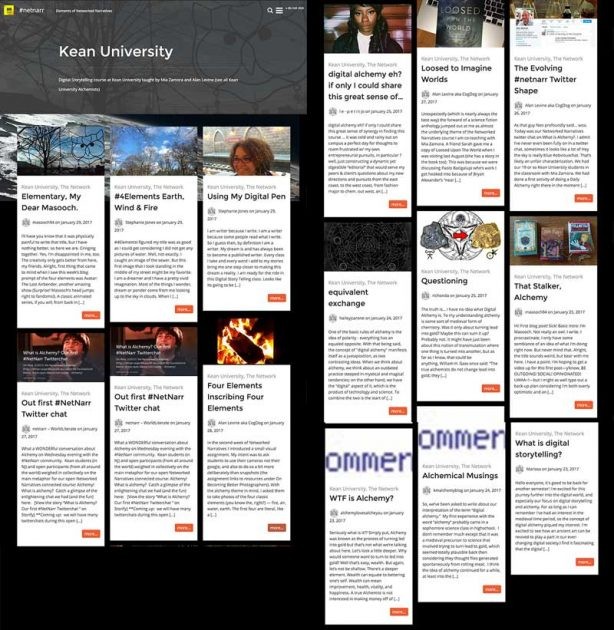
With the way I set up syndicated sites, we can slice the flow; in networked Narratives we have a page for posts just by Open Participants or just ones by the Kean University students.

Screen shot montage of the most recent syndicated posts by Kean students; by now it’s already changed

Hocus Pocus… OPML

So I am going to share you some web alchemy, and a magic potion called OPML. You need not know what that stands for (make something up), nor do you even have to look at it (it’s cryptic XML, don’t look).

If you can understand that an RSS feed represents an updated data file that shows the latest content of one blog, and OPML file is a bundle of links to RSS feeds, it’s like a mega subscription file. It’s like a big folder of — okay, the metaphors are getting in the way.

Let’s just do it.

First we need to get these magical mysterious files. I am going to do this with the interest of following just our Kean blogs, but this could work for all of them or the open ones as well. You will find the same links on all.

From each of these “flow” pages, in the header you will find links to a page that lists all of the blogs that are connected, I call them Notebooks — here is the one for Ken alchemists (see also the one for all blogs or open ones).

Check the four orange buttons

Click the buttons for Blogs OPML and the one for Blog Comments OPML (you should do this on a computer, mobile devices probably will cry when you click on these).

Both links will save files to your computer. Just download them. Do not open them.

To set up yourself to be an OPML Alchemist, you need a tool called an “RSS Reader.” There are a number you can use (Google had a great one, and they killed it, sigh. I’m still in mourning).

I will recommend Feedly, but you could easily use other ones. Feedly is free, go create an account. It will give you something blank. Like twitter, they want to suggest things for you. Do that later. Or never.

But do click (if the right side here is not visible) the Discover and Follow button. Way down at the bottom, is the link you want:

So first import the Blogs OPML file you downloaded. Lights may blink and gears are churning.

On the left side, you will see a link that represents all of the blogs listed in the file. On the right will be some kind of listing of the posts from these blogs, the newest ones first.

Posts from all the blogs in one OPML file. Cool!

The titles in bold are ones I have not read. So the interface can tell you at a glance what is new.

Your first view may be more of a graphic grid layout, different from my screenshot above. That’s my preference; you can change the views by opening the small menu to the right of the title:

If there is a title that looks interesting, clicking it opens it so I can read the blog post right here:

Reading one post…

When a post os open, if you click it’s title, you can then jump over to the blog itself if you prefer reading it there (or if you want to add comments).

You can even use keyboard shortcuts to read through them– j loads the next one and k the previous. You can read through many blogs this way.

As they say on late night TV, “but wait, there is more!”

If you click the OPML feed open on the left, you can see the names of all blogs in the subscription. And if you click a blog, you can now scan all the posts from one blog:

Okay, let’s breathe. With this set up, we can read a whole bunch of blogs in one single interface. When a blog publishes new stuff, it will be updated here (there might be some lag in how often feedly checks for updates).

That’s why I consider this one of the few technologies I can safely say that it saves you time.

Okay, but there is the second OPML file. We use the first to read the posts. The second one contains the activity on the comments to all blog posts (this works for blogs published on WordPress or Blogger only).

That’s right, folks– you can monitor the comment conversations on hundreds (or 10 or 3) blogs in one place. AMAZING! ?

Now import the other OPML file, the blog comments one.

In this case, I see the title of the post that was commented on, as well as the name of the commenter, all in my scan view:

Just flip through them (j and k are your friends), and if you want to respond, click the title and jump out to a blog.

And like above, I can quickly see what the activity looks like on a single blog:

Yes, Writeannabella is getting good activity on her new blog– I can see it in a glance, as well as seeing that there are no comments. At once glance, we can get a sense of the participation level on every blog or the community as a whole.

I cannot say enough how critical this alchemy is to stay in touch with the activity in an open networked course. Yes, it is good for teachers, but it is just as useful for participants to take in all the activity in one place.

Are you ready to do some OPML Alchemy? Fear not the funky acronyms!


Top / Featured Image: A screen shot of a real OPML file for Networked Narratives, edited in Photoshop (inverted, rotated, scaled, blurred) by me shared under CC BY

The post “OPML Is the Alchemy of Following Blogs in an Open Networked Course” was originally slapped on the butt by a cigar smoking doctor yelling “It’s a post!” at CogDogBlog (http://cogdogblog.com/2017/01/opml-is-the-alchemy/) on January 30, 2017.

That time when the AACU Virginia FacCollab held a Twitter Journal Club Event

On January 27, 2017, the AACU Virginia Faculty Collaboratives Experience (#OpenLearning17) teamed up with Twitter Journal Club (#TJC17) for a synchronous reading & discussion of Jeffrey Pomerantz & Robin Peek’s 50 Shades of Open.  Through serendipitous networking (thank you, Phil Edwards), author Jeffrey P. discovered the event and made himself available to provide additional background, resources, and insights into the nature of the article and the concept of open (Thank you again, Jeffrey!).

A diverse group participated, tweeting in from Mexico, California, Texas, Washington, New Mexico, Pennsylvania North Carolina, Maryland, and Virginia.  The Virginia institutions of higher education represented during the event included University of Mary Washington, James Madison University, George Mason University, Virginia Commonwealth University, and Virginia Tech. (*Disclaimer: This is not be a comprehensive list, though I can make it comprehensive if you give me a compelling reason to do so.)

Tweets came in from both hashtags, but due to time constraints I’ve focused on only on tweets that included the #TJC17 hashtag.  We were active in this space, tweeting approximately than 300 times in less than an hour.  Many participants were so engaged in the conversation that they continued to talk with each other (and with the hashtag) well after the event was over.  Days later, pieces of the conversation are still being retweeted by people who were not involved in the original conversation.

I’ve lightly organized these tweets (bearing in mind I collected only those from the #TJC17 hashtag) into conversational threads and storified them, here.

Loosely, conversations emerged around the following themes:

  • The stability and evolution of ‘open.’  While some participants focused on the extreme stability of the meaning of open over the years, others focused on how the ever-changing world has led to different and more nuanced uses of the word.  The concept of valuing a thing for what it is versus valuing it for how it can be used…it came up again and again in different ways throughout the conversation.
  • Marveling over all the types of ‘open.’ Many participants hadn’t thought about all the contexts of open before reading this article; they mentioned which ones struck them as particularly interesting or new.
  • Implications of ‘open skies.’ Of those new ways of considering open, the “open skies” conversation took on a life of its own, revealing tensions between hospitality, use, ownership, surveillance, and accessibility.
  • ‘Open’ in terms of accessibility versus use. General agreement that once we take accessibility for granted, our focus turns almost entirely to how we are able to use that which is accessible.  Some participants reminded us that accessibility is still a huge issue for many people.  We must balance our focus on accessibility and use.
  • The source code of pedagogy. In many ways the heart of the conversation. In what started as a reference to open software, some participants wove through the concept of education as ‘made’ and codified…codified in ways that can potentially be shared, remixed, and reused.  We moved past open-as-availability and into the realm of open-as-transparency, allowing for links across theory, practice, and learner’s goals. We moved from valuing-as-is to valuing-as-application.
  • The commons. As part of that conversation, we moved through references to the commons, most notable for the number of outside references that were added to the overall conversation, as people shared their favorite authors and resources with each other.
  • Connecting ‘open’ to liberal education. This conversation is worth reading in whole from the storify. Gardner Campbell asked: “How do you think 50 shades of open connect w ideals of “mind-liberating education,” aka “liberal learning”? The article’s author, Jeffrey Pomerantz, responded: “Short answer? I think openness is not necessary to liberal learning but sure helps. Liberal learning must aim for self-sufficiency in the student. Openness encourages exploration.”
  • The Twitter Journal Club experience (a meta-commentary). Some people watched the stream with an eye for meta-analysis and commented on it at regular intervals. When I say “most people,” I mean mostly me and it was the preliminary work for this post. However, it also included people talking about other activity on the hashtag, their learning experiences, and their physical surroundings.

Participants linked this event to the following entities: 

In terms of my own experience:

For critics who say nothing can be learned in this sort of chaotic, unscaffolded digital environment, I merely point you to the summary and analysis above. For those who were disconcerted by the porn bots sharing our hashtag (yes, #TJC17 must mean something else…to someone), well, to be honest, I loved it.  Absolutely loved it.  We do not own hashtags – hashtags are open or shared resources.  I can’t think of a better way of demonstrating the concept of openly shared resources than academe sharing a hashtag with porn bots.  Furthermore, as I was discussing with Gardner Campbell after the event, the strangeness of such a juxtaposition can be liberating, if you let it be so.

The freewheeling thinking associated with Twitter Journal Club will always be one of my favorite approaches to informal knowledge construction.  I realize that it isn’t for everyone, nor does it fulfill every scholarly need. However, we cannot spend our days approaching scholarly articles in the same way, from the same direction.  We need to mix up scholarly thoughts, challenge them, throw them against the wall, enter into them with our minds open and academic defenses down. Twitter Journal Club offers me – and presumably those of us who keep coming back – that opportunity.  I always emerge feeling rejuvenated, connected, and even more curious than before.  For me, this is what a joyful approach to liberal education looks like.

Featured Image by Jon Eric Marababol


Imagining and Visualizing Little Miss Open and Mr. Open #openlearning17 #oer17

Reading Time: 4 minutes

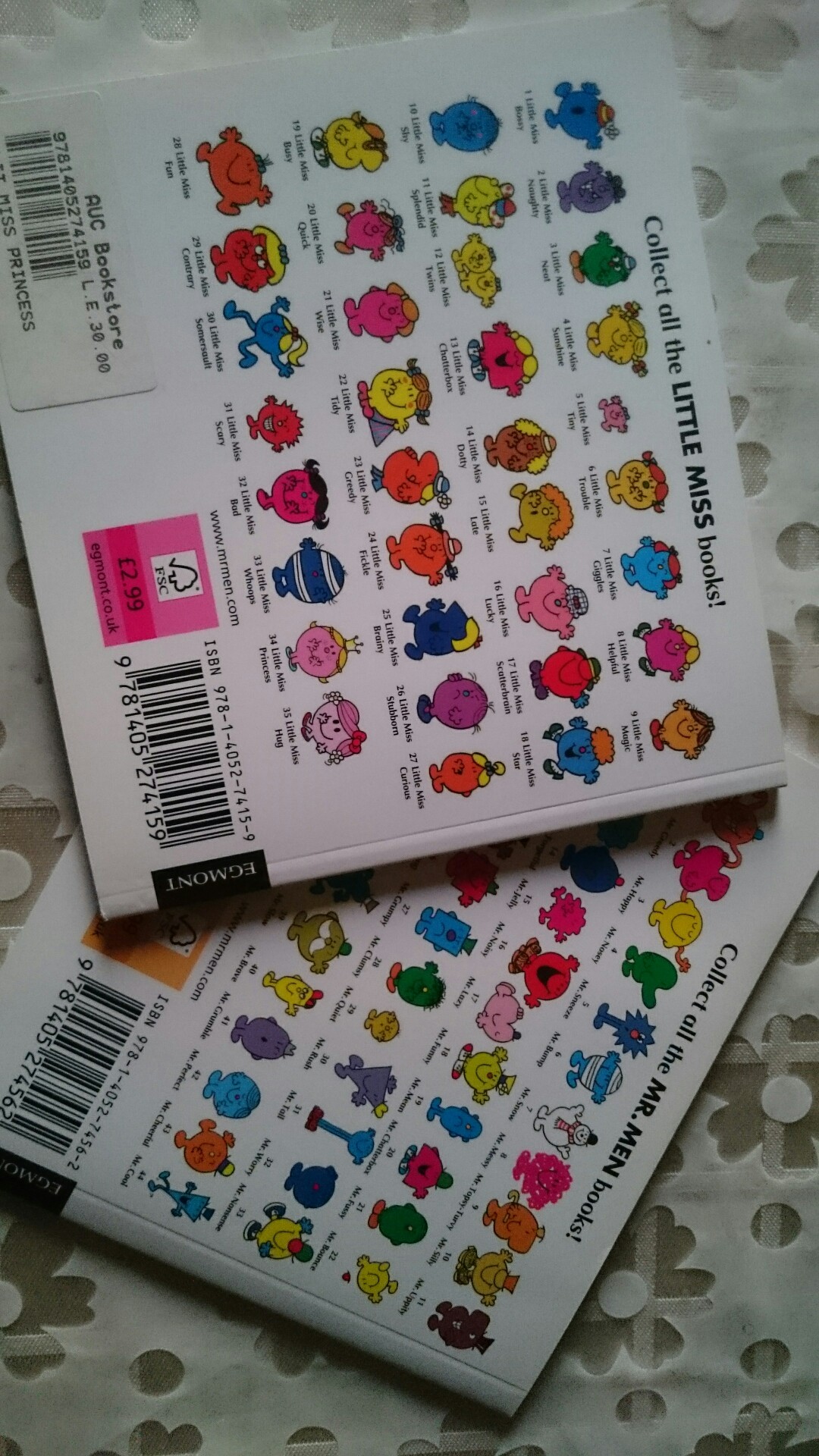
I have been doing a lot of reading and thinking ahead of #oer17 but what I am reading MOST are books to my little kid each night and throughout the day. Because I am neurotic about raising a kid who loves to read more than I am neurotic about anything else in parenting, and because the technical teaching of reading in school is OK but it doesn’t give kids the confidence to read and does not nurture a love of reading. So she is currently addicted to the Mr. Men and Little Miss series.

(back of Little Miss/Mr. Men books flickr photo by me (just took a photo from my phone

Now I buy these books for 3 main reasons

  1. They’re cheap 🙂 and abundant (so we haven’t yet run out of new ones)
  2. They’re small and light and portable so I can put several in her backpack wherever we go
  3. They remind me of my own childhood coz I used to read them to myself when I was a bit older than her (this means she can’t read them on her own yet, but she can read parts and she enjoys the reading together process so much the words “Read it Yourself” on some of her other books seem to traumatize her! This was a funny but worrying revelation. Making me wonder if she enjoys reading simply because it ties me to her rather than enjoying the reading intrinsically)

I have a lot of objections to the books, though. I don’t understand why the male characters are fully Mr but the female characters are Little Miss. Why little? I read about the original author (Roger Hargreaves) inventing the series to answer his (at the time young) son’s question “what does a Tickle look like?” and I love that the son in question, Adam, continued to add more books to the series after his father passed away.

I often think a book has so much potential but ends up falling waaaay short of what it could have done (like Mr. Nobody – imagine how meaningful such a book could be! But it was rather silly in the end). And sometimes the storyline is downright annoying. And often the humor is really difficult for my child to understand… Though I get most of it, lilk the time Mr. Wrong said, “What? I was right? That’s so strange because I am usually…” [turn page over ] “…left!”.

I do love how these books help my child learn the meanings of difficult words that are the descriptions of the characters (I don’t think even I knew exactly what Fickle meant before). I also think it’s interesting how they choose to illustrate each character to represent the adjective (or occasionally noun) that is their name. I sometimes joke with my kid and call her one of the characters when she does something. Occasionally I will make one up, like “oh, you’re Little Miss Thoughtful” (and of course I am then asked to explain what thoughtful means).

Anyway. All this long intro is just to explain that immersion in these books has got me thinking of all kinds of other books and characters that could exist…but copyright and all that… I don’t think Adam Hargreaves is on Twitter so I hope he doesn’t mind what I am about to do…

I started imagining what a Little Miss Open or a Mr. Open might look like. I started to visualize what their character would look like, and to draw one on my phone (I remembered partway through the frustration of that…that I am actually much better at drawing by hand than I am drawing graphics on a machine, so I will make time to do that, and maybe invent a few extra characters for my child in the process! Why not, right?)

So here is my caricature of Little Miss Open and it’s still in progress.

How does Little Miss Open Look? 

Some ideas:

  1. Wide-eyed because she is open to looking at everything and curious?
  2. Open-mouthed because she talks about everything openly
  3. With perked up ears because she listens well?
  4. Transparent?
  5. Open-hearted? (we can see an open heary in her transparent self – at which point i realized that these characters have huge faces with tiny legs/arms but no body so nowhere to put the heart… So maybe wearing heart on her sleeve? Err arm?)
  6. Open-minded – would we draw an opening in the head, or just never really close the head and have the mind popping out, or have a gear icon on her head symbolizing open process?
  7. Participatory – should her head be filled with thoughts/ideas of other people?
  8. Open arms? Open to collaboration with others?

Beyond the character’s looks, her behavior could take any number of directions…

  1. Open door to her house and whether this is always a good thing
  2. Sharing things, and whether sometimes she ends up oversharing to the point she might hurt someone
  3. Overly transparent to the point that she makes herself too vulnerable sometimes?

And then something interesting occurred to me. There is a book about Mr. Good who originally lives in Badland (poor fellow) where he is unappreciated (duh) but eventually stumbles upon Goodland… And I was wondering if maybe Little Miss Open is born Open but lives in Closed-Land then eventually moves to Open-Land.

Then I realized I am pretty much describing myself here, right?

I am Little Miss Open in my office and in my personal life. I am married to Mr. Private and have some colleagues who are  Miss Secretive and Miss Careful and Mr. E-Safety and such 🙂 but I also have my Open-Land, my online PLN of all the many Opens… Who are each open in their own way but generally more geared towards open than closed. So the Miss Vulnerable and the Miss Welcoming and the Mr. Collaborative and Mr. Narrator-of-Process and Mr. Share and Miss Amplify

I dropped the “little” before the miss coz it’s so sexist but it’s one of those cute things that’s sexist

Anyhoooo just needed to get this silly little brainstorm off my chest… If you’re interested in working with me on visualizing this, I may use it in part of my keynote 😉 I hope that’s not too silly.The rest of the keynote is kind of serious, I promise. But one of the beauties of being a parent is that in this horrible world, you get to be silly by duty for part of your day. And that’s a blessing.
Imagining and Visualizing Little Miss Open and Mr. Open #openlearning17 #oer17

Reading Time: 4 minutes

I have been doing a lot of reading and thinking ahead of #oer17 but what I am reading MOST are books to my little kid each night and throughout the day. Because I am neurotic about raising a kid who loves to read more than I am neurotic about anything else in parenting, and because the technical teaching of reading in school is OK but it doesn’t give kids the confidence to read and does not nurture a love of reading. So she is currently addicted to the Mr. Men and Little Miss series.

(back of Little Miss/Mr. Men books flickr photo by me (just took a photo from my phone

Now I buy these books for 3 main reasons

  1. They’re cheap 🙂 and abundant (so we haven’t yet run out of new ones)
  2. They’re small and light and portable so I can put several in her backpack wherever we go
  3. They remind me of my own childhood coz I used to read them to myself when I was a bit older than her (this means she can’t read them on her own yet, but she can read parts and she enjoys the reading together process so much the words “Read it Yourself” on some of her other books seem to traumatize her! This was a funny but worrying revelation. Making me wonder if she enjoys reading simply because it ties me to her rather than enjoying the reading intrinsically)

I have a lot of objections to the books, though. I don’t understand why the male characters are fully Mr but the female characters are Little Miss. Why little? I read about the original author (Roger Hargreaves) inventing the series to answer his (at the time young) son’s question “what does a Tickle look like?” and I love that the son in question, Adam, continued to add more books to the series after his father passed away.

I often think a book has so much potential but ends up falling waaaay short of what it could have done (like Mr. Nobody – imagine how meaningful such a book could be! But it was rather silly in the end). And sometimes the storyline is downright annoying. And often the humor is really difficult for my child to understand… Though I get most of it, lilk the time Mr. Wrong said, “What? I was right? That’s so strange because I am usually…” [turn page over ] “…left!”.

I do love how these books help my child learn the meanings of difficult words that are the descriptions of the characters (I don’t think even I knew exactly what Fickle meant before). I also think it’s interesting how they choose to illustrate each character to represent the adjective (or occasionally noun) that is their name. I sometimes joke with my kid and call her one of the characters when she does something. Occasionally I will make one up, like “oh, you’re Little Miss Thoughtful” (and of course I am then asked to explain what thoughtful means).

Anyway. All this long intro is just to explain that immersion in these books has got me thinking of all kinds of other books and characters that could exist…but copyright and all that… I don’t think Adam Hargreaves is on Twitter so I hope he doesn’t mind what I am about to do…

I started imagining what a Little Miss Open or a Mr. Open might look like. I started to visualize what their character would look like, and to draw one on my phone (I remembered partway through the frustration of that…that I am actually much better at drawing by hand than I am drawing graphics on a machine, so I will make time to do that, and maybe invent a few extra characters for my child in the process! Why not, right?)

So here is my caricature of Little Miss Open and it’s still in progress.

How does Little Miss Open Look? 

Some ideas:

  1. Wide-eyed because she is open to looking at everything and curious?
  2. Open-mouthed because she talks about everything openly
  3. With perked up ears because she listens well?
  4. Transparent?
  5. Open-hearted? (we can see an open heary in her transparent self – at which point i realized that these characters have huge faces with tiny legs/arms but no body so nowhere to put the heart… So maybe wearing heart on her sleeve? Err arm?)
  6. Open-minded – would we draw an opening in the head, or just never really close the head and have the mind popping out, or have a gear icon on her head symbolizing open process?
  7. Participatory – should her head be filled with thoughts/ideas of other people?
  8. Open arms? Open to collaboration with others?

Beyond the character’s looks, her behavior could take any number of directions…

  1. Open door to her house and whether this is always a good thing
  2. Sharing things, and whether sometimes she ends up oversharing to the point she might hurt someone
  3. Overly transparent to the point that she makes herself too vulnerable sometimes?

And then something interesting occurred to me. There is a book about Mr. Good who originally lives in Badland (poor fellow) where he is unappreciated (duh) but eventually stumbles upon Goodland… And I was wondering if maybe Little Miss Open is born Open but lives in Closed-Land then eventually moves to Open-Land.

Then I realized I am pretty much describing myself here, right?

I am Little Miss Open in my office and in my personal life. I am married to Mr. Private and have some colleagues who are  Miss Secretive and Miss Careful and Mr. E-Safety and such 🙂 but I also have my Open-Land, my online PLN of all the many Opens… Who are each open in their own way but generally more geared towards open than closed. So the Miss Vulnerable and the Miss Welcoming and the Mr. Collaborative and Mr. Narrator-of-Process and Mr. Share and Miss Amplify

I dropped the “little” before the miss coz it’s so sexist but it’s one of those cute things that’s sexist

Anyhoooo just needed to get this silly little brainstorm off my chest… If you’re interested in working with me on visualizing this, I may use it in part of my keynote 😉 I hope that’s not too silly.The rest of the keynote is kind of serious, I promise. But one of the beauties of being a parent is that in this horrible world, you get to be silly by duty for part of your day. And that’s a blessing.