Tag Archives: openlearning17

Launching a week of digital literacy

AAC&U MOOC 2017Today I’m kicking off a week of digital literacy discussion.  This effort is part of the Open Learning MOOC, which in turn is part of the Association of American Colleges and Universities (AAC&U) Faculty Collaboratives program.  Gardner Campbell is the chief cat-herder and impresario.

What does digital literacy have to do with open education, and vice versa?  That is the subject of this week’s exploration.

My plan for the week is that each day centers on a document in different media platforms (web page, pdf, video, audio files).  Participants (such as these fine people) will discuss and riff upon it from their own sites and through Twitter (hashtag #OpenLearning17).  There is a bonus reading for each day as well.

Here’s the week’s schedule:

Monday, February 20: An audio introduction to digital literacy and why it matters for open education.  Twitter conversation.
Bonus content: “Evaluating Information: The Cornerstone of Civic Online Reasoning”.

Tuesday, February 21: Discussion of the ACRL Information Literacy Framework. Participants can annotate and respond to the Framework by using Hypothes.is.  Twitter conversation continues.
Bonus content: “DigComp 2.0: The Digital Competence Framework for Citizens. Update Phase 1: the Conceptual Reference Model.”

Wednesday, February 22: Watch and listen to the recent New Media Consortium webinar on Digital Literacy.  More Twitter conversation.
Bonus content: the NMC digital literacy briefing.

Thursday, February 23: Digital literacy, fake news, and politics. Reading: Crap Detection 101, by Howard Rheingold.  Google Hangout from 12-1 pm eastern standard time.  Still more Twitter conversation.
Bonus content: the Snopes fake news archive.

Friday, February 24: The future of digital literacy: audio statement from Bryan.  Twitter live chatfrom 12-1 pm eastern standard time. Irrepressible Twitter conversation.
Bonus content: a new digital literacy politics.

Please join in as much as you’d like.  You can connect yourself formally to the project here, or comment on my blog posts, or tweet, or a mixture of these.

You can find more about the MOOC and associated projects here.

A few thoughts on Twitter chats as course discussion

One of the exciting and fun experiences of the #openlearning17 cMOOC are the twitter chats. I have not been able to participate in all of them, but the ones that I could make it to were energizing, provocative, and – I don’t want to say full of, but they provided their share of ideas and references. Here we are, in different corners of Virginia, the US, and the world, engaging in an intellectual

Nelson part 2: of teachers and curricula

In the time between writing Computer Lib/Dream Machines in 1974 and being interviewed by Gardner Campbell in 2014, Ted Nelson seems to have become a bit more sympathetic to teachers (or at least a bit less inclined to attack them/us directly).   In 1974, he presents teachers as holding considerable power in, and power to shape students’ experiences within, an “educational system. . .committed to the fussy and prissy, to the enforcement of peculiar standards of righteousness and the elevation of teachers.” While “most teachers mean well,” he writes, “they are so concerned with promoting their images, attitudes, and styles of order that very little else can be communicated in the time remaining, and almost none of it attractively” (Computer Lib, p. 309 of New Media Reader reprint/excerpt).  By 2014, he describes teachers as less powerful, trapped  within and limited by rather than shaping the system, ineffective in part because they are “so overworked, so boggled by appalling administrative crap” (c. 6:40+ in the video linked above).

One villain, however, remains constant in the two presentations of Nelson’s ideas: the curriculum.  “A child arrives at school bright and early in his life,” Nelson writes in 1974. “By drabness we deprive him of interests. By fixed curriculum and sequence we rob him of his orientation, initiative and motivation, and by testing and scoring we subvert his natural intelligence” (Computer Lib p. 308).  In 2014, responding to Gardner’s initial question about the current state of education, he speaks of a school system which reduces education to a “system of curricula, of gradation, of . . .attempting to stamp out homogenized minds,” “reducing knowledge to a small number of testable points” (c. .55+).  Later in the interview, in a discussion of the “oceanic mind” and the importance of understanding the “big picture” by seeing connections between ideas that are traditionally relegated to different fields of study, he reiterates that “taking a course is not necessarily the best way to learn something” (c.15:50 -17.25).

I agree with that final statement, especially for people who — in a phrase that comes up frequently in discussions of the promise and pitfalls of MOOCs, have learned how to learn.  I also agree — as I suspect most teachers do — with Nelson’s critique of an educational culture in which the standardized-testing tail often seems to be wagging a dog that represents every other part of the educational process.  Finally, I recognize and value the interdisciplinary nature of learning; in fact, the class that most shaped my college and professional career was an interdisciplinary class – women’s studies – taken during my first year of college.  In part as a result of that class, I spent a good deal of my time in college questioning the literary canon – an established curriculum of sorts, represented by which texts were and weren’t included in anthologies, or, in many cases, available in print at all, except, perhaps, in obscure corners of the library stacks, or in the rare book room.  As a result of that experience, I have some sympathy for Nelson’s questioning of set curricula and their value.

At the same time, I’m not so sure that Nelson’s proposals are quite as much of a departure from existing approaches to teaching, or from the idea of a curriculum, as he suggests. For instance, I notice that the learning space Nelson envisions as an alternative to single-path Computer Aided Instruction (CAI) seems itself to be a carefully curated space, with constrained rather than infinite choices. While the student chooses the “sequence” in which (s)he encounters the “interesting and clear” material, and also “the most appropriate form of testing available” (Computer Lib p. 313)  – from, presumably, an existing menu of options — the experience described seems more akin to exploring a well-designed hyptertext encyclopedia (perhaps one with abundant links to primary documents and more in-depth secondary sources), or perhaps the early AOL environment, than to trying to make one’s way unaided through the World Wide Web, or even the stacks of a large university library that has been collecting materials for a century or three (reading reviews of the Bronte’s novels, in bound copies of the periodicals that had once served as recreational reading for mid-19th century Harvard undergraduates, was another transformative experience of my first year in college).

And as Vannevar Bush points out, as the amount of available material representing the sum of human knowledge increases, so does our need to find paths through that material, and to seek help from others in tracing those paths. And what is a curriculum but a path blazed by others?  And do we not learn to blaze our own paths in part by using the methods and following in the footsteps of our predecessors, at least until a better way of doing things occurs to us, or something a bit off the established path catches our eye?

As a college freshperson, I was ready to be enthralled rather than intimidated by the stacks of Widener Library in part because I’d been guided (by excellent teachers, in the privileged environment of small, mostly discussion-based classes) through an established, more constrained curriculum in high school – the AP American history curriculum, with its emphasis on Document-Based Questions (DBQs).  Through my experience with curated sets of primary documents and pre-set questions, I learned that primary sources existed, and what kinds of questions I could use them to answer (though those questions, even in my girls’ high school, were never, as far as I can remember, about gender).

When I decided I wanted to explore ideas about gender and authorship in the mid-19th century for the assigned research paper in my Women’s Studies class, I was able to combine the experience of answering questions by analyzing primary sources and the particular perspective of the class to frame a question that was still somewhat outside the norm for English studies in 1983.  Similarly, I was able to combine skills and information from my education so far — the knowledge that primary sources in general existed, and could be used to answer research questions;  the information, most likely gleaned from lecture or class readings, that the Bronte’s novels had been reviewed while the gender of their authors was still a matter of speculation; and a general sense of how to search for periodicals (that was probably when I discovered that the Reader’s Guide to Periodical Literature had a 19th-century counterpart) — to locate those evocative bound volumes (rather than the microform copies that, based on past experience, I had anticipated). And, during the later years of college and eventually in graduate school, I was able to continue refining those research and analytical skills, and applying them to finding and reading texts increasingly distant from the established (though then as now ever-changing) canon.

Would I have learned even more from my early experiences with DBQs if the texts had been arranged in the sort of environment Nelson describes, rather than sequentially in printed or photocopied packets? Possibly (but we did a good bit of jumping around in those printed packets, and sometimes our teachers supplemented the printed packet with additional photocopies).  What about if there had been no set questions?  I’m not so sure about that; at least in this case, I’m pretty sure I benefited from having questions (and even, on occasion, answers) modeled for me before I went on to construct my own, often quite different, ones.

Would I have gotten less from my high school experience if the teachers had followed an even more constrained, and constraining, curriculum, or if (as seems to be the case with Nelson) I had chafed more against institutional structure of any kind?  Quite likely.  But at least in my experience (which, like Nelson’s, is a data set of n=1), it worked quite well to move from a constrained curriculum and a very structured day to an education that challenged some of the assumptions of that curriculum, and a course schedule that allowed me considerable time to explore readings, libraries, etc., on my own.

It’s also worth noting that even Nelson’s proposed system is not quite the guide-less free-for-all one might assume from the “no more teachers’ dirty looks” mantra, or the declaration that “anyone retaining his natural mental facilities can learn anything practically on his own, given encouragement and resources” (pp. 308-309). The qualifiers here — “practically,” “given encouragement and resources” — though easy to gloss over, are crucial.

The quality of the “resources” provided — by someone’s labor, whether one calls it “teaching” labor or something else — is central to the success of the project.  If there are no “teachers,” per se, in Nelson’s system, there are still creators, or at least choosers, of “clear” materials to be made “available” and even “attractive” to the learner.

“Encouragement” is also key, and also hints at the presence of implicit if not explicit teaching.   “Encouragement” and “on his own” are at odds; if someone is encouraging you to do something, you’re not truly doing it “on your own,” even if it feels like you are.  In fact, making it feel like you’re doing it on your own can be one of the subtler forms of encouragement, and of teaching.  Think of the five-year-old who declares “I did it all by myself,” and the parent who builds confidence by refraining from contradicting that declaration — or perhaps, if (s)he fears the child is becoming dangerously overconfident, smilingly adds “well, almost” (or “practically”).

It also seems likely that, in the process of choosing, these behind-the-scenes creators would imagine some (though perhaps not all) of the paths students might take through the created or chosen materials, and create or choose additional materials that would enhance that experience.  So, as with the five-year-old who picks what to wear from a parent-curated wardrobe,  the freedom the student feels is perhaps not so great as (s)he imagines, nor is the range of possible questions that can be answered infinite (for instance, if someone had created a collection of literary texts for study using Nelson’s model c. 1982, it might or might not have included many texts by women, or by the other noncanonical writers whose work I’ve studied).  However, in making their way through a well-designed set of constrained materials, students may well develop the skills they need to include materials outside the original set in their inquiry (on the other hand, if the original set of materials is too carefully curated, too selected for “clarity” and appeal, they might not; this is an ongoing challenge for educators seeking to create engaging, accessible instructional materials, and also to help students apply skills learned in carefully-designed environments to messier real-world situations).

Finally, are the people who create, collect, and to some extent arrange the collections of materials Nelson envisions teachers (or perhaps, in the parlance of an academy where the creation and “delivery” of curricula is in some cases becoming separated, instructional designers)?  And is the collection a “curriculum,” perhaps by another name?  For that matter, is Nelson himself, with his interest in the creation of engaging learning experiences, a teacher, or least someone who thinks a lot like a good teacher?  I’m not particularly interested in getting hung up on vocabulary, but I’d answer yes to all of these questions – Nelson describes a well-designed, usefully constrained, inquiry-based curriculum designed by thoughtful teachers engaged in – yes, Dr. Nelson – a creative process in which he himself is also involved.

Trailmix anybody?

Trail Mixes in Vending Machine flickr photo by Pat Guiney shared under a Creative Commons (BY) license

OK, I’m pretty late with this. My day job – workshops to give, roundtables to facilitate, assignments to grade etc. etc. – is running my agenda these days. I am kinda following the readings and listen to all of your blogposts on my one-hour commute, read by … I think the computer voice’s

Connecting Spaces

This afternoon, the steering committee for #openlearning17, a AACU Faculty Collaboratives Experience, met to discuss what has gone well with the experience thus far and what we can do to improve.  Several of us mentioned how thought-provoking and mind-binding the Twitter discussions have been, but others have made a request: specifically, those who have been attending Twitter discussions regularly want a little time to get to know each other.

To that end, let’s carve out a little time.

One of the more interesting things about connecting with people in virtual spaces is the knowledge that they could be doing all sorts of physical things in all sorts of physical places while they are holding that conversation with you. While I take pride in the fact that my online personality is very much the same as my face-to-face personality (maybe a little more confident, but I’m working on that), I’ve hosted Twitter chats from airplanes, airports, the attic, a Lincoln Town Car, a hotel bar (while ducking to avoid a bar brawl), taxis, offices (mine and others), my car, on my phone, in my doctor’s office, at the Hair Cuttery, and on four different continents.

What I’ve come to appreciate over the years is that physical context matters to our online interactions, as much as anything that is going on in our head while we are chatting.  And knowing the physical environment of those with whom we chat helps us get to know them.  It makes them more real.  It makes us more comfortable. Therefore, I propose the following:

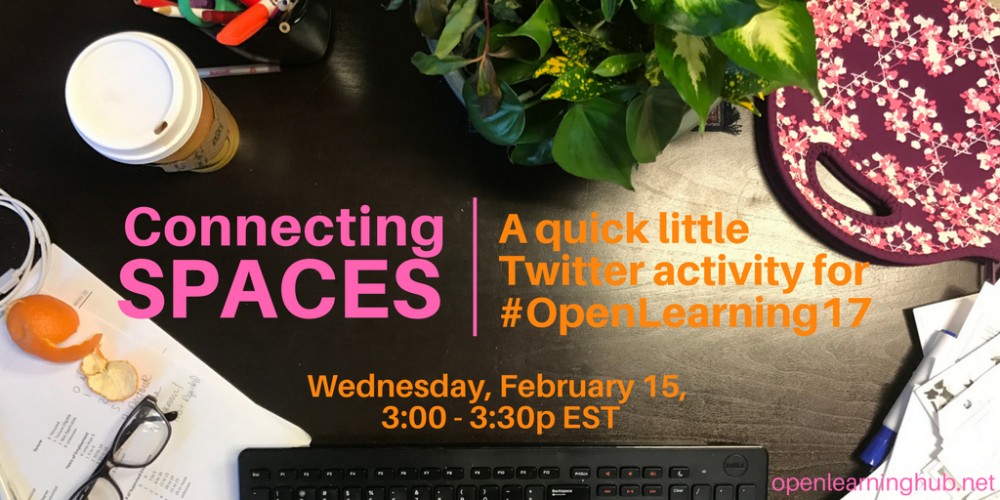
an invitation to connecting spaces: a quick little twitter activity for #openlearning17, wednesday February 15 from 3:00 to 3:30 pm eastern standard time. The invitation is placed on the background of an office desk, with glasses, an orange peel, some papers, a coffee cup and a plant.

That’s my office desk, by the way.  I bring my lunch because I prefer simple lunches and don’t like to waste valuable time going out.  I buy a large cup of coffee (a splash of milk) as a personal incentive to leave the seat warmer in my car every morning. I love seat warmers. I have to take off my glasses when I read because I’m months away from needing bifocals, and I’m trying to keep a dish garden alive, because one would think that an adult old enough to consider bifocals might be able to maintain a plant.  Also, I am building a database and working hard to develop coding schema that make sense and are entirely sustainable (all those papers).  I’ve been on the job for a month.  It’s not like I’m applying any pressure on myself at all.

On Wednesday, February 15, 2017 at 3:00pm EST, I will be hosting a quick little Twitter activity called Connecting Spaces.  Come. Chat however feels comfortable, but it might be interesting if we share a little about our physical spaces.  Where are you?  Why are you there?  Why or why not do you like to engage in Twitter chats in this space?

Taking a picture of your space, or better yet, a quick video would be a great way to introduce yourself.

Regardless, I hope to see you there.


Nelson: starting with the cover(s)

[Note: I’d love to include an image of the covers of Computer Lib/Dream Machines here, since they’re fascinating, and yes, images can aid understanding, especially when they represent the phenomenon under analysis.  But Nelson asserted copyright in his work, and that copyright still applies. I could probably use Wikipedia’s rationale for reproducing a low-resolution image.  But instead I’ll link to DigiBarn, which has some nice images of both the covers and some inside pages, scanned and posted with permission from Nelson. A google image search will turn up some additional (apparently unauthorized) images, including ones which show how the two covers connect, especially the intrusion of the superhero figure’s foot from the cover of Dream Machines onto the cover of Computer Lib]

In an attempt to feel a bit more caught up with the ongoing conversations in Open Learning 17, I decided to look ahead to the reading for week four (I like to think about things for a while before I write about them).  It looks like we’ll be reading excerpts (tba) of Theodor H. Nelson’s Computer Lib/Dream Machines, so I skimmed through the full(er?) version currently linked from the syllabus, trying to get a sense of the book(s) as a whole.  I found myself thinking about the information on the covers, including titles, subtitles, and illustrations.

The result, below, is some combination of a rhetorical analysis (courtesy of my current professional identity as a writing teacher), a gender analysis with particular attention to historical/cultural context and the book as an object (concerns common to my original fields of research/study), and the musings of someone who was just beginning to be culturally aware in 1974 (I was ten when the first edition of Computer Lib/Dream Machines came out).  There is also something of a trail, as I attempted to answer a research question using the affordances of the internet, a tool which, as we’ve noted, in many ways resembles the systems of knowledge-recording and building imagined by Bush, Engelbart, and Nelson himself.  So here’s the question, which came to me almost immediately on seeing the title, and the date of publication:

Why did Nelson choose Computer Lib as one of his titles? More specifically, what were the resonances of “lib” for him and his (possible/projected/ideal) reader(s)? 

My own immediate association, based on my somewhat-hazy memories of a 1974 spent living in the Northern Virginia suburbs, is with “women’s lib.”  Based on those associations, and on the androcentric perspective some of us have noted in our historical readings so far (Bush and Engelbart),  I was surprised.  Have we arrived at a reading which will display some awareness of, perhaps even sympathy for, contemporary gender struggles?  Or perhaps, thanks to age and/or location, I’m missing some other contemporary uses of “lib.”  How to answer this question?

I decided to look for other book titles from the early 1970s with “lib” in the title. This, as any librarian could have predicted, turned out to be a difficult search, since “lib” plays multiple roles, especially in databases of books: a part of many common words, an abbreviation for “book” or perhaps “volume,” and a part of the phrase “ad lib.” (which shows up in the titles of a good many music scores, among other things).  My attempts to search google books didn’t come out very well; I either came up with far too many results or far too few, with the “too few” identified as such in part by the fact that they didn’t include Nelson’s book.

WorldCat seemed to work better. Though I’m still not entirely confident of my results, it seems that most other books with the word “lib” in the title published in 1974 and indexed in WorldCat (eleven in all, that I could find) referred (positively or negatively) to the women’s liberation movement.  The two exceptions were closely related; there was one reference to “kids’ lib” and one to “gay lib” (a bit more skimming of results suggests that “gay” was the second-most-common word combined with “lib” in book titles in the early 1970s; looking back through 1970, I also found “city lib,” men’s lib,” and, most intriguingly, “mule lib,” which I didn’t explore further, lest the research trail become a rabbit trail; I do have student work to respond to today, which might explain some of my enthusiasm for this research digression).

So it seems that my memory/impression is correct: in 1974, “lib” was most often combined, in popular parlance, with “women’s.”  So why did Nelson choose to include it in one of his titles?  At least from my initial inspection, his work doesn’t seem to have an explicit gender focus, and one might even imagine that his primary imagined readers were men.    Were the cultural resonances of “lib” for him and/or his projected readers positive or attractive?  In my memory, “women’s lib” was more often than not a term of derision or dismissal, but, once again, cultural positions vary, and my memories stem from a particular time, place, and status.  Some authors who chose to include “women’s lib” in their titles clearly felt positively about the movement themselves, though some seem to have anticipated some resistance from some of their readers. Was Nelson simply looking for a shorthand term for “liberation,” and seized on one that was current in the culture, without considering its other associations?

I’m not sure of the answer, but I’ll be mulling this bit of cultural context, and its possible relevance (or not) as I take a closer look at what’s inside the book.

Similarly, I’ll be wondering about the fist: black power symbol?  anarchist symbol? general symbol of protest?

And the subtitle of Dream Machines.  The most likely referent for “minority report” seems to be a 1956 Philip K. Dick story (later made into a 2002 movie of the same name), but a quick google search on “minority report” plus each of the years between 1970 and 1974 revealed another reminder of the women’s liberation struggle: in 1972, a minority report played a role in the fight to seat more female delegates at the Democratic National Convention.

I should probably be wondering more about the superhero (Superman?) figure. For some reason, that’s the element that least engaged my attention, but it, too, certainly plays a role in constructing the immediate message of the book-as-artifact.  It seems possibly a bit at odds with the fist on the other cover (wasn’t Superman pretty establishment?), but maybe not?

Finally, I find myself wondering about the subtitle of Computer Lib, and what messages it sends to a possible/projected audience.  “You can and must understand computers NOW” is both encouraging/empowering (“can”) and prescriptivist (“must,” combined with the typographically shouted “NOW”). Some might find it inspiring, others offputting. Personally, I’m leery of gurus who not only assert that I must free myself, but also are eager to tell me exactly how to do it.  It’s a stance that seems both self-absorbed and lacking in self-awareness, and that does not inspire me with confidence that a self-appointed potential mentor has my best interests at heart, or is even much interested in me at all except as an object on which to project his own interpretations and ambitions.  In short, I don’t usually buy or read books with statements like that on the cover (except, perhaps, if I’m interested in them as historical artifacts).

A similar tension can haunt our attempts to be leaders in implementing open learning in formal teaching and learning contexts, especially for those of us who teach exclusively required classes.  Do students want their classes to be open, by whatever definition of open? If not, do we feel comfortable asserting that we know better than they do what’s best for them?  Perhaps we do, but we need to be aware that that’s what we’re doing, and of the potential contradictions involved in doing so.  Teachers have very real power in the classroom, and we can’t  give it up entirely, though many of us can to some extent choose how we use it to shape the teaching and learning contexts for which we’re responsible.

Based on Computer Lib‘s somewhat contradictory subtitle, I find myself wondering, again: to what sort of readers did Nelson think this message would appeal?  Or, alternatively, wasn’t he thinking that much about appealing to a potential audience?  This volume, at least in its external trappings, looks a bit like a manifesto, and manifestos, for all their explicit desire to persuade, are often devoted as much to expression — giving the author(s) a chance to work out ideas in writing, and to place them where others can see them — as on the sort of persuasive communication that tries to meet a reader where (s)he currently is.

The book (or at least some of Nelson’s key ideas — a somewhat separate thing) has clearly had lasting impact, or we wouldn’t be reading it.  So at some level, whatever its quirks and apparent contradictions, it succeeded.  At the same time, as we consider the idea of open education, and how and whether we promote it, and to whom, it may also be worth looking at Nelson’s covers as an example of an attempt to play the role of leader/mentor/teacher, and to ask ourselves which parts of his approach we might choose to emulate (or not), and why.

In Medias Res

I’ve been meaning to start a blog – a blog with this title, in fact – for several years now, but haven’t done it. Part of my hesitation stems from an awareness that a blog is a public space, part of my public online presence/persona.  That awareness both evokes a healthy (I think) caution, and brings out a bit of lingering perfectionism (an impulse that still rears its head at times, despite being mostly vanquished by fifty-plus years of life, including several decades of teaching a 4/4 writing-intensive load; continuing, however slowly, my own research and writing; and doing my best to keep up with an ever-evolving list of other interests and responsibilities).

I’ve also gotten caught up in weighing many of the usual questions faced by aspiring academic bloggers: whether some degree of anonymity/pseudonymity would be wise given my lack of tenure (and lack of eligibility for same); how to balance that caution with the desire to have a public voice; how much of the rest of my life, identity, and interests to include.

In the end (or at least for the moment), as my “about” page indicates, I’ve decided on including all the identities/perspectives (or at least all the ones that currently come to mind), and trusting to academic freedom for any protection I may need (perhaps an odd decision at what feels like a particularly perilous moment, but there’s also something to be said for living out the values in which one believes, and the peril – either from increased government intolerance of dissent or from the ongoing influence of forces driving the growth of academic precarity — does not, at least at the moment, feel personal).  I will also do my best to exercise some discretion in what I write about and how, balancing that with an impulse that goes back at least as far as the perfectionism – to describe things as I see them, even if that makes others, or me, uncomfortable.

The immediate precipitating cause for my finally starting the blog is a desire to participate in Open Learning 17, a cMOOC sponsored by Virginia’s Faculty Collaboratives Steering Committee (itself a part of a larger American Association of Colleges & Universities initiative).  Behind that, there’s desire to write about the English 302 Open Educational Resources (OER) project in which I’m involved (of which I will write more anon; for the moment, there’s a brief description on the “about” page).  Since I’m late getting started on the blogging portion of Open Ed 17, my blog posts are probably going to lag a week or more behind the reading schedule, or I may skip around a bit in the interests of participating as fully as possible in the conversation.

In the longer term, I expect this will also be a space to write about a variety of topics, including teaching and learning more generally;  using digital humanities techniques in the classroom (physical or virtual);  contingency in academia; and my ongoing research, mostly into abolitionist authors Emily Clemens Pearson and Harriet Jacobs, and my attempts to convey the results of that research via both traditional publication and digital humanities methods.

Beyond that, we’ll see: Biblical exegesis and/or theological reflection?  Political reflection ?(!?).  Pictures of flowers (or flooding) from my community garden plot?  Reflection on just why I find towpaths so alluring (but don’t visit the one a mile from my apartment nearly as often as I intend)? At the moment, all possibilities are open.

Soylent Media Attribution

I knew this blog post title was a terrible metaphor. But once the metaphor took a hold in my brain, it would not let go. And then I am in Photoshop, mashing up a collage of assorted images from web sites that do not provide the source of the same image (see the end of the post for the story behind the image.

But much of the web, social media, is a huge conveyer belt where we move, take, toss media that have no sourcing, no mention of where they came from, no context.

I have no illusions this will change. But I will not be part of the consumption and production of Soylent Media.

And while I can feel lonely as an attributor (not as desolate as Charlton Heston’s portrayal), once in a while, an indication comes through out of the blue. I’m not alone.

In June of last year I wrote about a terrible “infographic” the so called “Bicycle of Education” that had been tweeted:

As an aside, it’s interesting when I embed that as the tweet where I found it, rather than just the image itself- the tweet has attached a time stamp and the name of the person who shared it. Kind of metadata-ish, though not of the media.

Because mostly in social media platforms, we just shove around images or reblog them in tumblr with no vestige of a beginning.

In my post I did a bit of detective work to find the likely source of the education bike. Because otherwise, it just keeps going with all the other piles of images, down the belt.

But here is the real story. I had found mention of the Bicycle of Education in a reddit thread, where also, someone else had suggested a much better use of a bicycle as a metaphor, the Krebs Bicycle:

As reddit goes, it was just shared. Down the belt. And by that time un my post, I got tired and wrote “I’ll be damned if I’m going to go look for the source of that (well not tonight)”.

Eight months later, a blog comment out of the blue (or green) from Jamie:

CogDog FYI, I wanted to pass on the Krebs cycle image & looked for attribution.

From the style it probably originated (http://bit.ly/2kRZ7vl) from this University of Sheffield page http://www.deconstructingthetour.group.shef.ac.uk/krebs-bicycle/, though it’s sinced been hacked by the busy Peshmerga sympathiser ‘ SA3D HaCk3D ‘ and it looks like the image has been replaced.

PS. The Krebs Cycle image was created by @_atwist from Sheffield University who doesn’t ask for attribution (and he’s also updated the WordPress version, killing the hack).

Boom. Updated the post.

Apparently in 2014, Sheffield University used the proximity to the Tour de France for some educational purposes, with a site about Deconstructing the Tour.

“To encourage more people to start cycling on a regular basis and to highlight the health benefits of the sport, the University of Sheffield has created a giant bicycle, using eco-friendly paint in a field close to the route of the Tour.”

Read more about the diagram that the big field painting represents:

The bicycle will also illustrate the Krebs cycle – the process by which mitochondria, the tiny “power stations” of the cells, turn food and oxygen into the energy needed for exercise. Local school children will play the part of molecules in a re-enactment of way the Krebs Cycle works on the field.

This is the payoff of digging for sources, the magical, unexpected rabbit holes you find yourself in while finding sources. The Sheffield site, doing education around a bicycle event, reminds me totally of the Great VCU Bike Racebook Project at VCU that I was a small part of.

Attribution is less interesting and compelling when it’s about following rules and letters of licenses.

It’s when someone like James jumps in and helps close the gap.

See it’s not about automated blockchain tracking of reuse– it’s Soylent media.

It’s made of people!


Featured image: A collage of images for which none have open licenses, this is to make a point. But it is for the purposes of education/commentary, a dash of parody, a heavier dose of irony, and of course on this blog, blatant non commercialized purposes.

The scene from the 1973 movie Soylent Green is a single frame among many, maybe one of many clips from the many of movie on YouTube. I found it on a Nerdist post about the movie.

I did a little trick to replace the conveyer belt, too lazy to reproduce the original– filled the corner area with a dark green, added gaussian noise in Photoshop, and a motion blur in the direction of the belt.

The strewn photos are from a pair of random images, one from a site for a home decorating show the other from a blog post about saving old family photographs — all of them masked, rotated, duplicated.

On none of these sites are the sources of the images used the published web pages credited or attributed.

Get it?

The post “Soylent Media Attribution” was originally dropped like a smoking hot potato at CogDogBlog (http://cogdogblog.com/2017/02/soylent-media-attribution/) on February 9, 2017.