Category Archives: Virginia Group

Virginia Faculty Collaborative Group

“Help Me Grok it and I’ll Help You Make it Real” / Filtering Forward the High Value Trails

Grok Hybrids?

Wednesday’s webinar and twitter chat with Hypothes.is founders Jon Udell and Jeremy Dean — masterfully MC’d by OpenLearning17′s  Gardner Campbell — gave me so much food for thought.  We are starting to use Hypothes.is in the graduate pedagogy class I teach and we read “Working Openly on the Web” (7 Ways to Think like a Web) during the first week of class. So getting to listen to these three in action was a huge treat.

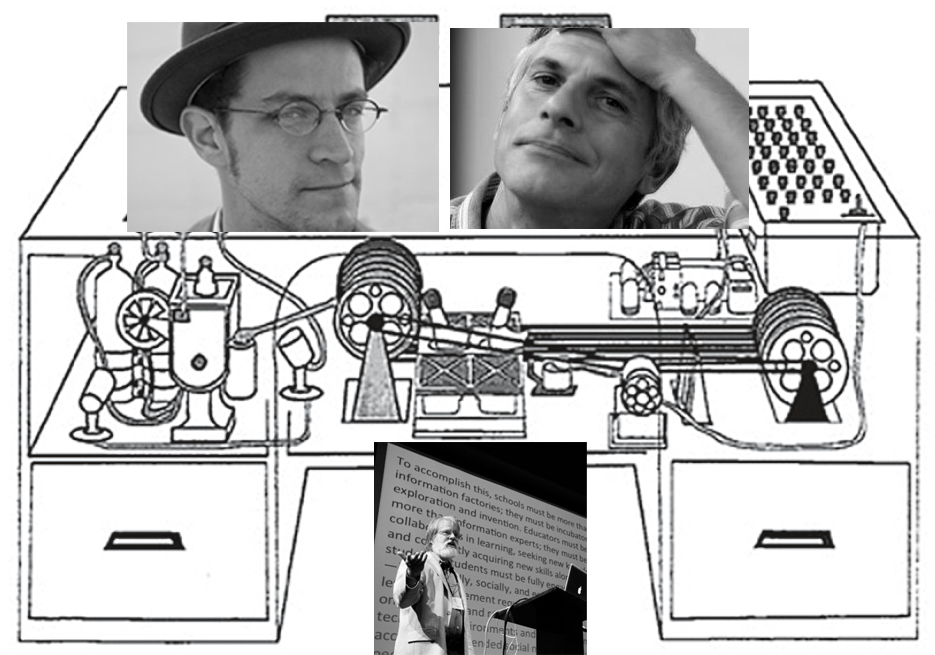
Our jumping off point  was Vannevar Bush’s “As We May Think,” published in the Atlantic in 1945 as the imperative to leverage the technological innovations of wartime to more peaceful purposes seemed especially compelling.  Bush’s vision of the memex – a computerized combination of note cards, annotations and information sources that could extend the reach (capacity) of any one learner by integrating that individual’s knowledge with the sources that informed it in a durable medium that could then be used and developed by others — underpins web annotation projects such as Hypothes.is. It also supports networked learning frameworks that facilitate collaborative learning, knowledge production and reflection.

As a historian, I’ve been intrigued by Hypothes.is since it first came to my attention last year. Historians are trained to think about how knowledge is produced and organized as an essential element of the research process: What was the author of this essay, article, book trying to say? Why was this archive created? Why are the records organized the way they are? Why did they keep what they kept? What are the assumptions behind the Dewey decimal or LOC cataloguing systems? In what context was this book, manuscript, court record, ship’s manifest created?)

Once you have a handle on those questions you need to figure out how to find where the resources you want to consult are and how to get to them. There is a dialogic process to this that involves reading, searching, thinking, taking notes, making lists, thinking, reading more, going back to your bibliography, supplementing it with new things you find, reading those things, taking more notes, thinking, going back to the older notes, etc…..I realize as I’m typing that this I might be describing a pretty generic research practice for many fields….

Anyway, at some point in there, I think two conceptual maps of a project emerge that overlay each other. The first is defined by types of sources — not so much a list, like a bibliography — but more like a grid of different kinds of evidence with points of overlap as well as nodes of distinction and empty spaces that still need to be filled in. The empty spaces let you know what you need to keep looking for and what silences your work might have to address. The points of overlap provide nuance, depth and corroboration, and the points of distinction raise new questions, redirect the inquiry or foreground a significant problem that might not have been evident when considering one source in isolation.

The second structure comprises the notes and annotations that are attached to those sources but also connected to each other (in your head or on a piece of paper or in your word processor) by the interpretation you are developing about the evidence. I see Hypothes.is as a medium through which those annotations can be assembled AND shared, which is just mind-blowingly wonderful.  (Hypothes.is annotations for “As We May Think” are here.) While the analog or un-networked digital version of note taking certainly allows for all kinds of remixing and re-purposing, with Hypothes.is the annotations can themselves become nodes on or elements of a new kind of crowd / collaborative / collective “source” – a distributed conversation about a particular web page. We’re used to thinking about different kinds of sources: primary, secondary, web-based, archival, print, biographical, testimonial, etc.. Maybe a set of Hypothes.is annotations on a particular article would be a Web 3.0 source? A networked source? A memex-cubed source?

Two points in the wide-ranging Twitter chat especially resonated with me. We had been talking about how Hypothes.is helped realize Bush’s vision of “associative trails” and I asked if Jon and Jeremy saw those trails as supplements to or replacements for conventional taxonomies. Jon thought they were complementary, and Jeremy cautioned that the annotations alone might not constitute “trails” — they needed to be connected or flagged somehow, perhaps by a tag. (I like  the metaphor of trail blazes.)


So, annotations become associative trails when they are marked out by tags or blazes — or any durable and accessible symbolic representation of the cognitive framework that helps you knit meaning into the tapestry (or navigate the cacophony?) of information about the world. And those trails serve as jet-packed complement to the conventional taxonomies for organizing knowledge. YES!!!!!

But how to get to the trails you really want or need? I’m imagining a future when a good chunk of the web has been trailed by Hypothes.is. And I’m imagining that all trails will not be created equal.  I won’t be able to read it all, and I don’t want to fall down a rabbit hole without some warning, so how am I going to know where the good stuff is? How will the high value trails get  filtered forward?

And here came the second nugget moment: Jon Udell responded to a query about this by saying “Help me grok it and I’ll help you make it real.”

Oh wow.

I’m pretty  sure I haven’t groked* it myself.  But here goes:

As teachers we spend a lot of time helping students learn how to find, sort through and evaluate resources. (Crane Librarian has spoken to the challenges of doing that in the library.) And as researchers our own successes (and failures) in finding the sources and communities we need depend largely on a somewhat ineffable combination of content expertise / experience, and skill — the “scaffolding” we’re always talking about providing and developing for learners. In this sense, I do feel like I have groked the research process. But the prospect of having something so powerful and potentially overwhelming as a Hypothes.ized web makes me think I’ll need to develop another kind of sensibility and that the trails and webs marked out by Hypothes.is will need some kind of context sensitive markers to help direct individual users where they want to go.  At the most basic level this would be a system whereby spam and trolls (they are, I fear inevitable) could be marginalized. But even more valuable would be a marker that would flag certain kinds of annotations — and the connections between them — and also allow for the dynamic process of ongoing annotation. What would that look like? I don’t know yet. But it would be cool. And I think it’s worth thinking about. I know I’m hoping for something that would make the web more akin to Doug Dorst’s and J. J. Abram’s book S. and would not like to see a set of user-conditioned algorithms  turn Hypothes.is into a colonial outpost of my Facebook feed.  It also seems that the conceptualization behind sites like Jon Stewart’s Open Note Database project could be really helpful. I’m just not sure how.

So there you go. Not at all groked, I’m afraid. But maybe glimpsed as a desirable future? Thanks for encouraging me to think about this. I will continue to do so.

*my working understanding of “grok” falls closer to the flower child sense of mastery that is so intuitive it feels innate than the techie understanding of internalizing a concept so completely it feels like second nature. But grok is also the only Martian word I know, so that might be an issue.
Associative trails in the post-notecard age

memex

From Life Magazine, Nov. 11, 1945

Like other scientists involved in producing weapons of mass destruction for WWII, Vannevar Bush eventually issued a clarion call to his colleagues to create “pacific instruments,” namely machines capable of collecting “the inherited knowledge of the ages.” This week I read his famous July 1945 essay, “As We May Think” and immediately recognized his memex as a proto-computer with the ability to create associative trails of information. Unlike the atomic bomb, which Bush oversaw, the memex’s purpose was constructive: by enabling scientists to select, annotate, and associate bits of information from myriad sources, the machine would allow them “to grow in the wisdom of [human] race experience” and “wield that great record [of human knowledge] for his [man’s] true good.” I confess I had to reread the final paragraphs several times to grasp Bush’s meaning; he abruptly shifts from “we” (a pronoun encompassing him and his fellow scientists) to “he” (which references Man or mankind—as in the phrase, “Presumably man’s spirit should be elevated . . . “). Yet, for all his visionary ideas about the future, Bush’s optimism that July was clearly measured. Allied troops had just recently liberated the death camps and he undoubtedly knew more about the genocide than the general public. As director of the Manhattan Project, he also knew that Little Boy was even at that moment being readied for use against Japan. The US was still very much at war. Would mankind “perish in conflict” or “live healthily” ever after?

I found it difficult to read “As We May Think” while questions about our nation’s future are swirling. I live in a blue dot surrounded by a swath of red, an established refugee resettlement community in a historically WASP locale, a college town set in a proud but declining agricultural region. Open learning is central to who I am and what I do here, but many of my neighbors want to close our borders, reject freedom of conscience, and deride long-established scientific and humanistic knowledge. What to do at such a moment? I turn inevitably to my students.

This semester I am teaching Intro to Public History, a survey of the major branches of the field: historic preservation, oral history, museum exhibit design, living history, archives, and so forth. Over the years, I have added a lot of digital content, as well, and once again I am requiring students to create their own websites or portfolios (shoutout to UMW’s Domain of One’s Own for inspiration) as a way to not only acquire new skills but to think carefully about curating their own digital identities. The assignment intersects with Bush’s essay in interesting ways. Besides posting several research projects, they must reflect on the digital traces they have already left behind, the FB likes and Instagram posts, the Amazon purchases and texts and sexts and tweets and all manner of bits and bytes that linger in databases everywhere. The same machines that allow ‘we’ scholars to make associative trails for purposes that serve the public good are also used to data-mine for private profit. There is indeed “a new profession of trailblazers,” as Bush called them, “those who find delight in the task of establishing useful trails through the enormous mass of the common record.” Young people care a great deal about privacy and their personal brands, but they often lack the information or tools they need to protect themselves.

So many new tools exist now. The goal of this week’s openlearninghub exercise was to consider innovative ways of locating, selecting, and processing information. Many years ago when I was dissertating, I relied on two ordinary shoeboxes to hold the hundreds of notecards I needed for my research. The project, a study of cultural identity in a 19thC company town, required me to keep track of thousands of individuals and the million factoids I had gathered about them from census records, parish records, wage records, probate inventories, and oral histories. I also used a relational database called Paradox, which I loaded on a dinosaur of a portable computer, and two file cabinets full of folders containing Xeroxes and pages of longhand notes. But the shoeboxes with their alphabetical dividers were the heart and soul of my “philosophical genealogies.” If I had had a memex, they would have been my code book. Once, my partner-now-husband saw me laying out cards on a table as I struggled to link members of several Dougherty families. He said, “You know, that’s how the Nazis kept track of the Jews. Notecards. I wonder what they would have done with computers.” I think about my notecards a lot these days. The days of notecards are long gone.

notes

Blank notecards with my laptop. Two ways of collecting and associating info.

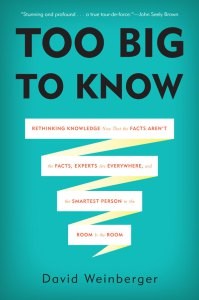
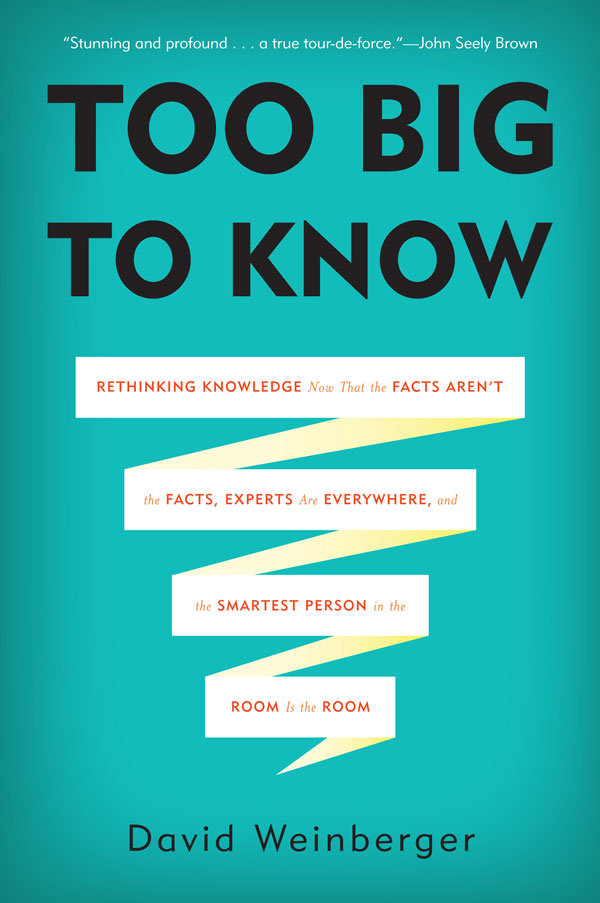
Too Big to Know: Monday Morning Live Tweet Class with David Weinberger

Too Big To Know

Greetings Open Learners!

We have a late-breaking, serendipitous opportunity tomorrow morning to talk about David Weinberger’s book, Too Big To Know on Twitter. Weinberger, a philosopher and technologist who writes about the effects of the internet on human relationships, is currently a senior researcher at Harvard’s  Berkman Center. In light of current discussions about the nature of facts and their alternatives, the book’s subtitle — “Rethinking Knowledge
Now that the Facts aren’t the Facts,
Experts are Everywhere, and
the Smartest Person in the Room
is the Room.”   — is especially compelling.

Dr. Weinberger will be Skyping into Tom Ewing‘s undergraduate course on Data in Social Context at Virginia Tech  to talk about Too Big To Know with Tom and his students.

I will be live tweeting the conversation tomorrow (Monday) from 10:10 to 11:00 am EST. If you’re familiar with the book or Weinberger’s work please join us. And if you aren’t please join us anyway!  You can follow along and send questions and thoughts to #Openlearning17 and #Faccollab.

Followers of #gedivt — I will try to flag you all as well, but the best bet would be to check #OpenLearning17

Twitter Handles: Data in Social Context: @DiSCVT ;David Weinberger: @dweinberger ; Tom Ewing: @EThomasEwing

Are We There Yet?

abstract-air-backdrop-1755967_1280

First off, I’ve had yet another library school connection. I’m not sure which class I read this article in, but somewhere along the line in one of my classes we were assigned this article. At the time I remember being impressed that someone would have such a good sense of the future of information, though a lot of the mechanics ended up being more sophisticated than he thought they’d be what with the Internet and the advances in computing. I’m a science-fiction reader, and I’m often similarly impressed with what older science fiction authors get right about the future. Of course, they often also get it wrong. I don’t know whether to be amused or upset that male science fiction authors of the 50s and 60s could not imagine a future in which women were not housewives (see Fahrenheit 451 and Do Androids Dream of Electric Sheep?).

I named this post “Are We There Yet?” because it seems to be that the seamless access of information and ease of annotation is lagging. As Bush notes, we have gotten very good at storing information and taking less and less space to store it cheaply. However, access and annotation are still regular snags. Search algorithms have a long way to go for research purposes. When I teach students how to use the library, knowing that they will be frustrated by the ever-present clunkiness of databases, I try to get them to see that the purpose of their searching is different. In a Google search, often the first web page or two will do the trick. Who ever scrolls to the bottom of a Google search results page? Who goes on to the next page? More likely you’d rerun the search with different words. The idea is that a web page or two will meet the need for information. Research for scholarly purposes ideally involves a more exhaustive search, and Google doesn’t handle that well. They prioritize precision over recall. A library database prioritizes recall over precision. As of yet having both done well isn’t possible. So, while the information is out there, still in traditional article form for the most part, it’s not simple to retrieve effectively.

Besides access is annotation. The research indicates that students still prefer print books, and the ease of annotating is often cited as a reason for that preference. Digital versions of annotation tools exist, but they are still awkward and limited. They also vary based on which e-reader software/hardware is being used. I feel there is a long way to go toward making annotations and links between data easy to achieve in the digital realm. Ultimately, while students prefer print, libraries generally see students use e-books more than print books. I don’t think this means the students were misleading us when they said they prefer print. I think convenience wins over preference and the student at home that wants to use information from a book for an assignment is going to use the book they can access immediately.

My musings are mainly concrete and concerning the technology we deal with right now. I’m aware that all of this assumes a scholarly communication environment that has perhaps stagnated, and some of the “but this is the way it’s always been done” needs to be challenged. My impression is that the challenges are happening – the movement behind this course is one example – but they haven’t hit a critical mass yet or gained full support from academia. When I reach the end of my career, 40 years from now perhaps, it will be interesting to see what has changed and what has stayed the same.

Is the Internet Your Griot?

“His excursions may be more enjoyable if he can reacquire the privilege of forgetting the manifold things he does not need to have immediately at hand, with some assurance that he can find them again if they prove important.” —from “As We May Think” by Vannevar Bush

The time is upon us! We can offload innumerable amounts of data onto our technological devices. Don’t bother remembering that phone number; just pull it up on your cell phone. Or…wait for it…just give your cell phone a voice command and tell it whom to call—and bask in the fanciness of your own pants. As I read Vannevar Bush’s work, however, I began to wonder—what are the “manifold things” we do not “need to have immediately at hand”? What happens when technology fails? Can we trust our technology? Can we trust ourselves to record those manifold things accurately? And as we each toss our contributions into/onto the intricate web, will our quest to find the right questions to access that information turn into a veritable search for the Holy Grail?

I keep thinking about context. Technology does permit us to forget and find again, but sometimes what we find is divorced from its context. We know that the web can hold the stories, and even hold the contextual aspects of the stories, but knowing the right questions to ask to access that information may be a bit tricky for some.

Last weekend, I attended an amazing event called “Building a Vocal Community,” a workshop led by Dr. Ysaye M. Barnwell (some may know her from the group Sweet Honey in the Rock). During the workshop, she discussed the importance of griots—the historians, story keepers, story tellers, and so much more.

As I consider the “manifold things” we have given to the internet, and the possibility to feel both immensely connected and terrifyingly disconnected on the web, I also consider how we find and contextualize the things that “prove important” (to quote Vannevar Bush). It leads me to ask quite simply, and with no intent to disempower the position, is the internet your griot?

“As We May Think,” Annotation, and Liberal Learning: a conversation with Hypothesi.is’ Jon Udell and Jeremy Dean

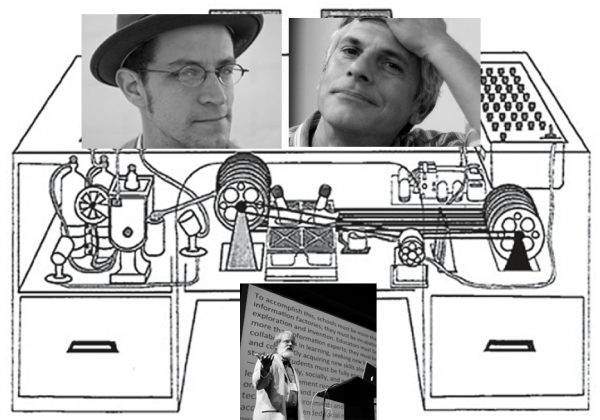
Our Faculty Collaboratives Open Learning ’17 cMOOC is in its second week! Today I had the great pleasure of speaking with two leaders at Hypothes.is: Jeremy Dean (Director of Education) and Jon Udell (Director, Integrations). Our topic was Vannevar Bush’s epochal “As We May Think,” especially as seen through the lenses of online annotation and liberal learning. Click on the image below to experience our conversation.


As you’ll hear, Bush’s phrase “associative trails” appropriately wound its way throughout the conversation. I encouraged Jon and Jeremy to reflect on robust resource linking across collaborating minds as well as the more idiosyncratic and sometimes apparently “random” associative trails that are forged within our individual brains. I had probably registered this distinction myself in one of my many earlier passes through this endlessly fascinating essay, but today the distinction became newly vivid for me, and helped me understand areas of connection and disjunction within the essay itself.

Since a classic blog-based distributed conversation brought us together many years ago, I have interacted with Jon on numerous occasions. Some of his own associative trails have grown familiar (and dear, I must say) to me, but he’s always full of surprises, too, and I remain consistently challenged and stimulated by his ongoing work with the Web as a platform for co-constructed knowledge. I have been fortunate to spend more time with Jeremy lately, learning of his literary and musical background, and learning much more about his work with educators who are adopting Hypothes.is in their teaching as a way of helping students learn to scaffold and extend their own learning. It’s fascinating to see two people who are quite distinctive in background and personality nevertheless strongly united in their commitment to building a better world out of deeper, more thoughtful, more educated, and more robust human interaction.

I’m confident you’ll detect my own enduring concerns and commitments here as well. As I reflect on today’s conversation, I can see how my own work, and perhaps my personality as well, are situated almost at the meeting point between Jeremy and Jon. I hope that middle-ness helped to elicit the uniqueness, and the tremendous connections, these two thinkers brought to bear today. My thanks to both of them. I hope we can do this again, and soon.