Category Archives: Virginia Group

Virginia Faculty Collaborative Group

Writing an Open Text: Getting Started (Step One)

In a previous post, I tried to convince you to write an open text. Supposing you agree, here is my number one piece of advice to help you get started: Start writing.

Pick a topic/section/chapter that you’ll eventually want to cover – pick a favorite! – and start writing that portion of the text. I wrote two sections of a math book. An “equivalent amount”, depending on your discipline, should be enough to serve your purposes. And what, pray tell, are these purposes?

First off, they serve as play. You want to write, so do it! Don’t impose too much structure on yourself. Just have fun producing something. In the end, you’ll change much of what you just wrote. But you’ll develop skills you’ll need later (just like your play as a kid did). 

Secondly, this play will point out things you’ll need to develop in the future in a way that is more meaningful than anything I could write/advise. I wrote a math book and thought I knew how to make good graphs of functions. Then I made two. And realized how different they looked. And how horrible it would be if each graph in the text had its own look. My play introduced my need for graphical standards. (I could tell you to “develop graphical standards”, such as font sizes and color schemes. But your playtime will make clear what things need to be standardized.)

Finally, undertaking a big project is hard. By writing something – anything – you will have started. Keeping that momentum going is easier that starting it. If the first few weeks are spent trying to plan, after a few weeks you’ll likely be discouraged for you’ll have little to show for your work. Write something. Tell people you have a section already completed. Then step back and do the necessary planning. The next posts will cover some of those planning needs.

“….it really gets hard when you start believing in your dreams….” — Doug Engelbart

In the hope that anything worth posting once can be re-posted again (different audiences?), I’m offering this reflection / question I wrote for Gardner’s New Media Seminar a couple years ago .  Thoughts, anyone?


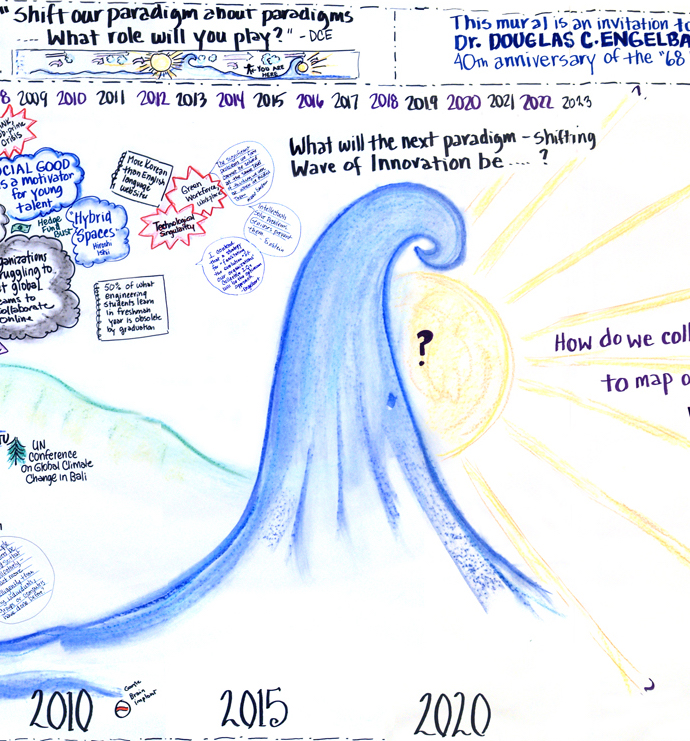
I’ve posted before about how central Doug Engelbart is to the Awakening of the Digital Imagination. This time I’m going to let an image — or more precisely, a mural — do the talking.  Created by Eileen Clegg and Valerie Landau for the fortieth anniversary of the Mother of All Demos, this graphic representation of the interaction between cultural change, technological innovation, and what Engelbart called “collective intelligence” suggests how we have co-evolved with our technology since the early twentieth century.  At the end of the mural, a blue wave asks us to think about “the next paradigm-shifting wave of innovation”….which seems to be happening in 2015.  I mean, RIGHT NOW.

OLYMPUS DIGITAL CAMERA

So I ask you, looking at the elements of the mural and the interactions and shifts it depicts — can we imagine and work for a future using technology and our collective intelligence to deal with the world’s “increasingly complex problems” in ethically responsible and constructive ways? Put another way, can we afford not to do this?

In The Abstract

concrete

Before I started this post, I looked around to see if anyone else had posted on this week’s content yet. I wanted to see about linking to other content as we have been prompted to do. Well, as far as I can tell, no one has written on this week yet, so someone has to start. Maybe I can come back to this post later and revise based on the other thoughts that crop up.

Something that I touched on in one of my earlier posts is that I am not an abstract thinker. I deal better with the practical, on-the-ground, concrete aspects of work. Being that way is a strength in some cases. However, I also recognize the limitations. Once I began my professional life and worked with other librarians on committees, I started to realize that my bent is to do things the way they’ve always been done. Not to the degree that I would resist a change because I’m used to doing a task a certain way. More that I don’t “think outside the box” naturally or take the bird’s eye view of a problem. Can’t see the forest for the trees, as the saying goes. As with any challenge, awareness is the first step to overcoming it. So, since I noticed that strength/weakness of mine, I’ve periodically reminded myself to consider the bigger picture or what the end goal really is.

All that to say – I admire Doug Engelbart’s vision and his ability to think outside the box in what appears to be a natural way to think for him. I’m reminded of a test I took at work recently called the Strengths Finder test. The 34 strengths are split into 4 categories, one of which is Strategic Thinking. Needless to say, only one of my top 5 strengths fell into this category. I get the sense that more of Doug Engelbart’s strengths would fall into that category.

Though I don’t think I see Engelbart refer to Bush anywhere, it seems to me that his creation is an attempt to take Bush’s ideas and make them real. And now, we feel closer and closer to that reality all the time. I’m waiting for when I can manipulate information on floating screens with hand gestures, like you often see in science fiction shows/movies.

Bringing Engelbart’s talks down to something concrete for me… I appreciate his point in one of his speeches about how the technology that makes a task easier, and therefore enhances human capability, can sometimes be difficult to learn. Or it seems difficult to learn if you’re thoroughly entrenched in a very different way of achieving a task. Where my mind goes with this is students and their study/learning habits. My impression of K-12 school is that it is still very physical book driven. That impression could very well be wrong, so someone correct me if they know better. I think the Almighty Textbook still reigns all throughout school. I don’t know how, given what happens in K-12, higher education is supposed to make a dramatic shift in student learning/studying habits. Given Engelbart’s point about how shifts happen slowly because of the difficulty in switching methods, I don’t know that I’ll see big change in higher education until we have a whole new generation or two coming through that have different expectations for what learning looks like. Young people that have grown up in a very different educational environment. I stress educational because outside of education, many dramatic shifts have already occurred. I myself am probably considered a “digital native” who is more used to ubiquitous technology, finding it easy to use. I can’t remember not owning a computer or having access to the Internet. Embarrassingly for someone in their 20s, I’ve only had a smartphone for a few years. I finally got on the bandwagon with iPhone 5. However, my educational experience, in terms of the classroom materials and methods, was largely lecture and largely print textbooks.

So, to wrap all this up, change needs to happen in the K-12 arena (easier said than done) if we’re going to have students prepared for a radically different way of learning and studying. Or we’d need to build into higher education some way of easing students into new methods. Right now we’re probably just looking at particular classes taught by exploratory professors who are willing to test out new methods. It occurs to me that perhaps community colleges could be on the forefront in this, given that we are more teaching focused institutions. Something to mull over…


How to survive (and thrive?) in a cMOOC

I’m in my first MOOC and I’m learning.  I’m learning how to be a learner in this new-to-me environment.  This is a constructivist MOOC, so while each of us is constructing our own learning path, we are also all shaping the learning experience together.

What I’m learning about how to be a learner in this space is this:

  • We need a strategy for managing our time.  This is exactly what our first-year students need to learn and I find myself struggling all over again to find time for learning.  This morning I replaced my 1/2 hour morning-coffee-social-media time with #OpenLearning17 time (I kept the coffee).   I think that’s going to work.  What little bit of time could you let go for the duration of the MOOC to spend on learning?
  • We need to engage.  Commenting on other people’s blog posts and writing my own is not in my current comfort zone, but here I am doing it and I’ve already been rewarded with some great interactions.  We need to step out of our comfort zones and engage.  And won’t it be fun if we meet in person someday and feel like we are already connected!
  • We need discipline.  Just like a new exercise routine, it takes discipline to create a new habit.  It takes discipline to get results.  If we are going to learn in this space, we need to be disciplined enough to come back to it regularly and actively participate.
  • We need to be discriminating.  Not every post will grab our attention, not every week’s topic will pique our interest.  That’s okay.  We don’t need to follow every hyperlink or comment on every post.  We just need to stay engaged in the overall learning and follow what interests each of us.
  • We need each other.  This form only works if we connect, discuss, and debate.  We need to ask questions.  We need to be provocative.  We need to be caring.

What am I missing?  What are your strategies for thriving in this learning environment? What have you learned so far?

Updated 2/10/17:  I just found Laura Gogia’s great Conversation with Gardner Campbell where she articulates the need to develop a strategy for our connected learning.  Great stuff!

A Few Thoughts on Nelson

Point 1

The text mentions the annoyance of fake interactions, like a toll booth with a “Thank You” sign in lights (Nelson). However, I rather like the automatic “thank you” programmed into various machines—or the automated voice that tells you to have a nice day on a phone call. There are some people who could learn a little something about politeness from those machines!

robot-1214536_1280

Point 2

I understand Nelson’s notion of removing course sequences and his “modest proposal” for greater course flexibility. For example, when people began taking MOOCs, particularly xMOOCs, the low completion rates raised the ire of many. However, there were others who highlighted that taking xMOOCs (or MOOCs in general, for that matter) could be viewed as an exploratory act—so participants could just “stop by” courses to investigate and learn more about what interested them.

A day late…

I didn’t get around to making a post happen for #openlearning17 week 2 before it ended, but I did participate in our cMOOC in few (low-profile, lurker-y) ways.

A lot of people seemed to have previously read or heard of Vannavar Bush’s “As We May Think,” but this was my first exposure to it somehow (I swear I really did go to library school!). As my professional focus has shifted more toward scholarly communication over the last year, I was glad to have been introduced to such a foundational piece. Even more, I’m glad to be reading it for the first time as a part of a group of people who can really help me understand the context and application to scholarly communication now. Since I’m a day late, I’ll add just a few reflections, for brevity, in .gif format.

On reading Bush’s article and this blog post which really helped me think about what associative trails mean now (#meta-metacognition):

image

On reading this twitter exchange on note-taking (or rather, note-making!) as a research methodology:

image

And, on reading all the other tweets in Friday’s twitter chat and blog posts on the openlearning hub network that really illuminated this topic for me:

image

Trails of wonder, rigorously explored.

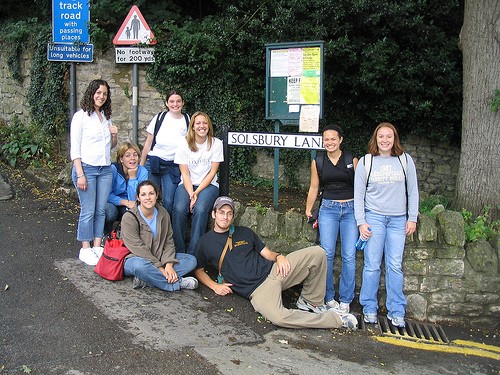
On our way to Solsbury Hill, 2003

This week, Open Learning ’17 turns to Doug Engelbart’s “Augmenting Human Intellect: A Conceptual Framework”–but I want to write a few words about “As We May Think,” first.

One of the great things about a learning experience undertaken with others is the way familiar texts reveal new layers of meaning and implication. This time around with “As We May Think,” an essay I’ve read maybe twenty times or more, I was particularly struck the multiple meanings of Vannevar Bush’s idea of “associative trails.” Some of these trails we make deliberately, the way we construct an argument, but also the way we build a curriculum, organize a course of study, or even write a story. Bush envisions a time when such trails, with all the context (or “scaffolding”) that’s part of the story of the trail-blazing, will help good ideas come into being more frequently:

When the user is building a trail, he names it, inserts the name in his code book, and taps it out on his keyboard. Before him are the two items to be joined, projected onto adjacent viewing positions. At the bottom of each there are a number of blank code spaces, and a pointer is set to indicate one of these on each item. The user taps a single key, and the items are permanently joined. In each code space appears the code word. Out of view, but also in the code space, is inserted a set of dots for photocell viewing; and on each item these dots by their positions designate the index number of the other item.

Thereafter, at any time, when one of these items is in view, the other can be instantly recalled merely by tapping a button below the corresponding code space. Moreover, when numerous items have been thus joined together to form a trail, they can be reviewed in turn, rapidly or slowly, by deflecting a lever like that used for turning the pages of a book. It is exactly as though the physical items had been gathered together from widely separated sources and bound together to form a new book. It is more than this, for any item can be joined into numerous trails.

This process, amplified considerably across the Web, is very much what Jon Udell describes during our conversation last week, in a powerful demonstration of Hypothes.is as both an individual and a crowdsourced Memex.

I think it’s fair to say that we believe expertise will result in more interesting and fruitful trails, some of them so interesting and fruitful that the trails themselves become objects of study. The Memex also gives us a better opportunity to study both results and process, and to study in particular those associative trail-makers who are particularly ingenious and conceptually powerful in their ability to build new ideas and implementations out of new combinations. This power of juxtaposition and connection drives the primary modes of discovery Steven Johnson analyzes in Where Good Ideas Come From, and it also underlies Jon Udell’s idea of “manufactured serendipity” that’s taken up as “designed serendipity” by Michael Nielsen in Reinventing Discovery: The New Era of Networked Science. 

Of course, environments that increase the likelihood of interesting and revelatory juxtapositions only work if the learner in those environments has a combinatorial disposition, one that adds to innate curiosity the disciplined education that yields the conceptual frameworks one can build with and upon, the divergent-convergent meta-education that helps one recognize when to arrange the cards and when to shuffle them (and thus try to elude confirmation bias and path dependency), and the cognitive energy to present novelty to a blinking audience and share that novelty widely whether or not the occasion provides immediate affirmation–or any affirmation at all.

Bush writes:

There is a new profession of trail blazers, those who find delight in the task of establishing useful trails through the enormous mass of the common record. The inheritance from the master becomes, not only his additions to the world’s record, but for his disciples the entire scaffolding by which they were erected.

This new profession is in one respect an old one: that of the teacher. (A quick aside: I recognize and regret that Vannevar Bush is sexist throughout the essay, even allowing for the old and regrettable practice of using “he” and “him” as so-called “general pronouns.” At the same time, I want to be hospitable to his ideas, and humble about matters about which the future will likely judge us harshly because of our own blindnesses.) The talk of “master” and “disciple” may cause our Foucault to fall off the shelf, narrowly missing our heads, or not. For me, the language is deeply resonant and liberating, as the idea of mastery conveys what Bruner defines as “understanding,” that is, “going beyond the information given.” That power of going-beyond can, I believe, be taught, not so much through direct instruction but by the teacher’s energy and commitment in modeling that process. For me, that’s what it meant to be a disciple of Dr. Elizabeth Phillips, my beloved English professor. She found delight in her making, in her going-beyond, not as a means of humiliating her disciple Gardner, putting me in my place, but as a way of encouraging me, putting me in her place, if only by helping me to imagine her and her place more deeply.

In the poet Walt Whitman’s words:

Failing to fetch me at first keep encouraged,
Missing me one place search another,
I stop somewhere waiting for you. (Song of Myself, section 52, 14-16)
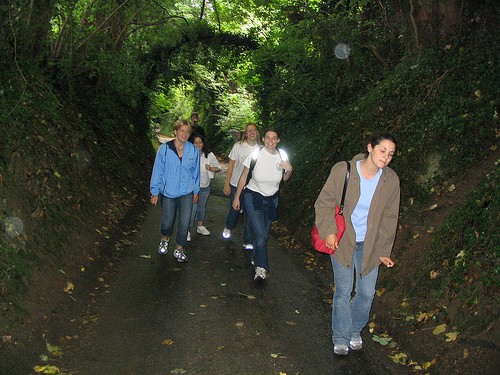
Climbing up on Solsbury Hill

Though her death has put our lives so far apart we can no longer hear each other speak, I continue to find my beloved professor, indeed to find her by following her, emulating her as I practice my own mastery, such as it is. For among many other things, Elizabeth’s mastery revealed itself in her delighted sharing of the scaffolding of her additions to the world’s record. She instructed me, but she did so by inviting me into the workshop where she crafted those additions. That invitation is precious indeed, because the associative trails of master trail blazers can become mere “content” to be “delivered,” and thus lose what the poet Robert Frost calls the “most precious quality” of a poem, “its having run itself and carried away the poet with it … its sense of a meaning that once unfolded by surprise as it went.” My intellectual discipleship (a word related to discipline, as in the object of study we pursue and the focused energy of that pursuit) follows not only the trails she blazed, but the light of that blazing, the surprise and delight shared generously and openly by my beloved English professor, shared that I might follow.

That opening does not come within “the information given,” but in the masters’ willingness to share their experience of being carried away. The disciples learn they may be carried away too, not by the cult of personality (always a danger, to be sure) but by the energy of insight as experienced in the context of lived experience. Michael Nielsen describes something like this in Reinventing Discovery, when he recounts a transformative moment in his own learning, one that the Internet at its best can amplify and extend:

What’s important then is that blogs make it possible for anyone with an internet connection to get an informal, rapid-fire glimpse into the minds of many of the world’s scientists. You can go to the blog of Terence Tao and follow along as he struggles to extend our understanding of some of the deepest ideas of mathematics. It’s not just the scientific content that matters, it’s the culture that is revealed, a particular way of viewing the world. This view of the world can take many forms. On the blog of experimental physicist Chad Orzel you can read his whimsical explanations fo physics to his dog, or his discussions of explosions in the laboratory. The content ranges widely,but as you read, a pattern starts to take shape: you start to understand at least a little about how an experimental physicist views the world:L what he thinks is funny, what he thinks is important, what he finds irritating. You may not necessarily agree with this view of the world, or completely understand it, but it’s interesting and transformative nonetheless. Exposure to this view of the world has always been possible if you live in one of the world’s intellectual capitals, places such as Boston, Cambridge, and Paris,. Many blog readers no doubt live in such intellectual centers. But you also routinely see comments on the blog from people who live outside the intellectual centers. I grew up in a big city (Brisbane) in Australia. Compared to most of the world’s population, I had a youth of intellectual privilege. And yet the first time in my life that I heard a scientist speaking informally was when I was 16. It changed my life. Now anyone with an internet connection can go online, and get a glimpse into how scientists think and how they view the world, and perhaps even participate in the conversation. How many people’s lives will that change? (168-169)

I suppose the answer to Nielsen’s question depends on the willingness of professional trail blazers to keep an open Memex, and the willingness of other trail blazers to make their own Memexes available to help even more trail blazers to discover the work of those professionals … and the scaffolding of their delights and serendipities, the records of insight in the context of their lived experience, the context we provide to each other, to keep each other encouraged to keep looking.

Nielsen writes:

Science blogs show in nascent form what can happen when you remove the barriers separating scientists from the rest of the community, and enable a genuine two-way flow of information. A friend of mine who was fortunate enough to attend Princeton University once told me that the best thing about attending Princeton wasn’t the classes, or even the classmates he met. Rather, it was meeting some of the extraordinarily accomplished professors, and realizing that they were just people–people who sometimes got upset over trivial things, or who made silly jokes, or who made boneheaded mistakes, or who had faced great challenges in their life, and who somehow, despite their faults and challenges, very occasionally managed to do something extraordinary. “If they can do it, I can do it too” was the most important lesson my friend learned. (167-168)

Vannevar Bush’s idea of “associative trails” extends that insight in yet another direction, one that links the professional trail blazer sharing connections and scaffolding with the amateur trail blazer, the disciple, who realizes, as Nielsen’s friend realizes, that associative trail blazing is a human birthright, one to be exercised within freely chosen following as well as idiosyncratic non-following. The idea is that we should attend to our own thinking, and learn from it, and respect the humanity of it, and let that respect free us into agency: “If they can do it, I can do it too.” To which the best mastery will reply, “Yes! Go discover and create your mastery!”
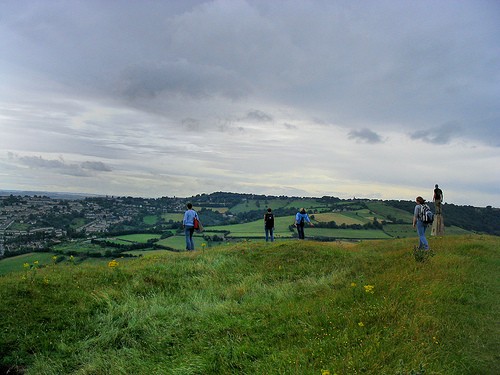
Solsbury Hill

Vannevar Bush writes:

The human mind … operates by association. With one item in its grasp, it snaps instantly to the next that is suggested by the association of thoughts, in accordance with some intricate web of trails carried by the cells of the brain. It has other characteristics, of course; trails that are not frequently followed are prone to fade, items are not fully permanent, memory is transitory. Yet the speed of action, the intricacy of trails, the detail of mental pictures, is awe-inspiring beyond all else in nature.

Man cannot hope fully to duplicate this mental process artificially, but he certainly ought to be able to learn from it. In minor ways he may even improve, for his records have relative permanency. The first idea, however, to be drawn from the analogy concerns selection. Selection by association, rather than indexing, may yet be mechanized. One cannot hope thus to equal the speed and flexibility with which the mind follows an associative trail, but it should be possible to beat the mind decisively in regard to the permanence and clarity of the items resurrected from storage.

There are holes in the argument, things to critique, and (regrettably, as one sees from the Hypothesis annotations online) occasions for smuggery and snark. First, however, hospitality: the “speed of action” in our minds that creates an “intricate web of trails” and “detail[ed] mental pictures” is “awe-inspiring beyond all else in nature.” The human mind: as we say to our toddlers when we walk them to the mirror, “Look, that’s you!” The associative trails within each of our minds, linkages that include others’ associative trails as well as the results and modes of professional trail blazers whom we follow, constitute the poem of the self that we draft each day, writing ourselves into being yet once more. How can one not feel interest, surprise, wonder, awe, or even liberating confusion, all of the feelings Paul Silvia calls “knowledge emotions,” at these daily rites, profoundly individual, profoundly shared? Perhaps more open and opening Memexes will bring us more occasions for wonder, at ourselves and at others. Perhaps wonder will open the way to equity, reverence, love. Perhaps we have something to say about that.
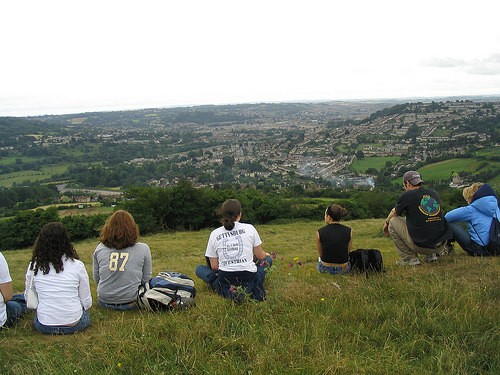
Overlooking Bath on Solsbury Hill

So what does all of this have to do with mind-liberating education? Dear reader, fellow traveler, you have some of my scaffolding and some of the trails they support. If you’re part of my network, as very many of you are, I have some of your scaffolding and the trails they support as well.

Thank you.

There is no easy way to be free.

Let us keep encouraged.
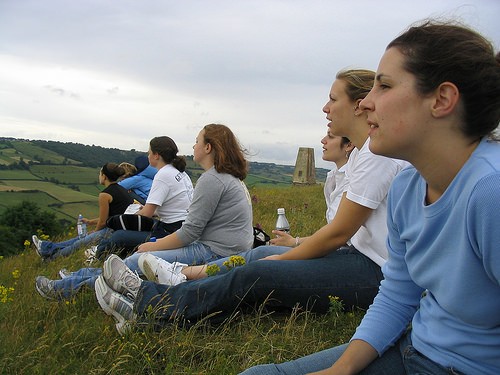
Overlooking Bath, Solsbury Hill

Why #openlearning17 should consider embedding visual elements in blog posts

As the connected learning coach for the AACU Virginia Faculty Collaboratives Experience, #OpenLearning17, it is my pleasure to wind my way through the open learning hub,  focused predominantly on how participants are making connections through their blog posts and tweets.  There has been a lot to love in the first two weeks of blog posts.  As I mentioned in my greetings and hyperlinking posts, connected learning takes place when learners network their current learning/thinking across disciplines, contexts, people, and time. Digital platforms have unique affordances that allow us to make and reveal our connections.  As Autumm’s #openlearning17 post on digital citizens, fake-news, and microtargeting demonstrates, hyperlinking is an amazing way to connect ideas and build infrastructure around a post; if you need additional convincing, check out how she used hyperlinks to define, cite, provide examples, and contextualize.

What do visual elements add?

Hyperlinks are important.  However, blogging also allows for the embedding of visual elements (including but not limited to photographs, images, data visualizations, videos, and gifs). Visual elements can enhance the message of a blog post by establishing mood, illustrating points, and extending the narrative. I’ve created an infographic on the topic, but I have also found many wonderful examples among the #openlearning17 blog posts.

Aesthetics. Images can establish or consolidate a mood within a post.  Use the same type (meaning color, theme, style etc) of image across multiple blog posts and you can establish a personal brand: a way for your readers to recognize your work in a glance.  In #openlearning17, Erin Crane, creator of the Crane Librarian, has established a clean and compelling aesthetic across her blog posts. Check out her most recent post in which the meandering intermingled color flumes in the large centered image match her title, Are We There Yet? perfectly. Camille Freeman has also created an aesthetic around beautiful photographs in her introductory post. Her choice of the partially unfurling plant aligns well with her self-described “tentative toe dip.”

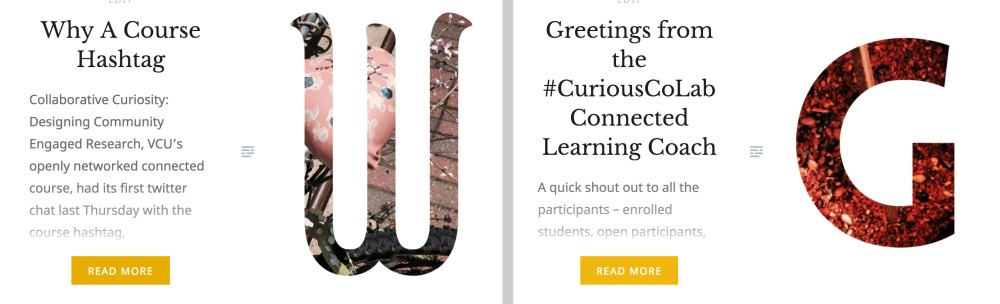
Additionally, check out an example of my own: As the connected learning coach for #CuriousCoLab, I created digital letters from my own photographs to use as featured images for all of my coaching-specific blog posts.

Two blog posts by the author, each with a featured image that includes a large letter filled with an image
From my blog posts. Note the pattern in the featured image.

Illustrations. Images, videos, and gifs can help illustrate the point of your post. John Stewart’s post, Open Note Databases and the Promise of the Memex, not only incorporates the relevant #openlearning17 video panel discussion but also offers readers several compelling visual examples from open note databases.

Outside the realm of #openlearning17 (but juxtaposed with it in my Twitter timeline), are the social media hashtag phenomena of #dresslikeawoman and #actuallivingscientist. Take a moment to reflect on how the addition of an image impacts the power of the message.

An actual living scientist tweet that includes a photograph of a smiling African American female scientist working in the field
A actual living scientist and dress like a woman tweet that includes a smiling female conservationist working in the field
A actuallivingscientist tweet that does not include a picture beyond the avatar

Extending. Finally, bloggers can integrate images, data visualizations, and videos into the posts so that they extend the narrative of the post beyond the text.  In the #openlearning17 hub, check out the way RaptnRent incorporated a song and music video into the post….Making the connection between the song and the week’s readings is the primary theme of the post.  Also check out Alan Levine’s post in which he moves seamlessly between text and illustrations – it’s hard to tell where one begins and the other leaves off.

Alternatively, check out my first post on why embedding visual images into blog posts makes an impact, in which I interviewed my eldest daughter who explained everything you need to know over a slice of pizza at the Virginia Museum of Fine Arts. This video basically served as an advanced organizer for the rest of my post.

What about the learning?

With all this talk about using visual elements to express oneself, it might be easy to forget the learning aspects of using embedded images and videos.  How does going to all of the extra work to embed non-text based elements into your post contribute to your learning?

Making connections across books, music, maps, photos, charts, and .gifs means making connections across disciplines, contexts, people, and time. Consider that adding visual components takes time: time that is mostly spent on considering what you are trying to say and how you might express it through other avenues.  Reflecting on what you are trying to say and considering it in other contexts is always a good thing for learning.

What about the technicalities?

If you need more specific details on how to embed, how to create your own images, or where to go to find CC-licensed or public domain offerings, check out my previous blog post on visuals.

As always, please remember to cite your image sources. Videos that are embedded from Vimeo or YouTube are self-citing…click on them and you automatically go to the original video publishing platform; photos and images are different.  You must give credit to the image creator and provide a url somewhere in the post. Caption, hyperlink, integrate it into the post text – just do something!  And consider this, I know that CC-0 and public domain images do not technically require citation, but you should consider doing it anyway for reasons of karma and transparency.

Additionally, please add alt text to your images so that it can be read by text readers.  A little description is fine, just enough to keep those who use text readers in the loop.  It’s a good practice.