Category Archives: Virginia Group

Virginia Faculty Collaborative Group

Dreams of Liberation (Notes)

For the Open Learning 17 blog post on week 4 I sat down to watch the abridged interview with Ted Nelson. I readied my coffee and shut my office door, as not to disturb the rest of the suite.

ted-nelson-image
Young Version (courtesy of hyperland.com)

And I honestly grabbed a paper and pen and took notes. I think Ted Nelson would frown on this method of learning, but my educational structure is ingrained in me. No, this is not how I run my own classes, and I rarely lecture (my students can learn from themselves and each other without me…Ted would like that). However, this is what I did. So, instead of taking the time to come up with something wonderfully creative, I’m going to share my notes:

The computer is a universal machine.

Most people don’t know how it works and those that do aren’t willing to share.

Teachers in classrooms: overworked, working for curricula, can’t buy packages (only use free).

NOTHING Magazine, published by Ted. Seems like an early Prezi presentation.

Oceanic Mind-Learning as much as you can.

Motivation within the system: Degree/Job or “be a learned person”.

Ted’s Philosophy:

Schematics: Structure

Normatics: Philosophy of ‘shoulds’

Gamics: Structure of situations and maneuvers, “enforcement”

Ideamics: Representation of tokens. We present our ideas and they can be manipulated. Ideam=token of though.

Thought: Wow, those seem like an argument for liberal arts education.


Trailmix anybody?

Trail Mixes in Vending Machine flickr photo by Pat Guiney shared under a Creative Commons (BY) license

OK, I’m pretty late with this. My day job – workshops to give, roundtables to facilitate, assignments to grade etc. etc. – is running my agenda these days. I am kinda following the readings and listen to all of your blogposts on my one-hour commute, read by … I think the computer voice’s

#Openlearning17 — Ted Nelson

Photo of Computer Lib, Dream Machine
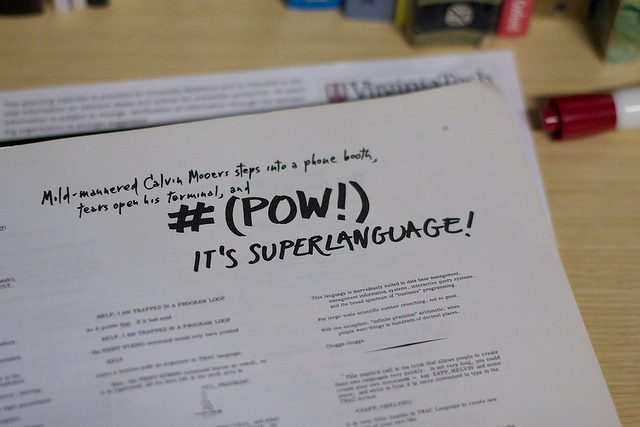
POW! It’s Super Language, Alan Levine 2011


Repost of For the Wholiness of the Human Spirit (2015)

Re-watching Ted Nelson’s eulogy for Doug Engelbart last week reminded me of one of the many (many) reasons Nelson’s thinking about computers and society resonates so powerfully with me. Mourning the loss of one of the most pivotal stars of the new media revolution by indicting his colleagues and making them laugh (nervously), invoking the tropes of classical funeral orations and quotes from Shaw and Shakespeare, and recounting the highlights and tragedies of Engelbart’s career, Nelson’s eulogy is a tour de force in terms of form (technique) and content.  He insists, as passionately as he had in 1974, that computers should support our dreams, indeed that technology is an expression of those dreams.  And dreams, of course, are as much about the emotions as they are about reason and calculation.

 Movies and books, music and even architecture have for all of us been part of important emotional moments. The same is going to happen with the new media. To work at a highly responsive computer display screen, for instance, can be deeply exciting, like flying an airplane through a canyon, or talking to somebody brilliant. This is as it should be…..

In the design of our future media and systems, we should not shrink from this emotional aspect as a legitimate part of our fantic (see p. 317) design. The substratum of technicalities and the mind-bending, gut-slamming effects they produce, are two sides of the same coin; and to understand the one is not necessarily to be alienated from the other.

Thus it is for the Wholiness of the human spirit, that we must design. (NMR, p. 307)

The democratizing, radically-reimagining agenda laid out in Computer Lib / Dream Machines is as relevant today as it was in 1974.  In the early seventies, computing was about inscrutable calculations, fiendishly massive quantification, and the expertise of, yep, experts.  Nelson summoned every woman to “understand computers,” to engage with them, and to create with them. He insisted (rightly) that we are creatures of culture and of interaction as much (perhaps even more so) as we are creatures of reason and calculation. And he wanted us to use computers to develop a “fantic space” (inspired by Eisenstein’s and Pudovkin’s concept of filmic space) to help us communicate emotionally as well as cognitively:

 RESPONSIVE COMPUTER DISPLAY SYSTEMS CAN, SHOULD AND WILL RESTRUCTURE AND LIGHT UP THE MENTAL LIFE OF MANKIND. (NMR, p. 317)

Forty years later, the landscape has changed, but the challenge remains.  We carry computers with us all day long, communicate with people downstairs and around the world in the blink of an eye, and can summon nearly all the world’s texts and many of its numbers to our screens with a few key strokes and a good internet connection. I do feel that my mental life has been illuminated and transformed by the innovations Nelson envisioned. But do we understand computers and the networked world in the way that Nelson thought we needed to? Has the Computer Priesthood” been ousted? Or just changed clothes?  And what about “Computer Aided Instruction” (CAI, as Nelson calls it)?  I look at computerized testing,  video taped lectures, the march of MOOCs, the “Learning Management System” industry, and the relentless pressure to scale, standardize, measure and homogenize an experience that should be so much more….and I think we still need to focus instead on using this technology to provide students (and ourselves) with a real education:

Instead of devising elaborate systems permitting the computer or its instructional contents to control the situation, why not permit the student to control the system, show him how to do so intelligently, and make it easy for him to find his way? Discard the sequences, items and conversation, and allow the student to move freely through materials which he may control. Never mind optimizing reinforcement or validating teaching sequence. Motivate the user and let him loose in a wonderful place” (NMR, p. 313).

I want to keep my beacon set on that wonderful place.

Ted Nelson: Artist, Philosopher, Filmmaker, New Media Pioneer

For Week Four, Open Learning ’17 features Dr. Ted Nelson, author of Computer Lib/Dream Machines. Click on the image below to watch excerpts from the interview I did with Ted in 2014.

Ted Nelson interview-click on image to play


Ted spoke with me as part of the Thought Vectors in Concept Space connectivist MOOC VCU ran in that summer long ago (feels that way, anyhow). That interview ran nearly two hours and is still up on YouTube. For Open Learning ’17, I’ve created this abridged version that runs a more manageable 30 minutes.

Ted’s call for learners to aspire to an “oceanic mind” that draws on multicontextual knowledge aligns well with the goals of liberal learning generally, as well as with the Essential Learning Outcomes of the AAC&U’s LEAP initiative and the Faculty Collaboratives project that Open Learning ’17 is proud to participate in. For best results, I encourage everyone to read the following bits from Computer Lib/Dream Machines as a rich context for understanding Ted’s ideas in the interview.

Counting pages in the downloadable pdf excerpt available at the New Media Reader site, including the introduction:

1-10, 17-19, 26 (explains “fantics”), 30 (“Thinkertoys”)

Throughout his life, Ted Nelson has been provocative, even irascible, but he also burns with the hard, gem-like flame Walter Pater aspired to. Enjoy the tempo presto of his words and ideas as they tumble forth. Remember that Heraclitus is his philosophical guide. Ted’s care for the arts of expression, juxtaposed with Doug Engelbart’s care for the arts of collaboration, continues to inspire readers, writers, and educators worldwide.


Connecting Spaces

This afternoon, the steering committee for #openlearning17, a AACU Faculty Collaboratives Experience, met to discuss what has gone well with the experience thus far and what we can do to improve.  Several of us mentioned how thought-provoking and mind-binding the Twitter discussions have been, but others have made a request: specifically, those who have been attending Twitter discussions regularly want a little time to get to know each other.

To that end, let’s carve out a little time.

One of the more interesting things about connecting with people in virtual spaces is the knowledge that they could be doing all sorts of physical things in all sorts of physical places while they are holding that conversation with you. While I take pride in the fact that my online personality is very much the same as my face-to-face personality (maybe a little more confident, but I’m working on that), I’ve hosted Twitter chats from airplanes, airports, the attic, a Lincoln Town Car, a hotel bar (while ducking to avoid a bar brawl), taxis, offices (mine and others), my car, on my phone, in my doctor’s office, at the Hair Cuttery, and on four different continents.

What I’ve come to appreciate over the years is that physical context matters to our online interactions, as much as anything that is going on in our head while we are chatting.  And knowing the physical environment of those with whom we chat helps us get to know them.  It makes them more real.  It makes us more comfortable. Therefore, I propose the following:

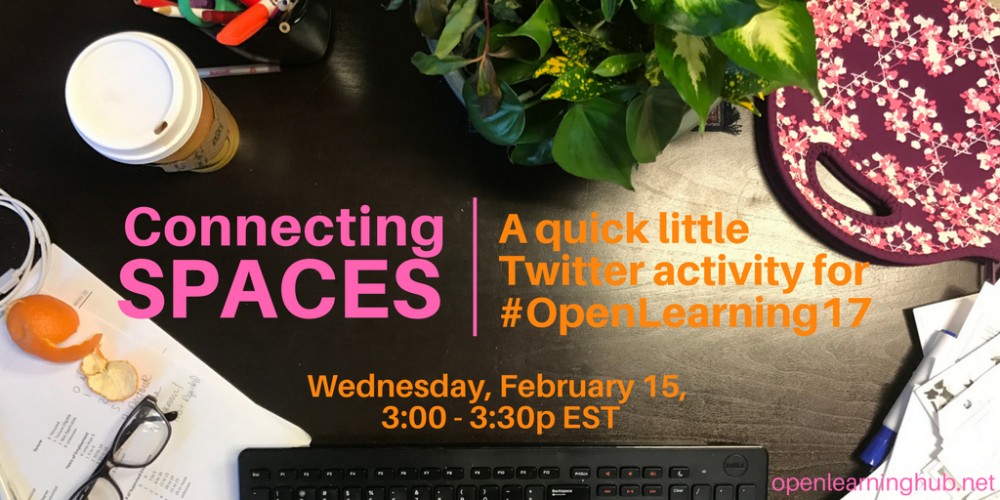
an invitation to connecting spaces: a quick little twitter activity for #openlearning17, wednesday February 15 from 3:00 to 3:30 pm eastern standard time. The invitation is placed on the background of an office desk, with glasses, an orange peel, some papers, a coffee cup and a plant.

That’s my office desk, by the way.  I bring my lunch because I prefer simple lunches and don’t like to waste valuable time going out.  I buy a large cup of coffee (a splash of milk) as a personal incentive to leave the seat warmer in my car every morning. I love seat warmers. I have to take off my glasses when I read because I’m months away from needing bifocals, and I’m trying to keep a dish garden alive, because one would think that an adult old enough to consider bifocals might be able to maintain a plant.  Also, I am building a database and working hard to develop coding schema that make sense and are entirely sustainable (all those papers).  I’ve been on the job for a month.  It’s not like I’m applying any pressure on myself at all.

On Wednesday, February 15, 2017 at 3:00pm EST, I will be hosting a quick little Twitter activity called Connecting Spaces.  Come. Chat however feels comfortable, but it might be interesting if we share a little about our physical spaces.  Where are you?  Why are you there?  Why or why not do you like to engage in Twitter chats in this space?

Taking a picture of your space, or better yet, a quick video would be a great way to introduce yourself.

Regardless, I hope to see you there.


Accelerating Augmentation

For what one might call “Engelbart Week” at Open Learning ’17, I abridged Engelbart’s epic, and epochal, “Augmenting Human Intellect: A Conceptual Framework.” My thought was to make the reading more manageable, and to bring together resonant passages in a way that revealed some of the more subtle and nuanced textures of the 1962 framework. As often happens, my efforts to help present the material helped me attend to it more thoroughly as well. That, and a Twitter chat in which for the first time, courtesy of the mighty Mo Pelzel, I saw the lovely “whing-ding” part. (Thanks, Mo!)

I always have a lot to say about “Augmenting Human Intellect: A Conceptual Framework.” I’ve blogged about it many times. I’ve mulled it over since 2004, when I first learned of it, and first encountered the name of Doug Engelbart. Rather than rehearse every bit of that, however, I want to share just a few thoughts. I hope they’re relevant to the larger goals of Open Learning ’17 and the Faculty Collaboratives initiative from which our cMOOC springs.

First: It’s interesting that Engelbart is not asking us to consider augmenting human intellect. Instead, he’s asking us to think about the way we as a species have always sought to augment our intellects–with language, with math, with engineering, with symbols generally–and consider his conceptual framework as a research opportunity for studying how we might accelerate the augmentation of our intellects. In this way he’s very aligned with Vannevar Bush. Rather than focusing on the means of augmentation–associative trails. shareable archives, and multiple modalities, etc.–Engelbart focuses on the nature of augmentation itself, what he calls Humans using Language, Artifacts, and Methodologies in which they are Trained (H-LAM/T). He also recognizes that language, artifacts, methodologies, and training will change the humans, who in turn will find ways to change language, artifacts, methodologies, and the process of training itself.

I’m not a big fan of the word “training,” but I take Engelbart’s point. There is an interesting process at work in this suite of human-tool interactions. Engelbart refers to that process as co-evolution. The research project he proposes is to study whether, and in what ways, that co-evolution might be accelerated. Without that research, he argues, we risk being at the mercy of our own ingenuity, forever inventing problems faster than we can solve them. Augmenting human intellect is what our intellects strive to do. The question is whether we will do that intellectual augmentation well, to good purposes, and create solutions faster than we create problems.

Second: purposeful, beneficial co-evolution will require much improved LAM/T affordances for communication and collaboration. Vannevar Bush’s magic desk, the Memex, becomes a visual display, backed up by computers available to individual knowledge workers, that permits and encourages complex symbol exchange as well as flexible storage, retrieval, and sharing capabilities.

Third, and this is something that became newly vivid for me this time, a system that permits and encourages complex symbol exchange as well as flexible storage, retrieval, and sharing capabilities will almost inevitably lead to newly complex symbols and symbol manipulation processes. Mo has blogged very insightfully about this facet of Engelbart’s imagination. What I’d add is two more points. One, that these co-evolutionary processes need to be considered within Engelbart’s conceptual framework in an ongoing manner–as John Seely Brown puts it, the interactions of increasingly complex systems become hyperexponential. (“No top to the ‘S-curve’.”) The other is that even as modes of comprehension increase for some, modes of incomprehension increase for others. The person who sits with “Joe” as Joe demonstrates his new symbol-manipulating capacities reacts in ways that many of us may recognize, either in ourselves or, when we have some inkling of Engelbart’s vision, in those who watch us do the work in open learning that we believe will accelerate the augmentation of human intellect in formal schooling:

[Joe] suggests that you sit and watch him for a while as he pursues some typical work, after which he will do some explaining. You are not particularly flattered by this, since you know that he is just going to be exercising new language and methodology developments on his new artifacts–and after all, the artifacts don’t look a bit different from what you expected–so why should he keep you sitting there as if you were a complete stranger to this stuff? It will just be a matter of “having the computer do some of his symbol-manipulating processes for him so that he can use more powerful concepts and concept-manipulation techniques,” as you have so often been told….3b3b

Lacking some essential humility, Joe’s colleague decides Joe is “just” going to do a little something more with regard to work and contexts Joe’s colleague is already quite familiar with. That word “just” comes up twice. It signals the way in which learning can be exceptionally difficult for many highly trained knowledge workers–not as a result of learning, necessarily, but as a result of the culture within which that learning has occurred. Namely, school.

Then you realized that you couldn’t make any sense at all out of the specific things he was doing, nor of the major part of what you saw on the displays. You could recognize many words, but there were a good number that were obviously special abbreviations of some sort. During the times when a given image or portion of an image remained unchanged long enough for you to study it a bit, you rarely saw anything that looked like a sentence as you were used to seeing one. You were beginning to gather that there were other symbols mixed with the words that might be part of a sentence, and that the different parts of what made a full-thought statement (your feeling about what a sentence is) were not just laid out end to end as you expected. But Joe suddenly cleared the displays and turned to you with a grin that signalled the end of the passive observation period, and also that somehow told you that he knew very well that you now knew that you had needed such a period to shake out some of your limited images and to really realize that a “capability hierarchy” was a rich and vital thing.3b3f

Given the exuberance and even the playfulness with which Engelbart shares his vision, I am confident Joe’s grin was friendly, even empathetic. But it probably didn’t feel that way to Joe’s colleague, whose sense of self-worth was bound up in a strong sense of self-sufficiency that doubtless made it even harder to follow Joe than it might otherwise have been.

“I guess you noticed that I was using unfamiliar notions, symbols, and processes to go about doing things that were even more unfamiliar to you?” You made a non-committal nod–you saw no reason to admit to him that you hadn’t even been able to tell which of the things he had been doing were to cooperate with which other things–and he continued. “To give you a feel for what goes on, I’m going to start discussing and demonstrating some of the very basic operations and notions I’ve been using. You’ve read the stuff about process and process-capability hierarchies, I’m sure. I know from past experience in explaining radical augmentation systems to people that the new and powerful higher-level capabilities that they are interested in–because basically those are what we are all anxious to improve–can’t really be explained to them without first giving them some understanding of the new and powerful capabilities upon which they are built.

This is a crucial moment in Joe’s explanation, underscoring Engelbart’s fundamental insistence on establishing a robust conceptual framework available for considering every single part of the “capability hierarchies.” As Joe will go on to argue, it’s no good tinkering with improvements at a higher level if one cannot understand and conceptualize every other level as well. (Which of course can make it difficult to distinguish “higher” and “lower” levels–as it should, confusing as that may seem.)

This holds true right on down the line to the type of low-level capability that is new and different to them all right, but that they just wouldn’t ordinarily see as being ‘powerful.’ And yet our systems wouldn’t be anywhere near as powerful without them, and a person’s comprehension of the system would be rather shallow if he didn’t have some understanding of these basic capabilities and of the hierarchical structure built up from them to provide the highest-level capabilities.”

I take it that Joe’s point, and Engelbart’s, is that we should be humble enough to recognize that a reconceptualization of much that we take for granted as a “low-level capability” will probably be necessary before we can have the depth of comprehension we need to pursue co-evolution and collective IQ (of all types!) in beneficial ways.

It takes humility, and hospitality, to spend time with new ideas, to try them on our pulses, to go deep and go long with concepts that ask us to re-examine many things we take for granted. There’s work to be done. No one has time for this kind of engagement. And what’s the incentive?

For Engelbart, the incentive was the chance to work toward the betterment of humankind by thinking about human ingenuity in a new framework, and with a new mind-like technology, the digital computer, that could accelerate both a) the research that discovered new knowledge and b) improvements in the knowledge-working environment that could c) devise ways to implement that knowledge and keep the process going in a beneficial direction.

It’s always seemed to me that this incentive is the very mission of education, particularly of higher education. Yet as many Open Learning ’17 participants pointed out in our Twitter chat last Friday, intellectual humility and hospitality can be hard to come by.

Engelbart said he never got over being naive. I take him at his word. But I also see that even in 1962, he knew all too well the cultural, intellectual, and professional barriers he would be likely to face. Certainly post-1962, Engelbart experienced several setbacks that would have stopped a lesser person. Yet in 2006, over forty years after he wrote “Augmenting Human Intellect: A Conceptual Framework,” he was humble and hospitable enough to telephone an English professor at a small public liberal arts college in Virginia, just to return his call, and to talk, if only for a little while, about the long-distance thinking Doug Engelbart never abandoned.

Nelson: starting with the cover(s)

[Note: I’d love to include an image of the covers of Computer Lib/Dream Machines here, since they’re fascinating, and yes, images can aid understanding, especially when they represent the phenomenon under analysis.  But Nelson asserted copyright in his work, and that copyright still applies. I could probably use Wikipedia’s rationale for reproducing a low-resolution image.  But instead I’ll link to DigiBarn, which has some nice images of both the covers and some inside pages, scanned and posted with permission from Nelson. A google image search will turn up some additional (apparently unauthorized) images, including ones which show how the two covers connect, especially the intrusion of the superhero figure’s foot from the cover of Dream Machines onto the cover of Computer Lib]

In an attempt to feel a bit more caught up with the ongoing conversations in Open Learning 17, I decided to look ahead to the reading for week four (I like to think about things for a while before I write about them).  It looks like we’ll be reading excerpts (tba) of Theodor H. Nelson’s Computer Lib/Dream Machines, so I skimmed through the full(er?) version currently linked from the syllabus, trying to get a sense of the book(s) as a whole.  I found myself thinking about the information on the covers, including titles, subtitles, and illustrations.

The result, below, is some combination of a rhetorical analysis (courtesy of my current professional identity as a writing teacher), a gender analysis with particular attention to historical/cultural context and the book as an object (concerns common to my original fields of research/study), and the musings of someone who was just beginning to be culturally aware in 1974 (I was ten when the first edition of Computer Lib/Dream Machines came out).  There is also something of a trail, as I attempted to answer a research question using the affordances of the internet, a tool which, as we’ve noted, in many ways resembles the systems of knowledge-recording and building imagined by Bush, Engelbart, and Nelson himself.  So here’s the question, which came to me almost immediately on seeing the title, and the date of publication:

Why did Nelson choose Computer Lib as one of his titles? More specifically, what were the resonances of “lib” for him and his (possible/projected/ideal) reader(s)? 

My own immediate association, based on my somewhat-hazy memories of a 1974 spent living in the Northern Virginia suburbs, is with “women’s lib.”  Based on those associations, and on the androcentric perspective some of us have noted in our historical readings so far (Bush and Engelbart),  I was surprised.  Have we arrived at a reading which will display some awareness of, perhaps even sympathy for, contemporary gender struggles?  Or perhaps, thanks to age and/or location, I’m missing some other contemporary uses of “lib.”  How to answer this question?

I decided to look for other book titles from the early 1970s with “lib” in the title. This, as any librarian could have predicted, turned out to be a difficult search, since “lib” plays multiple roles, especially in databases of books: a part of many common words, an abbreviation for “book” or perhaps “volume,” and a part of the phrase “ad lib.” (which shows up in the titles of a good many music scores, among other things).  My attempts to search google books didn’t come out very well; I either came up with far too many results or far too few, with the “too few” identified as such in part by the fact that they didn’t include Nelson’s book.

WorldCat seemed to work better. Though I’m still not entirely confident of my results, it seems that most other books with the word “lib” in the title published in 1974 and indexed in WorldCat (eleven in all, that I could find) referred (positively or negatively) to the women’s liberation movement.  The two exceptions were closely related; there was one reference to “kids’ lib” and one to “gay lib” (a bit more skimming of results suggests that “gay” was the second-most-common word combined with “lib” in book titles in the early 1970s; looking back through 1970, I also found “city lib,” men’s lib,” and, most intriguingly, “mule lib,” which I didn’t explore further, lest the research trail become a rabbit trail; I do have student work to respond to today, which might explain some of my enthusiasm for this research digression).

So it seems that my memory/impression is correct: in 1974, “lib” was most often combined, in popular parlance, with “women’s.”  So why did Nelson choose to include it in one of his titles?  At least from my initial inspection, his work doesn’t seem to have an explicit gender focus, and one might even imagine that his primary imagined readers were men.    Were the cultural resonances of “lib” for him and/or his projected readers positive or attractive?  In my memory, “women’s lib” was more often than not a term of derision or dismissal, but, once again, cultural positions vary, and my memories stem from a particular time, place, and status.  Some authors who chose to include “women’s lib” in their titles clearly felt positively about the movement themselves, though some seem to have anticipated some resistance from some of their readers. Was Nelson simply looking for a shorthand term for “liberation,” and seized on one that was current in the culture, without considering its other associations?

I’m not sure of the answer, but I’ll be mulling this bit of cultural context, and its possible relevance (or not) as I take a closer look at what’s inside the book.

Similarly, I’ll be wondering about the fist: black power symbol?  anarchist symbol? general symbol of protest?

And the subtitle of Dream Machines.  The most likely referent for “minority report” seems to be a 1956 Philip K. Dick story (later made into a 2002 movie of the same name), but a quick google search on “minority report” plus each of the years between 1970 and 1974 revealed another reminder of the women’s liberation struggle: in 1972, a minority report played a role in the fight to seat more female delegates at the Democratic National Convention.

I should probably be wondering more about the superhero (Superman?) figure. For some reason, that’s the element that least engaged my attention, but it, too, certainly plays a role in constructing the immediate message of the book-as-artifact.  It seems possibly a bit at odds with the fist on the other cover (wasn’t Superman pretty establishment?), but maybe not?

Finally, I find myself wondering about the subtitle of Computer Lib, and what messages it sends to a possible/projected audience.  “You can and must understand computers NOW” is both encouraging/empowering (“can”) and prescriptivist (“must,” combined with the typographically shouted “NOW”). Some might find it inspiring, others offputting. Personally, I’m leery of gurus who not only assert that I must free myself, but also are eager to tell me exactly how to do it.  It’s a stance that seems both self-absorbed and lacking in self-awareness, and that does not inspire me with confidence that a self-appointed potential mentor has my best interests at heart, or is even much interested in me at all except as an object on which to project his own interpretations and ambitions.  In short, I don’t usually buy or read books with statements like that on the cover (except, perhaps, if I’m interested in them as historical artifacts).

A similar tension can haunt our attempts to be leaders in implementing open learning in formal teaching and learning contexts, especially for those of us who teach exclusively required classes.  Do students want their classes to be open, by whatever definition of open? If not, do we feel comfortable asserting that we know better than they do what’s best for them?  Perhaps we do, but we need to be aware that that’s what we’re doing, and of the potential contradictions involved in doing so.  Teachers have very real power in the classroom, and we can’t  give it up entirely, though many of us can to some extent choose how we use it to shape the teaching and learning contexts for which we’re responsible.

Based on Computer Lib‘s somewhat contradictory subtitle, I find myself wondering, again: to what sort of readers did Nelson think this message would appeal?  Or, alternatively, wasn’t he thinking that much about appealing to a potential audience?  This volume, at least in its external trappings, looks a bit like a manifesto, and manifestos, for all their explicit desire to persuade, are often devoted as much to expression — giving the author(s) a chance to work out ideas in writing, and to place them where others can see them — as on the sort of persuasive communication that tries to meet a reader where (s)he currently is.

The book (or at least some of Nelson’s key ideas — a somewhat separate thing) has clearly had lasting impact, or we wouldn’t be reading it.  So at some level, whatever its quirks and apparent contradictions, it succeeded.  At the same time, as we consider the idea of open education, and how and whether we promote it, and to whom, it may also be worth looking at Nelson’s covers as an example of an attempt to play the role of leader/mentor/teacher, and to ask ourselves which parts of his approach we might choose to emulate (or not), and why.

In Medias Res

I’ve been meaning to start a blog – a blog with this title, in fact – for several years now, but haven’t done it. Part of my hesitation stems from an awareness that a blog is a public space, part of my public online presence/persona.  That awareness both evokes a healthy (I think) caution, and brings out a bit of lingering perfectionism (an impulse that still rears its head at times, despite being mostly vanquished by fifty-plus years of life, including several decades of teaching a 4/4 writing-intensive load; continuing, however slowly, my own research and writing; and doing my best to keep up with an ever-evolving list of other interests and responsibilities).

I’ve also gotten caught up in weighing many of the usual questions faced by aspiring academic bloggers: whether some degree of anonymity/pseudonymity would be wise given my lack of tenure (and lack of eligibility for same); how to balance that caution with the desire to have a public voice; how much of the rest of my life, identity, and interests to include.

In the end (or at least for the moment), as my “about” page indicates, I’ve decided on including all the identities/perspectives (or at least all the ones that currently come to mind), and trusting to academic freedom for any protection I may need (perhaps an odd decision at what feels like a particularly perilous moment, but there’s also something to be said for living out the values in which one believes, and the peril – either from increased government intolerance of dissent or from the ongoing influence of forces driving the growth of academic precarity — does not, at least at the moment, feel personal).  I will also do my best to exercise some discretion in what I write about and how, balancing that with an impulse that goes back at least as far as the perfectionism – to describe things as I see them, even if that makes others, or me, uncomfortable.

The immediate precipitating cause for my finally starting the blog is a desire to participate in Open Learning 17, a cMOOC sponsored by Virginia’s Faculty Collaboratives Steering Committee (itself a part of a larger American Association of Colleges & Universities initiative).  Behind that, there’s desire to write about the English 302 Open Educational Resources (OER) project in which I’m involved (of which I will write more anon; for the moment, there’s a brief description on the “about” page).  Since I’m late getting started on the blogging portion of Open Ed 17, my blog posts are probably going to lag a week or more behind the reading schedule, or I may skip around a bit in the interests of participating as fully as possible in the conversation.

In the longer term, I expect this will also be a space to write about a variety of topics, including teaching and learning more generally;  using digital humanities techniques in the classroom (physical or virtual);  contingency in academia; and my ongoing research, mostly into abolitionist authors Emily Clemens Pearson and Harriet Jacobs, and my attempts to convey the results of that research via both traditional publication and digital humanities methods.

Beyond that, we’ll see: Biblical exegesis and/or theological reflection?  Political reflection ?(!?).  Pictures of flowers (or flooding) from my community garden plot?  Reflection on just why I find towpaths so alluring (but don’t visit the one a mile from my apartment nearly as often as I intend)? At the moment, all possibilities are open.

Writing an Open Text: Getting Started (Step One)

In a previous post, I tried to convince you to write an open text. Supposing you agree, here is my number one piece of advice to help you get started: Start writing.

Pick a topic/section/chapter that you’ll eventually want to cover – pick a favorite! – and start writing that portion of the text. I wrote two sections of a math book. An “equivalent amount”, depending on your discipline, should be enough to serve your purposes. And what, pray tell, are these purposes?

First off, they serve as play. You want to write, so do it! Don’t impose too much structure on yourself. Just have fun producing something. In the end, you’ll change much of what you just wrote. But you’ll develop skills you’ll need later (just like your play as a kid did). 

Secondly, this play will point out things you’ll need to develop in the future in a way that is more meaningful than anything I could write/advise. I wrote a math book and thought I knew how to make good graphs of functions. Then I made two. And realized how different they looked. And how horrible it would be if each graph in the text had its own look. My play introduced my need for graphical standards. (I could tell you to “develop graphical standards”, such as font sizes and color schemes. But your playtime will make clear what things need to be standardized.)

Finally, undertaking a big project is hard. By writing something – anything – you will have started. Keeping that momentum going is easier that starting it. If the first few weeks are spent trying to plan, after a few weeks you’ll likely be discouraged for you’ll have little to show for your work. Write something. Tell people you have a section already completed. Then step back and do the necessary planning. The next posts will cover some of those planning needs.