The way Reddit works is really quite conducive to open pedagogy. I think, if I’m understanding the meaning of this saying properly, it is one of those things that is ‘of’ the Internet and not just ‘on’ it. The structure wasn’t designed specifically for educational purposes, but it sure does a better job of it than most things designed with ed-tech in mind.
Here’s how it works, put simply:
Subreddits:
are subdomains with their own topic/category/culture/set of rules. r/hockey is a place to talk hockey. r/Toronto is a place to talk about Toronto (helpful if you live there!). r/Askscience is a place to ask science questions that you hope somebody who knows more than you to answer. r/shittyaskscience is the same thing only with deliberately shitty answers, just for fun. There is a whole suite of ‘shitty’ subreddits, which is hilarious. Subreddits can be whatever the community wants and you can create your own.
Posts:
You can post a link, image or just some text to a subreddit. See something cute and educational anywhere else on the Web? Go post it to r/awwducational
Comments:
Each post basically gets its own discussion board by default. Know some more info about that cute thing on r/awwducational? Add your knowledge and link to more in-depth info. Or just ask for more detail if you don’t know.
Voting:
Each post, and each comment, can be upvoted or downvoted. The stuff with the higher +/- in votes is higher up, with the idea being upvoted stuff is the best stuff. It doesn’t always work that way as hive-minds can get carried away, but it often lets you find the quality stuff more quickly. You can also sort by new comments or controversial etc.
And all those things together gives us what?
What we end up with is a place where we can create our own community, easily contribute ideas and things, discuss, and vote on (to give more/less visibility). If the Open Education community were to post the awesome things that they find or do on Reddit (say, anything that someone would Tweet out) what we would have is a stream with a little more permanence than your Twitter feed. If Twitter were a rushing creek or waterfall, Reddit could be a slowly plodding brook or river full of life meandering through it.
The most interesting Subreddits seem to grow organically. Here are some neat communities:
Patches the cat almost did me in. We’ve been conceptualizing our Open Faculty Development Textbook for a few months now and were searching for a foundational idea to build the project around.
The other day, on a not-directly-related search, I was trying to find an image for a badge or patch for faculty to wear once they’d agreed to contribute to the text, so I CC Flickr searched for ‘patch’. I was inundated with images of Patches the Cat, sometimes with his owner, sometimes not. I’m glad you love your cat, buddy, but it wasn’t helping me.
I thought it was funny to see so many pictures of Patches, but was disheartened that I wasn’t finding what I was really looking for. And in the back of my mind that this project didn’t have a hook yet. I don’t remember exactly the mental steps it took to go from Patches the Cat, to The Faculty Patchbook, but it happened, and here we are with our hook.
Patchwork. A community quilt. This is what we’re trying to make. A community built collection of ‘chapters’ or whatever you want to call it. Each individual telling the story of one pedagogical skill in order to build an entire quilt. Tales about pedagogy for teaching in-class, online, designing/redesigning lessons and courses. Whatever the community quilt needs to cover our teaching and learning needs.
It seems serendipitous that in further searches for ‘quilts’ and ‘patchwork’, I came across a very fitting image by the cogdog himself, whom I take a great deal of open learning inspiration from. This image is now the feature image on the About this Project page for The Patchbook. The link is coming, don’t worry! Farm Quilt flickr photo by cogdogblog shared under a Creative Commons (BY) license
Check out the quilt in progress here. There you’ll see a description of what we want to do and how you can get involved, too. Fleming College’s main campus is in Peterborough, Ontario, (also known as The Patch!) and we are dispatching The Patchbook out to you and with you.
Maybe it should be dedicated to Patches the Cat.
Feature photo: “Patches” flickr photo by Steam Pipe Trunk Distribution Venue https://flickr.com/photos/waffleboy/8918477914 shared under a Creative Commons (BY) license
Re-watching Ted Nelson’s eulogy for Doug Engelbart last week reminded me of one of the many (many) reasons Nelson’s thinking about computers and society resonates so powerfully with me. Mourning the loss of one of the most pivotal stars of the new media revolution by indicting his colleagues and making them laugh (nervously), invoking the tropes of classical funeral orations and quotes from Shaw and Shakespeare, and recounting the highlights and tragedies of Engelbart’s career, Nelson’s eulogy is a tour de force in terms of form (technique) and content. He insists, as passionately as he had in 1974, that computers should support our dreams, indeed that technology is an expression of those dreams. And dreams, of course, are as much about the emotions as they are about reason and calculation.
Movies and books, music and even architecture have for all of us been part of important emotional moments. The same is going to happen with the new media. To work at a highly responsive computer display screen, for instance, can be deeply exciting, like flying an airplane through a canyon, or talking to somebody brilliant. This is as it should be…..
In the design of our future media and systems, we should not shrink from this emotional aspect as a legitimate part of our fantic (see p. 317) design. The substratum of technicalities and the mind-bending, gut-slamming effects they produce, are two sides of the same coin; and to understand the one is not necessarily to be alienated from the other.
Thus it is for the Wholiness of the human spirit, that we must design. (NMR, p. 307)
The democratizing, radically-reimagining agenda laid out in Computer Lib / Dream Machines is as relevant today as it was in 1974. In the early seventies, computing was about inscrutable calculations, fiendishly massive quantification, and the expertise of, yep, experts. Nelson summoned every woman to “understand computers,” to engage with them, and to create with them. He insisted (rightly) that we are creatures of culture and of interaction as much (perhaps even more so) as we are creatures of reason and calculation. And he wanted us to use computers to develop a “fantic space” (inspired by Eisenstein’s and Pudovkin’s concept of filmic space) to help us communicate emotionally as well as cognitively:
RESPONSIVE COMPUTER DISPLAY SYSTEMS CAN, SHOULD AND WILL RESTRUCTURE AND LIGHT UP THE MENTAL LIFE OF MANKIND. (NMR, p. 317)
Forty years later, the landscape has changed, but the challenge remains. We carry computers with us all day long, communicate with people downstairs and around the world in the blink of an eye, and can summon nearly all the world’s texts and many of its numbers to our screens with a few key strokes and a good internet connection. I do feel that my mental life has been illuminated and transformed by the innovations Nelson envisioned. But do we understand computers and the networked world in the way that Nelson thought we needed to? Has the Computer Priesthood” been ousted? Or just changed clothes? And what about “Computer Aided Instruction” (CAI, as Nelson calls it)? I look at computerized testing, video taped lectures, the march of MOOCs, the “Learning Management System” industry, and the relentless pressure to scale, standardize, measure and homogenize an experience that should be so much more….and I think we still need to focus instead on using this technology to provide students (and ourselves) with a real education:
Instead of devising elaborate systems permitting the computer or its instructional contents to control the situation, why not permit the student to control the system, show him how to do so intelligently, and make it easy for him to find his way? Discard the sequences, items and conversation, and allow the student to move freely through materials which he may control. Never mind optimizing reinforcement or validating teaching sequence. Motivate the user and let him loose in a wonderful place” (NMR, p. 313).
I want to keep my beacon set on that wonderful place.
In the hope that anything worth posting once can be re-posted again (different audiences?), I’m offering this reflection / question I wrote for Gardner’s New Media Seminar a couple years ago . Thoughts, anyone?
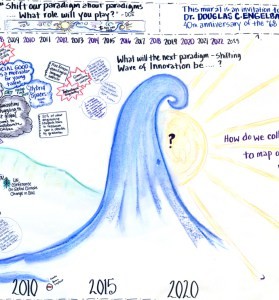
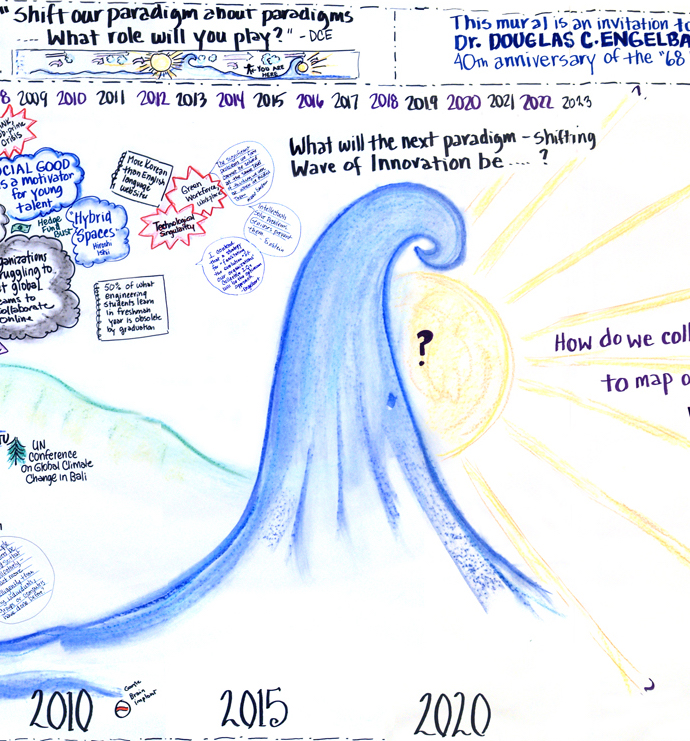
I’ve posted before about how central Doug Engelbart is to the Awakening of the Digital Imagination. This time I’m going to let an image — or more precisely, a mural — do the talking. Created by Eileen Clegg and Valerie Landau for the fortieth anniversary of the Mother of All Demos, this graphic representation of the interaction between cultural change, technological innovation, and what Engelbart called “collective intelligence” suggests how we have co-evolved with our technology since the early twentieth century. At the end of the mural, a blue wave asks us to think about “the next paradigm-shifting wave of innovation”….which seems to be happening in 2015. I mean, RIGHT NOW.
So I ask you, looking at the elements of the mural and the interactions and shifts it depicts — can we imagine and work for a future using technology and our collective intelligence to deal with the world’s “increasingly complex problems” in ethically responsible and constructive ways? Put another way, can we afford not to do this?
This week – last week, really (I am running a bit behind) – as part of #openlearning17 we were asked to read As We May Think, an article written in The Atlantic by Vannevar Bush in 1945.I was struck by how abrasive the use of “man” to refer to people in general and scientists more […]
This week – last week, really (I am running a bit behind) – as part of #openlearning17 we were asked to read As We May Think, an article written in The Atlantic by Vannevar Bush in 1945. I was struck by how abrasive the use of “man” to refer to people in general and scientists more […]
Our jumping off point was Vannevar Bush’s “As We May Think,” published in the Atlantic in 1945 as the imperative to leverage the technological innovations of wartime to more peaceful purposes seemed especially compelling. Bush’s vision of the memex – a computerized combination of note cards, annotations and information sources that could extend the reach (capacity) of any one learner by integrating that individual’s knowledge with the sources that informed it in a durable medium that could then be used and developed by others — underpins web annotation projects such as Hypothes.is. It also supports networked learning frameworks that facilitate collaborative learning, knowledge production and reflection.
As a historian, I’ve been intrigued by Hypothes.is since it first came to my attention last year. Historians are trained to think about how knowledge is produced and organized as an essential element of the research process: What was the author of this essay, article, book trying to say? Why was this archive created? Why are the records organized the way they are? Why did they keep what they kept? What are the assumptions behind the Dewey decimal or LOC cataloguing systems? In what context was this book, manuscript, court record, ship’s manifest created?)
Once you have a handle on those questions you need to figure out how to find where the resources you want to consult are and how to get to them. There is a dialogic process to this that involves reading, searching, thinking, taking notes, making lists, thinking, reading more, going back to your bibliography, supplementing it with new things you find, reading those things, taking more notes, thinking, going back to the older notes, etc…..I realize as I’m typing that this I might be describing a pretty generic research practice for many fields….
Anyway, at some point in there, I think two conceptual maps of a project emerge that overlay each other. The first is defined by types of sources — not so much a list, like a bibliography — but more like a grid of different kinds of evidence with points of overlap as well as nodes of distinction and empty spaces that still need to be filled in. The empty spaces let you know what you need to keep looking for and what silences your work might have to address. The points of overlap provide nuance, depth and corroboration, and the points of distinction raise new questions, redirect the inquiry or foreground a significant problem that might not have been evident when considering one source in isolation.
The second structure comprises the notes and annotations that are attached to those sources but also connected to each other (in your head or on a piece of paper or in your word processor) by the interpretation you are developing about the evidence. I see Hypothes.is as a medium through which those annotations can be assembled AND shared, which is just mind-blowingly wonderful. (Hypothes.is annotations for “As We May Think” are here.) While the analog or un-networked digital version of note taking certainly allows for all kinds of remixing and re-purposing, with Hypothes.is the annotations can themselves become nodes on or elements of a new kind of crowd / collaborative / collective “source” – a distributed conversation about a particular web page. We’re used to thinking about different kinds of sources: primary, secondary, web-based, archival, print, biographical, testimonial, etc.. Maybe a set of Hypothes.is annotations on a particular article would be a Web 3.0 source? A networked source? A memex-cubed source?
Two points in the wide-ranging Twitter chat especially resonated with me. We had been talking about how Hypothes.is helped realize Bush’s vision of “associative trails” and I asked if Jon and Jeremy saw those trails as supplements to or replacements for conventional taxonomies. Jon thought they were complementary, and Jeremy cautioned that the annotations alone might not constitute “trails” — they needed to be connected or flagged somehow, perhaps by a tag. (I like the metaphor of trail blazes.)
So, annotations become associative trails when they are marked out by tags or blazes — or any durable and accessible symbolic representation of the cognitive framework that helps you knit meaning into the tapestry (or navigate the cacophony?) of information about the world. And those trails serve as jet-packed complement to the conventional taxonomies for organizing knowledge. YES!!!!!
But how to get to the trails you really want or need? I’m imagining a future when a good chunk of the web has been trailed by Hypothes.is. And I’m imagining that all trails will not be created equal. I won’t be able to read it all, and I don’t want to fall down a rabbit hole without some warning, so how am I going to know where the good stuff is? How will the high value trails get filtered forward?
And here came the second nugget moment: Jon Udell responded to a query about this by saying “Help me grok it and I’ll help you make it real.”
Oh wow.
I’m pretty sure I haven’t groked* it myself. But here goes:
As teachers we spend a lot of time helping students learn how to find, sort through and evaluate resources. (Crane Librarian has spoken to the challenges of doing that in the library.) And as researchers our own successes (and failures) in finding the sources and communities we need depend largely on a somewhat ineffable combination of content expertise / experience, and skill — the “scaffolding” we’re always talking about providing and developing for learners. In this sense, I do feel like I have groked the research process. But the prospect of having something so powerful and potentially overwhelming as a Hypothes.ized web makes me think I’ll need to develop another kind of sensibility and that the trails and webs marked out by Hypothes.is will need some kind of context sensitive markers to help direct individual users where they want to go. At the most basic level this would be a system whereby spam and trolls (they are, I fear inevitable) could be marginalized. But even more valuable would be a marker that would flag certain kinds of annotations — and the connections between them — and also allow for the dynamic process of ongoing annotation. What would that look like? I don’t know yet. But it would be cool. And I think it’s worth thinking about. I know I’m hoping for something that would make the web more akin to Doug Dorst’s and J. J. Abram’s book S. and would not like to see a set of user-conditioned algorithms turn Hypothes.is into a colonial outpost of my Facebook feed. It also seems that the conceptualization behind sites like Jon Stewart’s Open Note Database project could be really helpful. I’m just not sure how.
So there you go. Not at all groked, I’m afraid. But maybe glimpsed as a desirable future? Thanks for encouraging me to think about this. I will continue to do so.
*my working understanding of “grok” falls closer to the flower child sense of mastery that is so intuitive it feels innate than the techie understanding of internalizing a concept so completely it feels like second nature. But grok is also the only Martian word I know, so that might be an issue.
Wondering whether an associative thinking exercise could weave together reflections from bloggers and glimpse connections to and renewal of general and liberal education. Answer is yes.
Information literacy as hopeful vision of creativity and flow as students develop self-awareness of their own associative trails and perspective on those of others–in other words as they perceive themselves in context of other learners and dare to try collective learning beyond the print book. As they learn in these new ways, they find it easier to cross disciplinary boundaries and go after the kinds of wicked problems so many of us hope they’ll address. They could revitalize the humanities through collective historical and interpretive work across disciplines and fields.
Below are the passages I used in the exercise. It was way fun!
Autumm Caines writes “for me it is a call for better general and liberal education. I think the first step may just be in realizing (and getting students to realize) that my internet is different from your internet. Where possible, taking ownership for our own ‘associative trails’ and demanding that ownership when it is kept from us. Finally, simply realizing that there are political forces and companies with lots of your data… which has always been the case but maybe realizing that they are trying to influence you in increasingly intimate ways” http://autumm.edtech.fm/2017/02/04/digcizfakenewsmicrotargeting/
raptnrent.me writes: “If we work to understand the hows and whys of information creation and flow, what I would call information literacy, then presumably we will be better able to review our shady present. That would elevate my spirit. Until then, there’s always Aretha” “One for the Hippie Hub.”
Morris Pelzel: “Jon Udell, I believe, used the phrase ‘context is a service we provide each other.’ I’m still puzzling out what this means, but I’m guessing that it refers to the ideal of accessing and processing information, not in an abstract and depersonalized manner, but within the context of other learners and practitioners in ‘trust networks.’ And that’s the difference between reading ‘As We May Think’ on my own, and working through it in this community, this network of fellow learners.” “Notes and Trails”
Erin Crane, Librarian reflects on actual challenges of working with students who prefer physical books to annotatable e-text in “Are We There Yet?”
Samantha Veneruso imagines ways to help students learn through integrative thinking and problem solving: “I can see how Bush was looking at the depth of information increasing, but as he talks about new forms of encyclopedias because of new associations of knowledge, I think of the idea of solving wicked problems, and the increasing intersection of disciplines– or the break downs of strict disciplines, which I think is characteristic of where we are going today in education or where we should be going today.” “Connections and Associations”
John Stewart’s “Open Note Databases” observes, “While we certainly hope that our database will be used by and be useful to historians of chemistry, the real point of the project is to enable the collaborative epistemology proposed by Vannevar Bush. History and humanities more generally are dominated by the single-author article and monograph, so a system built to pool research notes may seem counterintuitive. However, we need to remember that the point of these publications is to share our knowledge. If we all share our coffee stained notebooks, idiosyncratic excel files, and shoeboxes full of notecards, we can engage in deeper and more nuanced studies in the history of chemistry and science more broadly. Without sacrificing traditional academic products, we can collectively populate searchable, interlinked reference guides that will accelerate research and model our methodologies for the generations to come.”
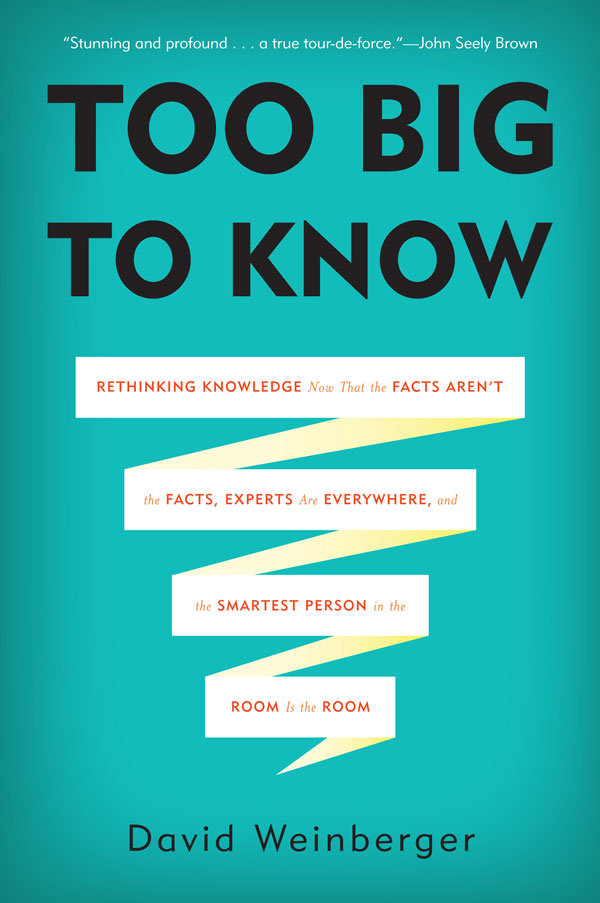
We have a late-breaking, serendipitous opportunity tomorrow morning to talk about David Weinberger’s book, Too Big To Know on Twitter. Weinberger, a philosopher and technologist who writes about the effects of the internet on human relationships, is currently a senior researcher at Harvard’s Berkman Center. In light of current discussions about the nature of facts and their alternatives, the book’s subtitle — “Rethinking Knowledge
Now that the Facts aren’t the Facts,
Experts are Everywhere, and
the Smartest Person in the Room
is the Room.” — is especially compelling.
Dr. Weinberger will be Skyping into Tom Ewing‘s undergraduate course on Data in Social Context at Virginia Tech to talk about Too Big To Know with Tom and his students.
I will be live tweeting the conversation tomorrow (Monday) from 10:10 to 11:00 am EST. If you’re familiar with the book or Weinberger’s work please join us. And if you aren’t please join us anyway! You can follow along and send questions and thoughts to #Openlearning17 and #Faccollab.
Followers of #gedivt — I will try to flag you all as well, but the best bet would be to check #OpenLearning17
Twitter Handles: Data in Social Context: @DiSCVT ;David Weinberger: @dweinberger ; Tom Ewing: @EThomasEwing
In 1945, Vannevar Bush wrote a now famous piece for The Atlantic called “As We May Think.” In it, he proposed the development of a machine called the Memex. This desk shaped machine would be able to display printed and handwritten texts and would be able to record notes made with a special stylus. The machine would be able to record meta-data noting connections between various sources and all of this information could be stored on removable cards.
The Memex served as inspiration in the development of the modern personal computer. Hundreds of articles in the 1990s pointed to the invention of the World Wide Web as the culmination of Bush’s vision, and those comparisons have continued into the new millennium with the modern Internet. But while the stylus-touch interfaces of modern tablets and the proliferation of online media do fulfill much of Bush’s technological vision, the key underlying epistemic concept put forth by Bush has been largely neglected.
The rapid sharing of ideas was an obvious use of the Memex, but Bush proposed that the educational value of the tool would be the ability to retrace the thought processes and connective strands that others had made through the ever growing sea of data. Bush said, “The inheritance from the master becomes, not only his additions to the world’s record, but for his disciples the entire scaffolding by which they were erected.” While academia is slowly moving towards open access models of publication, this deeper level of sharing the cognitive “scaffolding” of our theories has received far less consideration.
On Wednesday, Jeremy Dean and Jon Udell of Hypothes.is joined with Gardner Campbell as part of #openlearning17 to discuss how web annotation is allowing us to record and retrace our thoughts as we move from one website to the next. The collective pooling of reading notes, along with the ability to retrace the steps of an individual go a long way to fulfilling the epistemological vision of Bush’s Memex.
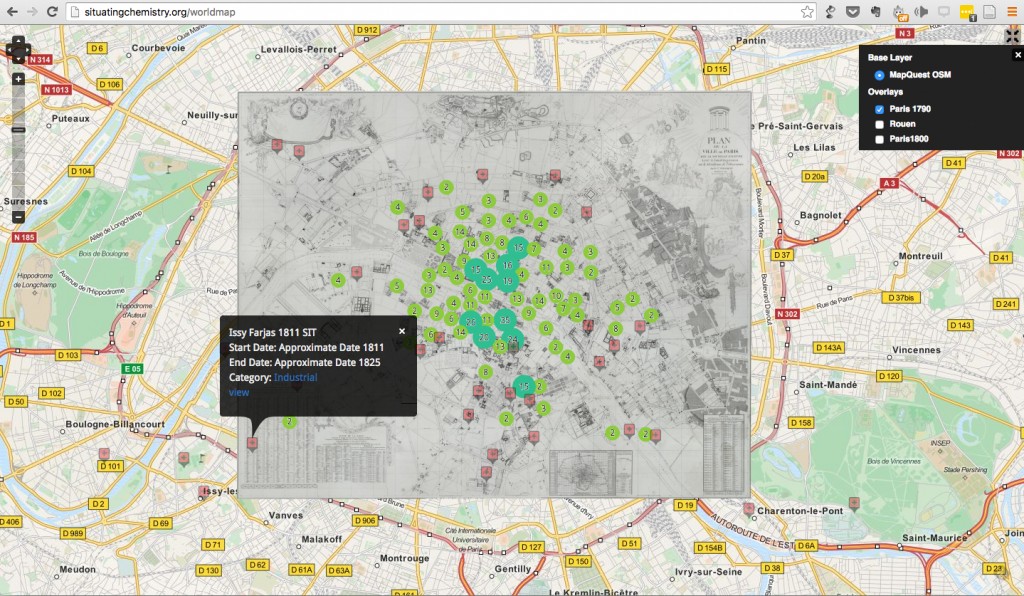
Here though I want to propose a different kind of database as an alternative and complimentary implementation of Bush’s vision. I have been working on an open note database called Situating Chemistry for a couple of years now. The concept is that researchers interested in the history of chemistry (don’t laugh, we exist) can come together to share a wide variety of notes. In addition to reading notes, the system can be used to create a profile of a historical person to record biographical notes compiled from both archival and secondary sources. These people can then be linked to each other to show familial, business, educational or any other type of relationship. Users can also record notes on the places that chemistry was done. A record can be created for a paritcular factory site, a university lab or lecture hall, or the site of an important conference. These sites can be linked back to the people who used them and mapped. Here we see a map from the 18th century of Paris with clustered pins representing the sites in our database:
In addition to people and places, users can use the system to record notes on organizations, events, courses, sources, objects, collections, processes, and theories. The key is that researchers can use the database to take notes on any facet of their studies and then connect that facet to both its particular context and the broader population of notes within the system. Users can choose to put a password on their records, but the default and usual practice is to leave the note sets open to all users so that we can extend each others’ individual records and pool our collective research.
Designing an Open-Notes Database
Web-based databases of historical people like the Prosopography of Anglo-Saxon England (PASE) and the Prosopography of the Byzantine World were produced as conclusive publications of completed research. As such, the developers could accommodate, truncate, or omit problematic pieces of data. Published databases can also choose data visualizations that best highlight key records or insights. Researchers with Stanford’s Mapping the Republic of Letters, put together this beautiful dashboard to explore the correspondence of Enlightenment thinkers.
Unlike these published databases, an open note system is designed to accommodate active note taking. Rather than structuring database fields to best present the data already collected, Situating Chemistry was built to be flexible. Because a researcher will more often than not have incomplete data, the only required field is the title of the record. The fields to record dates of birth and death can be partially filled out when only a year or year and month are known. They can also be marked approximate to indicate ambiguity in the historical record. Similarly, visualizations are employed to bring the researcher’s attention to interesting data and suggest new pathways for research.
Within any prosopographical project, the amount of biographical information available for the research subjects can vary widely. One project in Situating Chemistry focuses on the students of the noted Scottish professor William Cullen (1710-1790). In 1756, fifty-nine students attended Cullen’s chemistry course at the University of Edinburgh. Amongst them was George Fordyce (1736-1802) of Aberdeen who would go on to earn his medical degree from Edinburgh and become a lecturer of chemistry and medicine in London. Although there is no monograph length biography of Fordyce, he has entries in the Dictionary of National Biography and the Dictionary of Scientific Biography and is a relatively well-documented individual.
The other fifty-eight attendees of the course are less known. We know from Cullen’s notes that Robert Cumming was from Edinburgh, that John Richardson was from Northumberland, and that Henry Dunston was from some unspecified part of England. More surprisingly, at least two of the attendees were from Virginia—Thomas Clayton and James Taylor—and one was from Antigua—Christopher Hodge. Clayton, Fordyce, and eight other students would go on to earn their MDs from Edinburgh.
In designing Situating Chemistry database we wanted to ensure that we could capture structured, machine-readable data on someone like George Fordyce, or for that matter William Cullen. Additionally, we also wanted to be able to create records for people like Henry Dunston, for whom we had only a name and relationships of interest, in this case that he was a student in Cullen’s chemistry course, in Edinburgh, in 1756, with these other people, and he was from England.
The record for any individual can be linked to other individuals in several different ways. In addition to familial relations, we also have structured fields to collect information on instructor-student relationships and correspondents. There is also a somewhat generic person-to-person connection field that offers a list of relationships that can be expanded when needed. We designed the database such that every individual is the subject of their own record. A field denoting that a person was active in chemistry is automatically checked for every new record, but can be deactivated for familial relations, business partners, and others who are of interest but were not actively ‘doing’ chemistry even in the broadest definition.
In addition to linking a person to other individuals within the system, a person can also be linked to many other kinds of data. The database was initially conceived of as a way to catalogue sites of chemistry. We thus started the database with a table to collect information on apothecary shops, lecture halls, pharmaceutical manufactories, bleach fields, labs, etc. For a given site, the latitude and longitude of the site along with a modern address can be recorded along with information about the ownership and financial history of the site, the chemical activities associated with it, the organizational history, related images, documents, sources, etc. For each individual in the system, we display the sites that they owned and operated and also those additional sites that they were associated with.
After developing tables for the sites and people involved in chemistry, we developed further tables for chemical substances collections, courses, documents, events, images, letters, objects, organizations, primary and secondary sources, processes and techniques of chemistry, and archival and museum repositories. Any two records can be connected with an extensible series of subject-predicate-object relationships. For example a given individual could be a member of an organization or might have studied a particular chemical substance or been a practitioner of a particular process or technique of chemistry. Every record, whether it be for a person or any other type of data, can and should be sourced by linking it to primary and/or secondary sources. For the system as a whole then, we have tables for more than a dozen types of information and hundreds of structured data fields, all strung together into a relational web of information.
Interoperability & Extensibility
In its first conception, the Situating Chemistry database was thought of as a single table for sites with about a dozen fields. However, this variety of tables and fields grew organically through discussion of the research questions and practices that we, as historians of chemistry, conduct. The goal for the project was not to publish a completed set of sites or records, but rather to facilitate active research. A researcher could enter the data that they were collecting for a research project to organize and analyze the information, and they could take the database with them into the archives to continue to collect information. Researchers can access their records and add new records to Situating Chemistry from a laptop, tablet, or even a phone.
To accommodate both offline note-taking and the rapid upload of external data sets, the database has also been designed so that users can upload CSV files (excel-type tables). Any data in the system can in turn be downloaded as a CSV or in other structured formats including XML, RDF, and JSON. Because Situating Chemistry was designed as a research tool rather than a data-publication, the goal of the database is to allow users to both enter and access whatever fields and records sets they consider interesting. Several visualizations including tables, graphs, and a timeline are built into the system. The user can also extract whatever structured data they want to pull from the system, so that she can also generate her own visualizations using tools like Tableau or programming languages like Python and R.
The schema of the database is not specific to our current project, nor to the period 1760-1840. It could be readily adapted for use by other historians of chemistry (and alchemy) and historians of other sciences. If you were to dump out the 5000 records that we have input into the system, you could convert the project into a Sites of Archeology database and record the digs of the 19th and 20th century. You could just as easily record the observatories, telescopes, and astronomers of the 16th and 17th centuries or plot the biological specimens collected by Linnaeus’s correspondents.
While we certainly hope that our database will be used by and be useful to historians of chemistry, the real point of the project is to enable the collaborative epistemology proposed by Vannevar Bush. History and humanities more generally are dominated by the single-author article and monograph, so a system built to pool research notes may seem counterintuitive. However, we need to remember that the point of these publications is to share our knowledge. If we all share our coffee stained notebooks, idiosyncratic excel files, and shoeboxes full of notecards, we can engage in deeper and more nuanced studies in the history of chemistry and science more broadly. Without sacrificing traditional academic products, we can collectively populate searchable, interlinked reference guides that will accelerate research and model our methodologies for the generations to come.
Please visit our site to learn more about the project and let me know if you would like to set up an account or get a copy of the code.